


This matters because filing the wrong form creates problems. It can lead to incomplete reporting, errors in your tax return, and extra attention from LHDN. If you want a simple rule, start here.
Short Summary
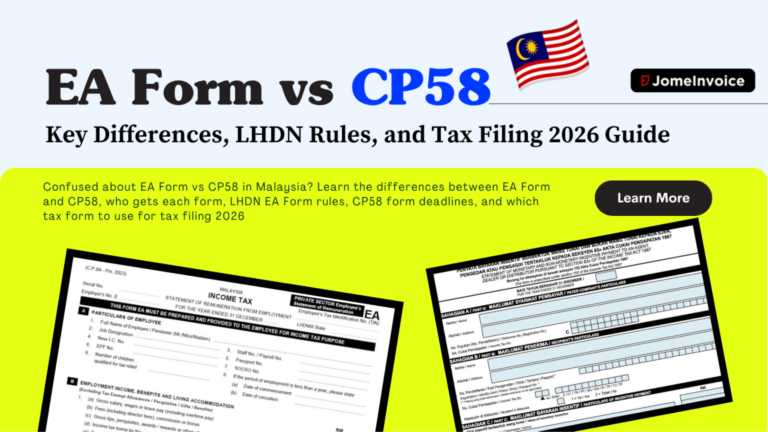
This guide explains the differences between EA Form and CP58, who receives each one, what income each form covers, the deadline for YA 2025, and which tax return to use for tax filing 2026.
What Is EA Form?
EA Form is an annual income statement issued by an employer to an employee. Many people also refer to it as the LHDN EA Form because it is used to support annual personal income tax reporting in Malaysia.
The EA Form is meant for people with employment income. In practical terms, this includes company staff who receive payslips and employment-related deductions or contributions.
Based on the content provided, the EA Form can include:
- Salary
- Bonus
- Commission
- Allowances
- Benefits
- PCB
- EPF
- SOCSO
If you work for a company as an employee, your employer or HR department is responsible for issuing your EA Form.
What Is CP58?
CP58, often called the CP58 form, is a statement of commission or incentive income. It is issued to agents, dealers, and distributors who are not employees in that role.
The company paying the commission or incentive issues the CP58 form. Based on the provided content, this form can include:
- Commission
- Incentives
- Allowances
- Non-cash rewards such as cars, travel, or flight tickets
The CP58 form is triggered when total yearly rewards exceed RM5,000.
This means CP58 is tied to commission or business-related income, not regular employment salary.
LHDN EA Form vs CP58: The Core Difference
The biggest difference between EA Form and CP58 is the type of income involved.
EA Form relates to employment income.
CP58 relates to commission or incentive income for agents, dealers, or distributors.
This is the foundation for understanding the differences between EA Form and CP58. Once you identify the income type, the correct tax treatment becomes much clearer.
Comparison Table: Differences Between EA Form and CP58
| Comparison Point | EA Form | CP58 |
| What it is | Annual income statement for employees | Income statement for agents, dealers, and distributors |
| Main income type | Employment income | Commission or incentive income |
| Who receives it | Company employees | Agents, dealers, distributors |
| Who issues it | Employer or HR department | Company paying the commission or incentive |
| Trigger condition | Employee worked more than 7 days | Annual rewards exceed RM5,000 |
| Income covered | Salary, bonus, commission, allowances, benefits, PCB, EPF, SOCSO | Commission, incentives, allowances, non-cash rewards such as cars, travel, or flight tickets |
| Best fit for | Salaried employees | Non-employee commission earners |
| Tax form to use | Form BE, if only employment income | Form B |
| If both EA Form and CP58 are received | Move to Form B and report both income sources | Move to Form B and report both income sources |
| YA 2025 deadline | 28/02/2026 | 31/03/2026 |
| Need to report to LHDN in tax filing | Use details from the LHDN EA Form to prepare your tax return | Use details from the CP58 form to prepare your tax return |
| Penalty if not issued | Fine from RM200 to RM20,000, imprisonment up to 6 months, or both | Fine from RM200 to RM20,000, imprisonment up to 6 months, or both |
| Record keeping | Keep for at least 7 years | Keep for at least 7 years |
LHDN EA Form and CP58 Form Deadlines for Tax Filing 2026
For YA 2025, the deadlines are:
LHDN EA Form: 28/02/2026
CP58 form: 31/03/2026
These are the deadlines for issuing the documents. They help taxpayers know when to expect their income records before filing taxes.
If you are waiting for your employer or the company paying your commissions, check which document applies to your situation. That helps you plan your filing correctly.
Which Tax Form Should You Use for Tax Filing 2026?
This is the question most people care about.
Use Form BE if you only receive EA Form and only have employment income.
Use Form B if you only receive CP58 form and only have commission or business-related income.
Use Form B if you receive both EA Form and CP58.
This is one of the most important parts of the differences between EA Form and CP58. The tax return form changes based on the type of income you earn.
If your income includes commission from agent, dealer, or distributor work, Form B becomes the correct route according to the content provided.
LHDN EA Form and CP58 for People with Salary and Side Income
A common situation in Malaysia is this:
You work full time as an employee.
You also earn commission as an agent, dealer, or distributor.
In that case, you may receive:
An EA Form from your employer
A CP58 form from the company paying your commission
This is where many people make mistakes. They assume their main job means they should still file Form BE. Based on the provided content, that is not correct if you also have CP58 commission income.
If you receive both EA Form and CP58, you should file Form B and report both income sources.
3 Common Mistakes People Make With EA Form and CP58
- Receiving CP58 but filing Form BE
This is one of the most common mistakes. People see their regular salary and assume Form BE is enough. Once CP58 income is involved, Form B should be used.
- Receiving both EA Form and CP58 but reporting only one
Some taxpayers declare only their salary income and leave out commission income. Others focus on their side income and ignore salary details. Both are wrong. If you receive both EA Form and CP58, both income sources need to be reported.
- Thinking no document means no need to report income
This is another common error. Income still needs to be declared even if you have not received the EA Form or CP58 form yet. The obligation to report income does not disappear because the document is missing or delayed.
Do You Submit EA Form or CP58 to LHDN?
EA Form and CP58 are supporting income documents. They are not the same as your actual tax return form.
In simple terms:
Both EA Form and CP58 Form helps you prepare your tax filing.
Form BE or Form B is the actual tax return you file.
So when comparing EA Form vs CP58, remember this point. These documents support your tax declaration. They are not replacements for it.
What If You Did Not Receive Your EA Form or CP58?
If you earned the income, you still need to report it.
That means:
No EA Form does not mean your salary disappears
No CP58 form does not mean your commission income disappears
The document is proof and support. The tax obligation comes from the income itself.
If your document is missing, you should still work from your actual income records and keep evidence such as payslips, commission statements, payment records, and related supporting documents.
Why the Differences Between EA Form and CP58 Matter More Today
In the e-Invoice environment, LHDN has greater visibility into income trails and transactions.
That means accurate reporting matters even more.
The differences between EA Form and CP58 affect:
- How income is classified
- Which tax return form you file
- Whether all your income is declared
- Whether your filing matches the records linked to your income
If you mix up EA Form and CP58, the result is usually a wrong filing form or incomplete income declaration.
Record Keeping for EA Form and CP58
Keep all supporting documents for at least 7 years, including:
- EA Form
- CP58 form
- Receipts
- Related tax records
This matters because supporting documents help you respond if questions come up later.
Read more: Learn why self-billed income still needs CP58 submission in our CP58 Filing Guide: Self-Billed Income Still Requires CP58 Submission.
FAQ Section
What is the difference between EA Form and CP58?
EA Form is for employees with salary income. CP58 form is for agents, dealers, and distributors who earn commission or incentive income.
Who issues the LHDN EA Form?
The employer or HR department issues the LHDN EA Form to employees.
Who receives the CP58 form?
Agents, dealers, and distributors receive the CP58 form from the company paying their commission or incentives.
What is the EA Form deadline for YA 2025?
The EA Form deadline is 28 February 2026.
What is the CP58 form deadline for YA 2025?
The CP58 deadline is 31 March 2026.
Should I file Form BE or Form B if I receive CP58?
If you receive CP58 form, you should file Form B.
What if I receive both EA Form and CP58?
If you receive both EA Form and CP58, you should report both income sources and file Form B.
Do I still need to report income if I did not receive my EA Form or CP58?
Yes. Income still needs to be declared even if you did not receive the document.
How long should I keep EA Form and CP58 records?
You should keep EA Form, CP58 form, and supporting records for at least 7 years.
Our Advice: Reduce Filing Mistakes by Organising Your Income Data Early! Learn More about the Best e-Invoice Software for SMEs and Large Enterprises
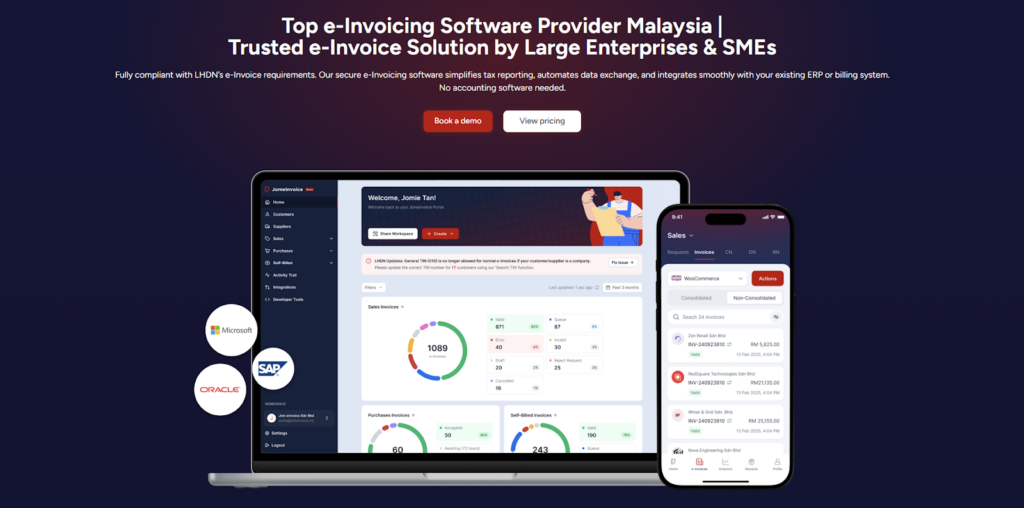
JomeInvoice is widely adopted as one of the best einvoicing software solutions in Malaysia. It is designed to support SMEs and large enterprises across all industries while meeting LHDN e-Invoice requirements with minimal operational disruption.
As a flexible e-Invoice platform for large enterprises and a practical solution for growing businesses, JomeInvoice supports high transaction volumes, complex workflows, and multi-system environments.
One e-Invoice Platform Built for All Business Sizes
JomeInvoice works as the best e-Invoice software for SMEs by offering fast onboarding, simple user interfaces, and automated compliance features. At the same time, it scales into a full e-Invoice platform for large enterprise use, supporting thousands of invoices daily through ERP and system integrations.
Key advantages
• Suitable for SMEs, mid-sized companies, and large enterprises
• Handles low and high invoice volumes efficiently
• Supports consolidated and self-billed e-Invoice workflows
Tailored for Every Industry
JomeInvoice works for a broad range of sectors, including retail, eCommerce, manufacturing, services, and more. It adapts to specific workflows, whether your business runs point-of-sale systems, online stores, or ERP platforms.
Retail e-Invoicing Solution for High-Volume Transactions
For retail businesses, JomeInvoice functions as a complete retail e-Invoicing solution. It supports POS integration, daily sales consolidation, and compliance with the RM10,000 consolidated e-Invoice threshold requirement
Retailers benefit from
• Automated consolidated e-Invoice generation
• POS system integration
• Reduced manual reporting during peak sales periods
e-Invoice for eCommerce and Online Businesses
JomeInvoice also serves as a reliable e-Invoice for eCommerce solution. It integrates with online stores and payment platforms, enabling seamless invoice issuance for high-frequency digital transactions.
eCommerce e-Invoicing features include
• Automated e-Invoice issuance for online sales
• Support for refunds, credit notes, and self-billed e-Invoice
• Compatibility with marketplaces and payment gateways
Enterprise-Grade Integration and Compliance
As a full einvoicing software for large enterprises, JomeInvoice integrates with major ERP systems such as SAP, Oracle NetSuite, Microsoft Dynamics, and other accounting platforms. It connects to the MyInvois system via API integration, minimizing the need for major changes to existing infrastructure.
Enterprise-ready capabilities
• ERP, accounting, and middleware integration
• Pre-validation checks to reduce rejection risks
• Audit trails and reporting for compliance and review
Book a free demo with JomeInvoice now!
See how your business can align with the Malaysia e-invoice guideline, stay prepared for any e-invoice compliance review framework selection, and move ahead of your e-invoice implementation timeline before enforcement tightens.Contact JomeInvoice to help your business stay compliant, reduce manual work, and prepare for full e-Invoice enforcement with confidence.