



If you earn money or receive benefits from content creation, brand work, audience growth, or your online identity, you are not only a creator. For tax purposes in Malaysia, you are often treated as a person carrying on business or earning taxable income linked to your activities.
Key Takeaway from this Social Media Influencer Tax Guide
The 6 main income types influencers need to watch are:
- Platform direct income
- Product endorsement and sponsored collaboration income
- Sales of your own goods and services
- Account or ID transfer income
- Character, image, and IP-related income
- Other common income such as speaking, judging, appearance, and reward-based income
This social media influencer tax guide explains the 6 types of income that commonly trigger tax exposure for creators, KOLs, streamers, reviewers, affiliate marketers, and content entrepreneurs.
Malaysia’s Inland Revenue Board states that Form B is used for resident individuals with business income, and the 2026 filing programme shows that Form B for Year of Assessment 2025 is due by 30 June 2026, with e-Filing given until 15 July 2026. IRBM also explains that CP500 is the instalment notice often used for individuals with non-employment income such as business, rental, and royalties.
Social Media Influencer Tax Guide: Who this applies to
This article applies to people who usually describe themselves as:
- 网红 / KOL
- 自媒体 / content creator
- 探店博主 / food review creator
- 视频创作者 / video creator
- 带货博主 / affiliate or live-selling creator
The label does not decide the tax treatment. The income does.
If your content helps you receive cash, products, perks, discounts, platform payouts, appearance fees, licensing fees, or other benefits, those receipts can form part of your taxable income.
KOL Tax Guide: Why many influencers get this wrong
Many creators assume only cash counts. That is where mistakes start.
A practical Malaysia tax guide for creators should begin with this rule:
Income is wider than bank transfers.
The key message is clear. Cash and non-cash benefits both matter. A free product, sponsored trip benefit, service credit, voucher, or valuable gift received because of your influence can still have tax relevance.
This matters because influencer income is rarely clean and simple. One month you receive platform payouts. The next month you get free devices, a paid event invitation, and a brand collaboration bundle. All of that needs to be tracked.
1. Platform Direct Income in this Social Media Influencer Tax Guide
Platform direct income means payments that come straight from social media platforms.
Examples include:
- Revenue based on clicks or likes
- Revenue based on follower count
- Payouts based on views
- Fixed payment per video or post published
- Ad display income paid by a platform or brand through the platform
- Platform share or commission from fan subscriptions
This is one of the most obvious income categories in any KOL tax guide. It is still often underreported because creators see it as casual side income, not business income.
If the platform pays you because your content performs, that payment is part of your income trail and should be recorded.
Tax filing 2026 tip for platform income
Download payout statements monthly. Keep screenshots, dashboard exports, invoices, and payment confirmations. Do not wait until filing season.
2. Product Endorsement and Sponsored Collaboration Income in a KOL Tax Guide
This category covers payments from brands or companies.
Examples include:
- Brand ambassador fees
- Paid product reviews
- Sponsored posting fees
- Campaign retainers
- Collaboration fees for reels, livestreams, stories, or event appearances
Non-cash consideration counts too.
That includes:
- Free products
- Free services
- Facilities or benefits
- Coupons or discount vouchers
This is where many creators lose control of their records. They report the cash fee but ignore the value of the product pack, hotel stay, or complimentary service. That creates gaps between actual benefits received and declared income.
3. Sales of Your Own Goods and Services in this Malaysia Tax Guide
Many influencers move from content to commerce. Once you start selling your own products or services, you are operating beyond sponsored content.
Examples include:
- Physical merchandise
- Digital products such as e-books, templates, music, presets, or posters
- Online classes
- Paid workshops
- Coaching
- Consulting
- Membership services
This type of income is easy to overlook because some creators think of themselves as influencers first and business owners second. Tax authorities usually look at the activity itself, not the title you use.
If you sell under your own brand, the sales receipts belong in your records.
Social media influencer tax guide note on valuation
Products and services should be measured based on market value. That is a practical principle for non-cash items tied to your work.
4. Account or ID Transfer Income in a KOL Tax Guide
This covers income from selling a social media account, page, channel, or digital identity.
Examples include:
- Selling a Facebook page
- Selling an Instagram account
- Selling a TikTok or X account
- Transferring a high-follower account for consideration
This category is often ignored because creators see the account as “just a profile.” In reality, a monetised audience, strong handle, or established channel can hold economic value. If you receive payment for the transfer, there is a tax issue to consider.
The bigger the audience and commercial use, the harder it is to argue that the receipt is irrelevant.
5. Character, Image, and IP Related Income in this Social Media Influencer Tax Guide
Some influencers earn from identity rights, image rights, characters, and licensing.
Examples include:
- Payment for use of your image
- Licensing of a virtual or animated persona
- Royalties or fees for use of a character concept
- Payment for portrait rights or character rights
- Commercial use of your likeness, avatar, or branded persona
The income does not stop being relevant because the persona is virtual. If the market pays for the use of a character, image, or intellectual property linked to your brand, the receipt still needs to be tracked.
This is a growing area for creators using AI avatars, mascots, animated identities, and virtual KOL branding.
6. Other Common Income in a Malaysia Tax Guide for Influencers
This last category catches the payments creators often forget.
Examples include:
- Training fees
- Speaking fees
- Panel or sharing session fees
- Mentor or manager service fees
- Competition judging fees
- Programme participation fees
- Appearance fees for events such as openings, weddings, launches, and fashion shows
- Gifts or rewards on social media that carry monetary value
This matters because creator income often spreads across many channels. A person may have platform payouts, affiliate commissions, a workshop fee, and an event emcee payment in the same quarter.
A solid social media influencer tax guide treats all of those receipts as part of one recordkeeping system.
Social Media Influencer Tax Guide: 4 tax habits to remember for tax filing 2026
These are the four habits creators should follow:
1. Cash and non-cash income both need attention
Do not only track banked money. Track products, services, benefits, vouchers, and perks received because of your work.
2. Record every income item
Small amounts still matter. One missing sponsored gift may seem minor, but repeated omissions create a weak record trail.
3. Use market value for products and services
When compensation comes in products or benefits, record a reasonable market value.
4. Keep supporting documents for at least 7 years
IRBM public rulings state that records generally need to be retained for at least 7 years from the end of the relevant year.
KOL Tax Guide: What forms matter in Malaysia tax filing 2026
For the Year of Assessment (YA) 2025, the standard deadline for submitting Form B (individuals with business income) is June 30, 2026. A 15-day grace period is provided for e-Filing (Form B) until July 15, 2026.
IRBM also states that CP500 is used for advance instalment payments for taxpayers with income other than employment income, including business income.
That means many creators should not wait until June or July to get organized. The work starts earlier:
- classify each income stream
- gather evidence
- total cash receipts
- value non-cash benefits
- separate business-related expenses properly
- check whether CP500 applies
Malaysia Tax Guide for Influencers: A simple recordkeeping checklist
For each campaign or income source, keep:
- contract or email agreement
- invoice issued
- payment proof
- platform payout statement
- screenshot of campaign deliverables
- list of free products or services received
- estimated market value for non-cash items
- event invitation and fee confirmation
- affiliate dashboard records
- sales reports for your own products
- bank statements and e-wallet statements
This is the easiest way to prepare for tax filing 2026 without scrambling through chats and screenshots at the last minute.
To avoid missing important submission dates, read our guide to [Malaysia tax filing deadlines].
Our Advice: Start Using the Best e-Invoicing Software Malaysia for Growing Creator Businesses
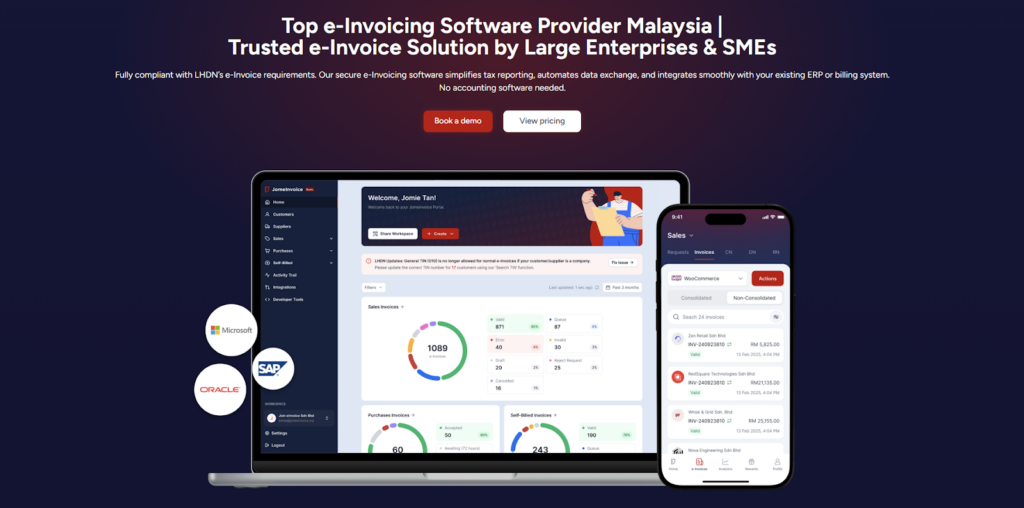
If you already run a registered business, work with a team or agency, or issue invoices to brands regularly, invoicing is no longer a small admin task. It becomes part of your day-to-day business operations.
i
Using the right einvoicing software helps keep billing records organised, reduces manual work, and supports smoother compliance as your creator business grows. This is where JomeInvoice becomes relevant.
JomeInvoice is positioned as one of the best e-Invoicing software Malaysia options for businesses that need a more structured invoicing workflow. It is designed to support recurring billing, consolidated e-Invoice workflows, and growing transaction volumes while helping businesses align with LHDN e-Invoice requirements. JomeInvoice also states that it is PDPA-compliant, holds ISO 9001, ISO 20000-1, and ISO 27001 certifications, and is MySTI certified under STI202501062.
k
For creators whose work has grown into a formal business, and for teams or agencies managing ongoing brand campaigns, this kind of structure becomes more important as operations scale. JomeInvoice also says it supports integration with accounting, ERP, POS, and e-Invoicing for eCommerce systems, which makes it more relevant for larger or more established setups rather than casual one-off creator work.
k
Book a free demo with JomeInvoice to see how this e-invoice system can support your invoicing workflow as your creator business grows.