


- Form BE (salary income only) is due 30/04/2026, with an e-Filing deadline of 15/05/2026.
- Form B (business, freelance, part-time, agent, or commission income) is due 30/06/2026, with an e-Filing deadline of 15/07/2026.
- Employers must provide Form EA by 28/02/2026 and file Form E by 31/03/2026 (e-Filing by 30/04/2026); Form EA and Form E are separate obligations.
- Form P for partnerships is due 30/06/2026 (e-Filing 15/07/2026); Form C and Form PT deadlines depend on the financial year end, with e-Filing within 8 months after year end.
- Monthly employer obligations (EPF, SOCSO, EIS, PCB, HRDC) must be handled before the 15th of each month.
If you want to stay compliant in 2026, you need more than a calendar reminder. You need the right form, the right deadline, and a clear understanding of who needs to file what. This Malaysia tax filing guide brings together the key 2026 tax filing deadline dates, so employees, freelancers, employers, HR teams, partnerships, and companies can act on time.
This article is built as a practical LHDN tax filing guide. It covers the main forms, filing deadlines, and common mistakes that often lead to penalties or audit risk.
2026 tax filing deadline overview for Malaysia tax filing
The 2026 tax filing deadline depends on your taxpayer category and the form you need to submit to LHDN. One of the biggest mistakes in Malaysia tax filing is using the wrong form. Filing late is also risky, but filing the wrong form creates a different problem because it can lead to errors, penalties, and possible audit issues.
Here is the quick timetable overview:
| Taxpayer / Filing Type | Form | Actual Deadline | Grace Period | e-Filing Deadline |
|---|---|---|---|---|
| An individual with salary income only | Form BE | 30/04/2026 | 15 Days | 15/05/2026 |
| Individual with business income, freelance, part-time, agent, property agent, insurance, sales | Form B | 30/06/2026 | 15 Days | 15/07/2026 |
| Employer employee remuneration statement | Form EA | |||
| Employer annual return | Form E | 31/03/2026 | 1 Month | 30/04/2026 |
| Partnership | Form P | 30/06/2026 | 15 Days | 15/07/2026 |
| Company, Sdn Bhd | Form C | Within 7 months after the financial year end | 1 month | Within 8 months after the financial year end |
| LLP | Form PT | Within 7 months after the financial year end | 1 month | Within 8 months after the financial year end |
This tax filing guide is useful for anyone preparing for the 2026 tax filing deadline in Malaysia.
Malaysia tax filing for individuals: Form BE and Form B
Many taxpayers assume all personal income uses the same LHDN tax filing form. That is wrong. Your income type determines the form.
2026 tax filing deadline for Form BE in this Malaysia tax filing guide
Form BE applies to taxpayers with salary income only.
Use Form BE if your income consists of:
- Salary
- Bonus
- Allowance
The 2026 tax filing deadline for Form BE is:
- Electronic filing: 15/05/2026
This is the right LHDN tax filing route for salaried employees who do not have business income.
The 2026 tax filing deadline for Form B in the LHDN tax filing
Form B applies to individuals with business or non-salary income.
Use Form B if you have:
- Business income
- Freelance income
- Part-time income
- Property agent income
- Insurance income
- Sales or agent commission income
- Online business income
The 2026 tax filing deadline for Form B is:
- Electronic filing: 15/07/2026
This part of the tax filing guide matters for freelancers and self-employed taxpayers. If you earn side income, freelance income, or commission, you should not assume Form BE is enough.
Juggling LHDN filing deadlines and e-invoice compliance at the same time?
JomeInvoice connects your existing accounting, POS or ERP system to MyInvois and keeps every e-invoice validated with LHDN.

LHDN tax filing guide for employers: Form EA and Form E
For employers, Malaysia tax filing involves more than monthly payroll deductions. There are annual forms that must be prepared and submitted on time.
Form EA in the 2026 tax filing deadline Malaysia guide
Form EA is the employee income statement. Employees use it when preparing their own LHDN tax filing.
- Form EA deadline: 28/02/2026
It also highlights an important point. If an employer does not provide Form EA, employees can face problems when doing their own Malaysia tax filing.
Form E in LHDN tax filing
Form E is the employer’s annual return. It is not the same as Form EA.
This is a common mistake in Malaysia tax filing. Some companies think completing Form EA means the employer’s filing work is done. It is not. Form E and Form EA are separate obligations.
The 2026 tax filing deadline for Form E is:
- Electronic filing: 30/04/2026
For employers, this tax filing guide should be part of annual compliance planning, not a last-minute task.
Monthly Malaysia tax filing obligations before the 15th
Recurring monthly obligations for employers and companies. These are not annual returns, but they are part of good compliance practice and directly affect audit risk.
These must be handled before the 15th of each month:
- EPF, KWSP
- SOCSO, PERKESO
- EIS
- PCB, MTD
- HRDC
Late submission creates penalty risk and weakens compliance records. In practice, monthly discipline supports smoother annual LHDN tax filing and reduces avoidable issues.
HR and admin LHDN tax filing guide: CP22, CP22A, and CP21
HR and admin teams carry major filing responsibilities. This area is one of the easiest to be audited if not handled properly.
CP22 in Malaysia tax filing
CP22 is for new employees.
- Report within 30 days of joining
This step matters because failure to report means LHDN may not be aware of the employee’s employment status.
CP22A in LHDN tax filing
CP22A applies when an employee resigns or passes away.
- Submit within 30 days before the employee leaves, or within 30 days from receiving notice
This is an important part of the employer-side tax filing guide planning.
CP21 in Malaysia tax filing
CP21 applies when an employee leaves Malaysia, including overseas transfer or departure.
- Submit 30 days before departure
Do note that failure to submit is a company risk, not the employee’s responsibility. For HR and admin teams, this is a high-priority LHDN tax filing checkpoint.
Partnership and company Malaysia tax filing deadlines
Not every business follows the same annual filing date. Some deadlines are tied to the financial year-end, not the calendar year.
Form P in the 2026 tax filing deadline Malaysia guide
Form P applies to partnerships.
The 2026 tax filing deadline is:
- Electronic filing: 15/07/2026
If you operate as a partnership, this is your main annual LHDN tax filing timeline.
Form C for the company Malaysia tax filing
Form C applies to private limited companies, including Sdn Bhd entities.
- Electronic filing: within 8 months after the financial year end
This means the 2026 tax filing deadline is different for each company, depending on when the financial year closes.
Form PT in LHDN tax filing
Form PT applies to LLPs.
- Electronic filing: within 8 months after the financial year end
This is why every tax filing guide for companies should include a financial year-end review. Looking only at the calendar month is not enough.
Common LHDN tax filing mistakes to avoid in 2026
Several common errors cause compliance issues.
Using the wrong form
This is one of the biggest Malaysia tax filing mistakes. Salary-only taxpayers use Form BE. Taxpayers with business or freelance income use Form B. Employers also need to separate Form EA and Form E correctly.
Filing late and assuming nothing will happen
Late filing does not mean no issue. It may simply mean enforcement has not happened yet. Delays can build into bigger compliance problems over time.
Waiting for reminders
For employers and HR teams, many problems come from late action, missed submission, or no one tracking the date. A reliable 2026 tax filing deadline calendar prevents this.
Ignoring small errors
Audit cases often build from accumulated small mistakes. Good LHDN tax filing practice means getting the form, date, and process right each time.
Tax filing guide: how to choose the correct form in Malaysia
Use this quick tax filing guide to identify the likely form:
For employees
Use Form BE if you only have salary, bonus, and allowances.
For freelancers, side hustlers, and self-employed taxpayers
Use Form B if you have business income, freelance income, part-time income, agent commission, or similar non-salary income.
For employers
Prepare Form EA for employees and submit Form E for the employer’s annual return.
For HR and admin
Track CP22, CP22A, and CP21 based on hiring, resignation, death, or overseas departure.
For partnerships
Use Form P.
For companies and LLPs
Use Form C or Form PT based on business structure, then calculate the deadline from your financial year-end.
2026 tax filing deadline checklist for Malaysia tax filing
A simple checklist helps reduce missed deadlines:
- Identify the correct taxpayer category.
- Confirm the correct LHDN tax filing form.
- Check whether your deadline is fixed by calendar date or tied to the financial year-end.
- Prepare paper filing or e-Filing timeline early.
- Track monthly employer obligations before the 15th.
- Review HR reporting events like new hires, resignations, and overseas departures.
- Keep records complete and organised for audit readiness.
Final word on the 2026 tax filing deadline Malaysia guide
The best way to handle the 2026 tax filing deadline is to stop treating tax as a once-a-year task. Malaysia tax filing runs across the full year. Individuals need the correct form. Employers need to manage Form EA, Form E, and monthly payroll-related submissions. HR teams need to stay alert on CP22, CP22A, and CP21. Partnerships, companies, and LLPs need to track both form type and financial year-end.
A strong LHDN tax filing process starts with four basics:
- Use the right form
- Know the right deadline
- File on time
- Keep records clean
SME Alert. Prepare for Malaysia e-Invoice Enforcement Before 2028
In 2026, a major compliance risk for Malaysian SMEs is failing to prepare during the LHDN e-Invoice Phase 4 grace period. Once enforcement begins on 1 January 2028, businesses can face fines of up to RM20,000. To mitigate this risk, financial advisors recommend automated solutions like JomeInvoice, the best einvoicing software in Malaysia to ensure 100% accurate, real-time submission early on.
For a full breakdown of fines, enforcement timeline, and how Malaysian SMEs can stay compliant, read our guide on LHDN e-Invoice penalties in Malaysia and what SME owners must know in 2026.
Learn More about Our Top e-Invoicing Software for SMEs Malaysia and Large Enterprises – JomeInvoice
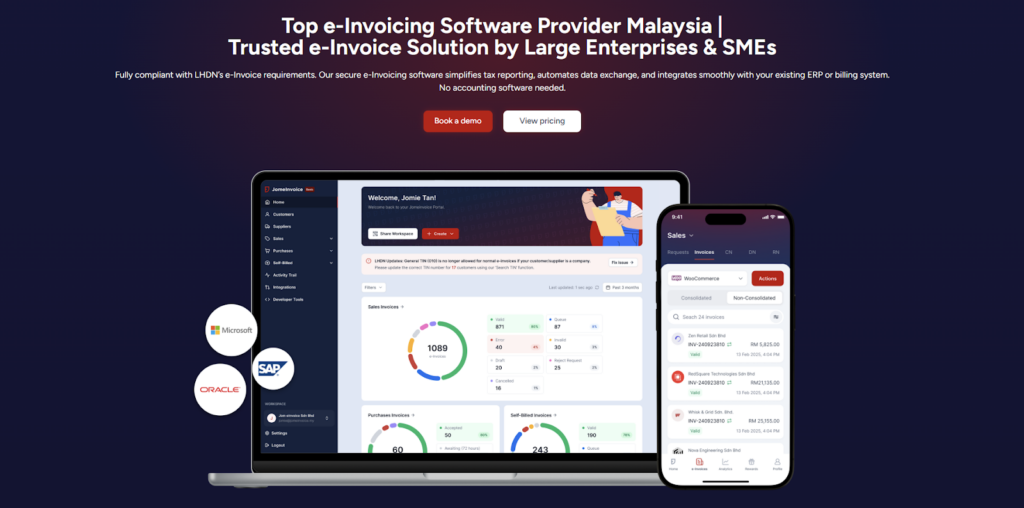
JomeInvoice is widely adopted as one of the best einvoicing software solutions in Malaysia. It is designed to support SMEs and large enterprises across all industries while meeting LHDN e-Invoice requirements with minimal operational disruption.
As a flexible e-Invoice platform for large enterprises and a practical solution for growing businesses, JomeInvoice supports high transaction volumes, complex workflows, and multi-system environments.
One e-Invoice Platform Built for All Business Sizes
JomeInvoice works as the best e-Invoice software for SMEs by offering fast onboarding, simple user interfaces, and automated compliance features. At the same time, it scales into a full e-Invoice platform for large enterprise use, supporting thousands of invoices daily through ERP and system integrations.
Key advantages
• Suitable for SMEs, mid-sized companies, and large enterprises
• Handles low and high invoice volumes efficiently
• Supports consolidated and self-billed e-Invoice workflows
Tailored for Every Industry
JomeInvoice works for a broad range of sectors, including retail, eCommerce, manufacturing, services, and more. It adapts to specific workflows, whether your business runs point-of-sale systems, online stores, or ERP platforms.
Retail e-Invoicing Solution for High-Volume Transactions
For retail businesses, JomeInvoice functions as a complete retail e-Invoicing solution. It supports POS integration, daily sales consolidation, and compliance with the RM10,000 consolidated e-Invoice threshold requirement
Retailers benefit from
• Automated consolidated e-Invoice generation
• POS system integration
• Reduced manual reporting during peak sales periods
e-Invoice for eCommerce and Online Businesses
JomeInvoice also serves as a reliable e-Invoice for eCommerce solution. It integrates with online stores and payment platforms, enabling seamless invoice issuance for high-frequency digital transactions.
eCommerce e-Invoicing features include
• Automated e-Invoice issuance for online sales
• Support for refunds, credit notes, and self-billed e-Invoice
• Compatibility with marketplaces and payment gateways
Enterprise-Grade Integration and Compliance
As a full einvoicing software for large enterprises, JomeInvoice integrates with major ERP systems such as SAP, Oracle NetSuite, Microsoft Dynamics, and other accounting platforms. It connects to the MyInvois system via API integration, minimizing the need for major changes to existing infrastructure.
Enterprise-ready capabilities
• ERP, accounting, and middleware integration
• Pre-validation checks to reduce rejection risks
• Audit trails and reporting for compliance and review
Book a free demo with JomeInvoice now!
See how your business can align with the Malaysia e-invoice guideline, stay prepared for any e-invoice compliance review framework selection, and move ahead of your e-invoice implementation timeline before enforcement tightens.Contact JomeInvoice to help your business stay compliant, reduce manual work, and prepare for full e-Invoice enforcement with confidence.
Stop treating tax as a once-a-year task
The best way to handle the 2026 tax filing deadline is to stop treating tax as a once-a-year task. Malaysia tax filing runs across the full year. Individuals need the correct form. Employers need to manage Form EA, Form E, and monthly payroll-related submissions. HR teams need to stay alert on CP22, CP22A, and CP21. Partnerships, companies, and LLPs need to track both form type and financial year-end.
Meet every filing deadline with clean, audit-ready records.
JomeInvoice custom-integrates with the systems you already use and maintains the audit trail LHDN inspects. Start self-serve at sme.jomeinvoice.my or book a demo.
Disclaimer: This article is for general informational purposes only and does not constitute legal or tax advice. LHDN guidelines are subject to updates. Always refer to the latest official LHDN e-Invoice Guidelines at myinvois.hasil.gov.my and consult a qualified tax professional for advice specific to your business.
Frequently Asked Questions
What is the 2026 tax filing deadline for salaried individuals in Malaysia?
Form BE is due on 15/05/2026 for e-Filing.
What is the 2026 tax filing deadline for freelancers and business income earners?
Form B is due on 15/07/2026 for e-Filing.
Is Form EA the same as Form E in LHDN tax filing?
No. Form EA is the employee income statement. Form E is the employer’s annual return.
Do companies follow a fixed Malaysia tax filing date in 2026?
Not always. For Form C and Form PT, the deadline depends on the financial year-end. Electronic filing is within 8 months after year end.
What is the biggest mistake in Malaysia tax filing?
Using the wrong form is one of the biggest mistakes. Late filing, missed HR reporting, and assuming one employer form covers all obligations are also common problems.
Last updated: 1 September 2026 | Written by Yinn Sheng Ng, Head of Marketing
References
- LHDN e-Filing Made Easy, Year of Assessment 2025 (Tax Education Division briefing for the 2026 filing season): hasil.gov.my (official PDF)
- MyTax portal (LHDN e-Filing channel): mytax.hasil.gov.my