

Many Malaysian businesses import Imported Goods from China every month. A common question follows. Can these costs be used for a tax claim
First, be clear. In this article, a tax claim does not mean a cash refund from the government.
It means claiming the cost of Imported Goods, including import duties and taxes, as a deductible business expense under Malaysia income tax rules within the e-Invoice framework.
If your documentation is complete and compliant, the imported cost can be treated as an allowable business expense.
This guide explains the required documents, the role of customs Malaysia, the K1 Form, and how to protect your tax claim during audit.
What Does Tax Claim Mean for Imported Goods in Malaysia
When businesses import goods from a foreign country such as China, they usually pay:
• Cost of goods
• Import duty
• Imported Goods related tax
• Clearance charges
A tax claim in this context means:
• Recording these costs properly
• Supporting them with valid documents
• Deducting them as business expenses in income tax computation
It does not mean you receive a direct refund. It reduces your taxable income if the expense is valid and properly documented.
Are Imported Goods From China Eligible for Tax Claim
Yes. Imported Goods used for business purposes are generally deductible, subject to income tax rules.
However, approval depends on documentation. During review, authorities will verify:
• The goods were genuinely imported
• Payment was made
• Duties and taxes were paid to customs Malaysia
• The transaction is supported by commercial evidence
• The amounts match across all documents
If records are incomplete or inconsistent, your tax claim may be disallowed.
4 Mandatory Documents for a Valid Tax Claim on Imported Goods to Malaysia
To support a compliant tax claim, you must maintain four key documents. Together they create a complete audit trail linking supplier, payment, customs Malaysia clearance, and accounting records.
- Invoice From the China Supplier
The commercial invoice from the foreign country supplier is the foundation.
It must show:
• Supplier name and address
• Buyer details
• Description of Imported Goods
• Quantity and unit price
• Total transaction value
This invoice supports the cost recorded in your accounts and the valuation declared to customs Malaysia.
2. Payment Proof or Receipt
You must show clear evidence of payment to the supplier.
Acceptable proof includes:
• Bank transfer confirmation
• Telegraphic transfer receipt
• Official remittance record
The payment amount must match the supplier invoice. Mismatch creates risk during audit.
Without payment proof, the expense may not qualify as a valid tax claim.
3. K1 Form From Customs Malaysia
The K1 Form is the official import declaration issued during customs clearance.
It records:
• HS code classification
• Customs value
• Import duties
• Tax payable
The K1 Form is a critical document. In many audit cases, authorities rely on this form to verify that Imported Goods entered Malaysia legally and that taxes were assessed.
4. Malaysia Customs Official Receipt
After clearance, customs Malaysia issues an official receipt confirming payment of duties and related tax.
This receipt must align with:
• The K1 Form
• The declared tax amount
• The payment made
If the receipt is missing, it becomes difficult to defend your tax claim.
Why Invoicing Still Matters for Foreign Country Suppliers
Foreign suppliers operate outside the Malaysia tax system. Their commercial invoice alone does not fulfill local reporting requirements.
Malaysian buyers must create compliant local records under the e-Invoice system. This ensures the Imported Goods cost is properly captured in domestic accounting and income tax reporting.
Without proper invoicing records, authorities cannot trace the transaction within Malaysia’s tax framework.
Self-Billed e-Invoice Requirement for Imported Goods
Under Malaysia e-Invoice implementation, imported transactions require additional compliance.
Even if the foreign country supplier issues a commercial invoice, the Malaysian buyer must issue a self-billed e-Invoice where required.
This is necessary because:
• The supplier is not registered in Malaysia
• The transaction must be recorded in the local tax system
• Digital reporting supports audit traceability
The self-billed e-Invoice links the foreign transaction to your local tax records and strengthens your tax claim position.
Common Mistakes That Lead to Tax Claim Disallowance
Many disallowed tax claim cases share similar issues:
• Invoice value does not match payment proof
• Missing K1 Form
• Missing customs Malaysia official receipt
• Incorrect tax amount recorded
• No self-billed e-Invoice issued when required
These gaps weaken your position during review.
Conclusion: Documentation Determines Tax Claim Approval
Imported Goods from China to Malaysia can qualify as deductible business expenses.
A tax claim in this context reduces taxable income. It is not a direct cash refund.
From an audit perspective, authorities assess eligibility based on documents, not explanations. Clear records linking invoice, payment, K1 Form, and customs Malaysia receipt protect your position.
Strong documentation is the deciding factor between approval and disallowance.
Read More: Self-Billed e-Invoice and Tax Claim Compliance for Imported Goods Tax
If you are managing import tax from China to Malaysia or handling foreign services, these guides help strengthen your tax claim documentation and compliance with customs Malaysia requirements.
Step-by-Step Guide to Issuing a Self-Billed e-Invoice for Taobao Shipping to Malaysia 2025 2026
Learn when a self-billed e-Invoice is required for Taobao imports, what documents support your Imported Goods Tax position, and how to align with customs Malaysia procedures.
Understand how to issue a self-billed e-Invoice for foreign service providers and how it impacts your tax claim and compliance reporting in Malaysia.
Choosing the Best e-Invoice Software for SMEs Malaysia and Large Enterprises – JomeInvoice
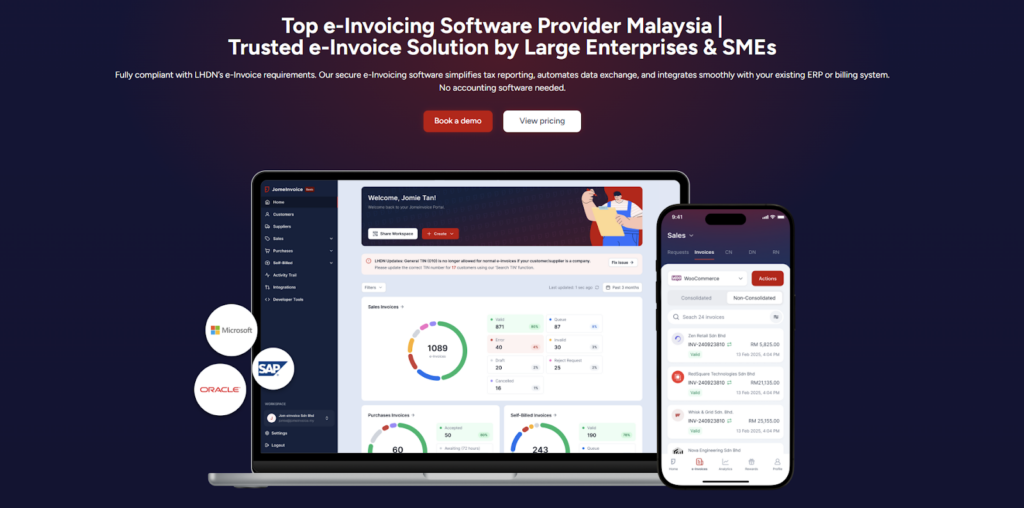
JomeInvoice is widely adopted as one of the best einvoicing software solutions in Malaysia. It is designed to support SMEs and large enterprises across all industries while meeting LHDN e-Invoice requirements with minimal operational disruption.
As a flexible e-Invoice platform for large enterprises and a practical solution for growing businesses, JomeInvoice supports high transaction volumes, complex workflows, and multi-system environments.
One e-Invoice Platform Built for All Business Sizes
JomeInvoice works as the best e-Invoice software for SMEs by offering fast onboarding, simple user interfaces, and automated compliance features. At the same time, it scales into a full e-Invoice platform for large enterprise use, supporting thousands of invoices daily through ERP and system integrations.
Key advantages
• Suitable for SMEs, mid-sized companies, and large enterprises
• Handles low and high invoice volumes efficiently
• Supports consolidated and self-billed e-Invoice workflows
Tailored for Every Industry
JomeInvoice works for a broad range of sectors, including retail, eCommerce, manufacturing, services, and more. It adapts to specific workflows, whether your business runs point-of-sale systems, online stores, or ERP platforms.
Retail e-Invoicing Solution for High-Volume Transactions
For retail businesses, JomeInvoice functions as a complete retail e-Invoicing solution. It supports POS integration, daily sales consolidation, and compliance with the RM10,000 consolidated e-Invoice threshold requirement
Retailers benefit from
• Automated consolidated e-Invoice generation
• POS system integration
• Reduced manual reporting during peak sales periods
e-Invoice for eCommerce and Online Businesses
JomeInvoice also serves as a reliable e-Invoice for eCommerce solution. It integrates with online stores and payment platforms, enabling seamless invoice issuance for high-frequency digital transactions.
eCommerce e-Invoicing features include
• Automated e-Invoice issuance for online sales
• Support for refunds, credit notes, and self-billed e-Invoice
• Compatibility with marketplaces and payment gateways
Enterprise-Grade Integration and Compliance
As a full einvoicing software for large enterprises, JomeInvoice integrates with major ERP systems such as SAP, Oracle NetSuite, Microsoft Dynamics, and other accounting platforms. It connects to the MyInvois system via API integration, minimizing the need for major changes to existing infrastructure.
Enterprise-ready capabilities
• ERP, accounting, and middleware integration
• Pre-validation checks to reduce rejection risks
• Audit trails and reporting for compliance and review
Book a free demo with JomeInvoice now!
See how your business can align with the Malaysia e-invoice guideline, stay prepared for any e-invoice compliance review framework selection, and move ahead of your e-invoice implementation timeline before enforcement tightens.Contact JomeInvoice to help your business stay compliant, reduce manual work, and prepare for full e-Invoice enforcement with confidence.