

- The Malaysian entity is the taxpayer, and for a company the responsibility for e-Invoice compliance rests with its directors; appointing a service provider or a head-office team does not transfer it (LHDN (Inland Revenue Board of Malaysia) e-Invoice General FAQs, 4 September 2026, Q30). Failing to issue an e-Invoice carries a fine of RM200 to RM20,000, imprisonment of up to 6 months, or both, for each offence (Income Tax Act 1967, section 82C(1) read with paragraph 120(1)(d)).
- The exemption for businesses below RM3 million does not apply to a subsidiary of a holding company with annual turnover or revenue of at least RM3 million (e-Invoice General Guideline v4.8, 30 August 2026, section 1.6.10(b)). The text does not require the holding company to be Malaysian. A subsidiary that begins operating in 2026 or later and cannot use the exemption starts on 1 July 2026 or its commencement date, whichever is later (LHDN FAQs, Q14(a)).
- Paying a parent company or supplier abroad for goods or services needs a self-billed e-Invoice issued by the Malaysian entity (e-Invoice Specific Guideline v4.9, 7 September 2026, sections 8.3(b) and 10.4), and intercompany charges need an e-Invoice (LHDN FAQs, Q60).
- e-Invoices can be issued in renminbi (RMB), New Taiwan dollars (TWD), Hong Kong dollars (HKD) or any other currency; the ringgit (RM) equivalent is needed only where a legal or tax requirement says so (Specific Guideline v4.9, section 13; LHDN FAQs, Q25).
- MyInvois, LHDN’s e-Invoice system, accepts e-Invoices through its portal or through an application programming interface (API), and the two can be combined (General Guideline v4.8, section 2.2; LHDN FAQs, Q134), so a head-office ERP (enterprise resource planning system) does not have to be replaced to comply.
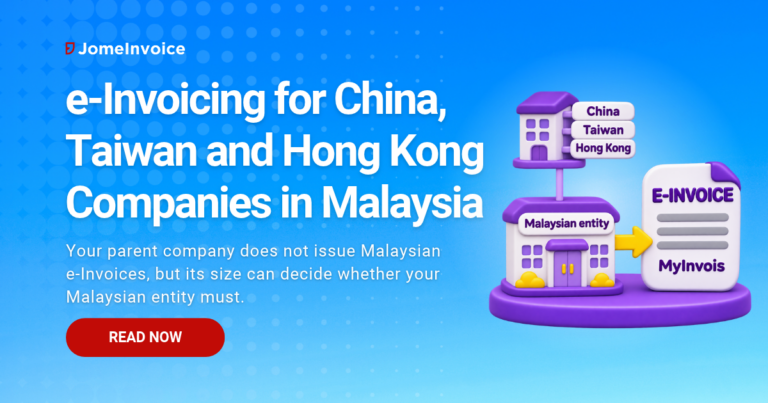
E-invoicing for China, Taiwan and Hong Kong companies in Malaysia is an obligation of the Malaysian entity, not of the parent company. The Malaysian company issues e-Invoices, and self-bills its payments abroad, through MyInvois, the e-Invoice system of LHDN (Lembaga Hasil Dalam Negeri Malaysia, the Inland Revenue Board of Malaysia, also called IRBM). Two rules catch head offices out: the parent’s turnover can remove the Malaysian entity’s small-business exemption, and payments from Malaysia to the group for goods, services and most interest need a self-billed e-Invoice.
This hub answers the questions head-office (HQ) decision-makers and the local finance team ask first: does the mandate apply, what does each flow with the group need, can the head-office ERP (enterprise resource planning) system connect, and how to choose a provider. Where another guide already covers a topic in depth, this page summarises it in one paragraph and links to it.
Does e-Invoicing Apply to the Malaysian Entity of a China, Taiwan or Hong Kong Group?
Yes, in most cases. The foreign parent issues its own invoices under its home rules and is not required to issue a Malaysian e-Invoice (Specific Guideline v4.9, section 10.4); foreign parties generally do not use MyInvois (LHDN FAQs, Q52). The Malaysian company is the one that must issue e-Invoices, and its start date depends on its own revenue, the year it began operating and, if its revenue is below RM3 million, its group’s turnover.
The table below shows when each type of Malaysian entity must start. Revenue bands use the entity’s financial year 2022 (FY2022) revenue for businesses operating before 2023.
| Malaysian entity’s situation | Mandatory from | Relaxation period | Penalty enforcement |
|---|---|---|---|
| Operating before 2023, FY2022 revenue above RM100 million (Phase 1) | 1 August 2024 | Ended 31 January 2025 | Active |
| Operating before 2023, RM25 million to RM100 million (Phase 2) | 1 January 2025 | Ended 30 June 2025 | Active |
| Operating before 2023, RM5 million to RM25 million (Phase 3) | 1 July 2025 | Ended 31 December 2025 | Active |
| Operating before 2023, RM3 million to RM5 million (Phase 4) | 1 January 2026 | Until 31 December 2027 | From 1 January 2028 |
| Began operating 2023 to 2025, revenue RM3 million to RM5 million | 1 July 2026 | Until 31 December 2027 | From 1 January 2028 |
| Began operating 2023 to 2025, revenue above RM5 million | 1 July 2026 | Not confirmed: Table 16.1 sets relaxation for 1 July 2026 starts “up to RM5 million” | Confirm with your tax adviser |
| Operating before 2026, below RM3 million, but the parent, a corporate shareholder or a related company has turnover of at least RM3 million | 1 July 2026 | Until 31 December 2027 | From 1 January 2028 |
| Began operating in 2026 or later and not exempt (for example, a new subsidiary of a group with turnover of at least RM3 million) | 1 July 2026 or the commencement date, whichever is later | Only if the start date is 1 July 2026 (Table 16.1) | From 1 January 2028 if the start date is 1 July 2026; otherwise confirm with your tax adviser |
| Below RM3 million with no carve-out below | Exempt; if revenue reaches RM3 million in YA2026 or later, from 1 January of the second year after that year of assessment (a business that reached RM3 million in YA2023 to YA2025 starts on 1 July 2026) | Not applicable while exempt; for a 1 July 2026 start, until 31 December 2027 if revenue is up to RM5 million (Table 16.1) | Not applicable while exempt; from 1 January 2028 for a 1 July 2026 start with revenue up to RM5 million |
Sources: General Guideline v4.8, section 1.5 and Table 1.1; Specific Guideline v4.9, Table 16.1; LHDN FAQs (4 September 2026), Q12 to Q14 and Q103.
Why the parent’s size matters more than the subsidiary’s
The RM3 million exemption is the provision a small, newly set-up Malaysian subsidiary would normally rely on, and it has three carve-outs (General Guideline v4.8, section 1.6.10). The exemption does not apply if the Malaysian entity:
- has a non-individual shareholder with annual turnover or revenue of at least RM3 million;
- is a subsidiary of a holding company with annual turnover or revenue of at least RM3 million; or
- has a related company or joint venture with annual turnover or revenue of at least RM3 million, “related company” having the meaning in section 2 of the Promotion of Investments Act 1986, as adopted by section 1.6.10.
For a group headquartered in Shenzhen, Taipei or Hong Kong, the second carve-out is usually the decisive one. Section 1.6.10(b) does not say the holding company must be Malaysian, and it states the RM3 million test in ringgit without saying how to convert a foreign parent’s turnover. Agree the conversion basis with your tax adviser and keep it on file.
LHDN’s own example fits this segment closely: a company already on e-Invoice sets up a new subsidiary on 1 September 2026, and because the exemption criteria are not met, the subsidiary must issue e-Invoices from that date (LHDN FAQs, Q14(a)). A new Malaysian entity of a China, Taiwan or Hong Kong group should therefore be ready to issue e-Invoices on its first trading day.
LHDN’s related-company tests turn on shareholding, not directors. A common corporate shareholder holding at least 20% of the issued share capital, or controlling operations at any shareholding, makes companies related; a common individual shareholder or a common director without shares does not (LHDN FAQs, Q103). Our guide to the related-company rules for e-Invoice works through those scenarios, and our e-Invoice exemption guide for businesses below RM3 million covers the threshold itself.
Once a business has been mandated under the current RM3 million threshold, it cannot re-qualify for the exemption in a later year (LHDN FAQs, Q104); businesses mandated under the earlier RM1 million threshold that are now below RM3 million are treated differently (Q15 to Q20). Plan the Malaysian entity’s setup as permanent: a later fall in revenue below RM3 million does not end the obligation. Check when a new foreign-owned Malaysian subsidiary must start e-invoicing.
What Are the Obligations and Penalties, and Who Is Liable?
The Malaysian entity’s directors carry the liability, wherever the group’s decision-makers sit. For a company, responsibility for compliance with the Income Tax Act 1967, including e-Invoice obligations, rests with its directors as defined in section 2, and appointing a service provider does not change that (LHDN FAQs, Q30). Errors caused by a provider are not a defence; they are regularised by the taxpayer (Q133).
| Offence | Provision | Penalty per offence |
|---|---|---|
| Failing to issue an e-Invoice | Section 82C(1), Income Tax Act 1967 | RM200 to RM20,000, up to 6 months’ imprisonment, or both (paragraph 120(1)(d)) |
| Failing to issue a self-billed e-Invoice | Section 82C(6) | RM200 to RM20,000, up to 6 months’ imprisonment, or both |
| Failing to submit a consolidated e-Invoice within the time allowed | Section 82C(7) | RM200 to RM20,000, up to 6 months’ imprisonment, or both |
The self-billed row is the one foreign-owned entities underestimate. A monthly management charge from the parent that is never self-billed is twelve missing e-Invoices a year, not one.
How far back LHDN can look
The table compares the periods for compliance reviews, record keeping and prosecution with the dates you can search in the MyInvois portal.
| Clock | Length | Source |
|---|---|---|
| Period an e-Invoice compliance review covers | Up to 2 assessment years | e-Invoice Compliance Review Framework, 15 December 2025, section 4.1 |
| Notice before a review site visit | At least 14 calendar days | Compliance Review Framework, section 6.1 |
| Record-keeping requirement | 7 years | 7-year record-keeping requirement |
| Prosecution time limit | Up to 12 years from the year of the offence | Income Tax Act 1967, section 121(1) |
| Validated documents available through Search All Documents in the MyInvois portal | Past 2 years, up to 31 days per search | HASiL MyInvois Portal FAQs, Q18 and Q19 |
The Malaysian entity therefore needs its own archive. Data kept only in a head-office system abroad still has to be produced when LHDN asks, and LHDN can access and download data from a taxpayer’s electronic systems during a review (Compliance Review Framework).
Missed or wrong e-Invoices can still be regularised through the e-Invoice Special Voluntary Disclosure Programme (SVDP), which runs from 7 July 2026 to 31 December 2027, and each group entity discloses separately (Specific Guideline v4.9, section 17; LHDN FAQs, Q123 to Q133). Our e-Invoice SVDP guide covers the steps, and our complete LHDN e-Invoice guide for 2026 covers the wider rules.
How Do e-Invoices Work for Flows Between the Malaysian Entity and the Group?
The Malaysian entity issues every e-Invoice in its group flows, including those for money it pays out. A foreign seller is not required to issue a Malaysian e-Invoice, so the Malaysian buyer issues a self-billed e-Invoice as its proof of expense (Specific Guideline v4.9, section 10.4).
| Flow | Who issues | e-Invoice type | Deadline |
|---|---|---|---|
| Malaysian entity buys goods from the parent or a supplier in China, Taiwan or Hong Kong | Malaysian entity | Self-billed (section 8.3(b), 10.4) | End of the 2nd month after customs clearance |
| Malaysian entity buys services from the parent or a supplier abroad (for example management or IT support charges) | Malaysian entity | Self-billed (section 8.3(b), 10.4) | End of the month after the earlier of payment or receipt of the foreign invoice |
| Malaysian entity sells to the parent or to overseas customers | Malaysian entity | Normal e-Invoice to a foreign buyer (section 10.5) | Current invoicing arrangement |
| Malaysian entity charges, or is charged by, another Malaysian group company | The supplying entity | Normal e-Invoice (LHDN FAQs, Q60) | Current invoicing arrangement |
| Malaysian entity pays a dividend to the parent | Malaysian entity, unless exempt | Self-billed (section 8.3(c), section 11), except for taxpayers not entitled to deduct tax under section 108 of the Income Tax Act 1967 and Bursa Malaysia-listed taxpayers (section 11.1.2) | Aligned with Companies Act approval dates |
Sources: Specific Guideline v4.9, sections 8.3, 10.4, 10.5 and 11; LHDN FAQs (4 September 2026), Q60, Q80, Q89, Q90. Each flow is covered in depth by the guides linked below.
Interest payments are also a self-billed scenario (section 8.3(g)). The centralised-treasury exception covers only interest paid to a related company incorporated in Malaysia that provides centralised treasury services to its group (section 8.3(g)(iv)), so interest paid to a group treasury centre in China, Taiwan or Hong Kong falls outside it and is self-billed by the Malaysian entity. Check each group loan against the full list of exceptions before choosing the e-Invoice type.
Dividends are self-billed under section 8.3(c) unless section 11.1.2 applies: taxpayers not entitled to deduct tax under section 108 of the Income Tax Act 1967, and taxpayers listed on Bursa Malaysia, are exempt from issuing self-billed e-Invoices on dividend distributions (Specific Guideline v4.9, section 11.1.2; General Guideline v4.8, section 1.6.7(d)). Confirm the entity’s position with your tax adviser. See which payments to an overseas parent need a self-billed e-Invoice for the treatment of management fees, royalties and group loans.
Tax identification numbers for group companies abroad
When a foreign supplier has no Malaysian tax identification number (TIN), the self-billed e-Invoice uses the general TIN EI00000000030; for a foreign buyer without one, the e-Invoice uses EI00000000020 (Specific Guideline v4.9, Appendix 1). The Malaysian entity must first check whether the group company has an LHDN-assigned TIN, because the general TIN is only for those without one (LHDN FAQs, Q35). Our guide to general TIN codes for foreign suppliers and buyers lists every code and when to use it.
Self-billed e-Invoices for services from the parent or suppliers abroad
Charges from the parent for services such as management, IT support or shared staff are services from a foreign supplier, so the Malaysian entity self-bills them, including any service tax on imported services where it applies (Specific Guideline v4.9, section 10.4.7). Our guide to self-billed e-Invoices for imported services covers the fields and timing step by step.
Importing goods from China, Taiwan or Hong Kong
For imported goods, the self-billed e-Invoice uses the actual transaction value on the foreign supplier’s invoice and leaves out the import duty and sales tax levied by the Royal Malaysian Customs Department (RMCD) (LHDN FAQs, Q77 and Q79). Our guide to self-billed e-Invoices for imported goods covers the customs form fields, and our explainer on import tax on goods from China to Malaysia covers the duties themselves.
Charges inside the group
Intercompany charges need an e-Invoice (LHDN FAQs, Q60). When a head office pays a third party on the Malaysian entity’s behalf and recharges the cost, the treatment depends on who the third party invoices: the guideline’s disbursement and reimbursement scenarios avoid double e-Invoices by having the paying company invoice only its own service, or show the passed-through cost as a separate line (Specific Guideline v4.9, sections 5.5 and 5.6). Where the head office is abroad, it does not issue a Malaysian e-Invoice; any fee it charges for paying on the entity’s behalf is self-billed by the Malaysian entity as a service from a foreign supplier (section 10.4). The related-company guide covers flows between Malaysian group companies.
Currency, exchange rates and corrections
Group invoices in RMB, TWD or HKD can stay in that currency on the e-Invoice, with the RM equivalent added only where a law or tax rule requires it (LHDN FAQs, Q25). Where a rate is needed, use an acceptable source applied consistently, for example the Bank Negara Malaysia reference rate, and document the policy (Specific Guideline v4.9, section 13).
Foreign parties generally do not use MyInvois, so corrections to e-Invoices with group companies abroad go through credit, debit or refund note e-Invoices (LHDN FAQs, Q52). A separate self-billed e-Invoice is needed for each purchase from a foreign supplier, save for the exceptions in section 3.6.5 (Q76). Phase 4 taxpayers and new businesses in the relaxation period may instead consolidate self-billed e-Invoices for all section 8.3 scenarios until 31 December 2027 (Specific Guideline v4.9, section 16.2(b)).
Can the Head-Office ERP Connect to MyInvois?
Yes. MyInvois accepts submissions through an API as well as its portal (General Guideline v4.8, section 2.2), so a Kingdee, Yonyou or other head-office ERP can be the source of Malaysian e-Invoices without being replaced. The real decisions are which system holds the Malaysian invoice data, and who maintains the link when LHDN changes its rules.
| Setup | How it works | Works best when | Watch-out |
|---|---|---|---|
| Head-office ERP as the source, through middleware | The HQ ERP produces invoice data; middleware maps it, validates it and submits it to MyInvois | The Malaysian entity’s books already sit in the group ERP | Malaysian fields are often missing from head-office master data |
| Local accounting system as the source | The Malaysian entity runs its own system and the group consolidates later | The entity keeps its own books locally | Two sets of master data to keep aligned |
| Direct API built by head-office IT | The HQ team builds and runs its own MyInvois integration | The group has a strong in-house team with Malaysian tax context | That team owns every LHDN software development kit (SDK) change |
| Manual entry in the MyInvois portal | Staff key each e-Invoice by hand | Very low volume only | Self-billed volume from group flows grows fast |
What a head-office system usually lacks
Malaysian e-Invoices need fields that a China, Taiwan or Hong Kong ERP was not built around. A self-billed e-Invoice, for example, asks for the supplier’s TIN, business registration number, sales and service tax (SST) registration, Malaysia Standard Industrial Classification (MSIC) code and classification codes (Specific Guideline v4.9, Table 8.3). Field formats also change: from 24 October 2026, MyInvois caps amount fields at 26 digits, and earlier releases set code-list rules for currency and country codes and length limits for foreign state codes and postcodes (MyInvois SDK release notes). Our explainer on the October 2026 SDK validation change lists the fields.
Timing on the same clock as head office
LHDN validates e-Invoices in near real time, generally in under 2 seconds, and an e-Invoice can be cancelled only within 72 hours of validation; after that, changes need a credit, debit or refund note (LHDN FAQs, Q42, Q47 and Q52). China, Taiwan and Hong Kong share Malaysia’s UTC+8 time zone, so the 72-hour window runs on the head office’s working clock. The gap to close is regulatory context, not time difference.
Middleware typically accepts invoice data in one of two ways: an API call from the ERP, or a scheduled file transfer over SFTP (secure file transfer protocol) where the ERP cannot call an API. Our comparison of ERP e-Invoice integration for SAP, NetSuite and Dynamics 365 shows how the large global ERPs approach the same problem. For Chinese ERP software, see how to connect Kingdee or Yonyou to MyInvois.
What Should a Foreign-Owned Company Look for in an e-Invoice Provider?
Choose on questions you can verify, not on badges. LHDN has no registration or certification requirement for technology providers at this juncture, as stated in its FAQs of 4 September 2026 (Q138 and Q139), and notes this may change, so a claimed “LHDN certification” is something to ask about, not a selection criterion. Liability also stays with your directors whoever you hire (Q30), so the contract must say who fixes provider-caused errors.
| Question to ask the provider | Why it matters for a China, Taiwan or Hong Kong-owned entity | A strong answer |
|---|---|---|
| In which languages can your support desk handle an urgent ticket? | Head-office approvers often read Mandarin; the local team reads English or Bahasa Malaysia | Named languages and a named response time for a rejected e-Invoice |
| How exactly will you connect our ERP, by name and version? | Head-office ERPs are often outside a vendor’s usual list | A scoped plan: API, file feed, or both, with who maps each field |
| Where is our e-Invoice data hosted, and for how long is it kept? | The portal searches the past 2 years. Businesses generally need to keep records for 7 years. | A stated location and a retention period of at least 7 years |
| How do you absorb LHDN guideline and SDK changes? | LHDN issued General Guideline v4.8 on 30 August 2026 and Specific Guideline v4.9 on 7 September 2026 | Changes absorbed by the provider, with dated release notes |
| How do you handle self-billed e-Invoices for group payments? | Most outbound group flows are self-billed | Self-billed e-Invoices issued and tracked in the same system as sales |
| Who fixes errors your system causes, and how fast? | Provider fault is not a defence (Q133) | A written remediation process, including SVDP support |
For how local and overseas middleware differ, see our guide to switching to a local e-Invoice middleware , and for security questions, our e-Invoice software security checklist . Use the e-invoice provider checklist for foreign-owned companies to compare Mandarin support, data hosting and ERP integration.
Action Plan for the First 90 Days
The sequence below moves a China, Taiwan or Hong Kong-owned Malaysian entity from first question to compliant submissions.
- Confirm the start date. Check the entity’s revenue, its commencement year and the parent’s turnover against section 1.6.10.
- Map every group flow. List each payment to and from the group and assign it a row in the flows table above.
- Collect TINs. Ask each group company and key supplier for an LHDN-assigned TIN; use general TINs only where none exists.
- Choose the source system. Decide whether the head-office ERP or a local system produces Malaysian e-Invoices.
- Add Malaysian fields. Extend master data with TIN, MSIC code, SST number and classification codes.
- Write the exchange-rate policy. Name the rate source, apply it consistently, and file it.
- Set up your own archive. Keep validated e-Invoices for at least 7 years outside the portal.
- Disclose past gaps. Regularise missed e-Invoices through the SVDP before 31 December 2027.
How JomeInvoice Supports China, Taiwan and Hong Kong Groups
JomeInvoice is a Malaysian e-invoicing middleware company headquartered in Kuala Lumpur and backed by AGMO Holdings Berhad, a Bursa Malaysia-listed company. For a group managed from China, Taiwan or Hong Kong, four points matter:
- Mandarin support alongside Bahasa Malaysia and English, from a Malaysian team with local LHDN expertise and a dedicated enterprise account manager.
- Any ERP or system connects through API, or through an SFTP file feed where an API is not possible; Kingdee and Yonyou are examples of head-office systems that can be connected this way. Each integration is scoped to the client. The file feed takes CSV, JSON or XML files and, where return files are enabled, writes back outcome files that report the result of every invoice (JomeInvoice docs, automated SFTP feed, accessed 25 November 2026).
- Onshore data hosted on Amazon Web Services (AWS) in Malaysia, archived for 12 years for the duration of the subscription.
- Enterprise go-live in 4 to 8 weeks, subject to change where more complicated or customised solutions are needed.
JomeInvoice holds ISO 9001, ISO 20000-1 and ISO 27001 certification. See our enterprise e-invoicing solution.
The parent never files, but it decides the setup
Your Malaysian entity issues and self-bills every e-Invoice in the group’s Malaysian flows, its directors carry the liability, and the parent’s turnover usually decides whether it can stay exempt. Confirm the start date, map the group flows, and connect the system that already holds the data.
Can your group’s ERP reach MyInvois without a rebuild?
Compare your current setup with JomeInvoice: Mandarin support, onshore data, and any ERP connected by API or SFTP.
Book a Demo Sign Up Free
Disclaimer: This article is for general informational purposes only and does not constitute legal or tax advice. LHDN guidelines are subject to updates. Always refer to the latest official LHDN e-Invoice Guidelines at myinvois.hasil.gov.my and consult a qualified tax professional for advice specific to your business.
Frequently Asked Questions
Does a Malaysian subsidiary of a Chinese company need e-invoicing?
Yes, in most cases. The Malaysian subsidiary is the taxpayer and must issue e-Invoices once its start date arrives. If its own revenue is below RM3 million, the exemption still does not apply when its holding company has turnover of at least RM3 million [General Guideline v4.8, section 1.6.10(b)].
Is a new Malaysian subsidiary exempt if its own revenue is below RM3 million?
No, not if its holding company, a corporate shareholder or a related company has turnover of at least RM3 million [General Guideline v4.8, section 1.6.10]. It then starts on 1 July 2026, or on its commencement date if it began operating after that [LHDN FAQs, Q12 to Q14].
Do we need a self-billed e-Invoice when we pay our parent company in China, Taiwan or Hong Kong?
Yes, for goods or services bought from the parent. A foreign seller does not issue Malaysian e-Invoices, so the Malaysian entity self-bills as proof of expense [Specific Guideline v4.9, sections 8.3(b) and 10.4]. Dividends are self-billed only where the section 11.1.2 exemption does not apply [section 11].
Can our e-Invoices be issued in RMB, TWD or HKD?
Yes. e-Invoices can be in any currency; the RM equivalent is required only where a legal or tax requirement says so [LHDN FAQs, Q25]. Use an acceptable, consistently applied exchange-rate source and document the policy [Specific Guideline v4.9, section 13].
Can our head-office ERP such as Kingdee or Yonyou submit e-Invoices to MyInvois?
Yes. MyInvois accepts submissions by API as well as through its portal [General Guideline v4.8, section 2.2], so a head-office ERP can be the source system, connected directly or through a provider. The ERP must hold Malaysian fields such as TIN, MSIC code and classification codes.
Who is liable if our provider or head office makes the mistake?
The Malaysian taxpayer is, and for a company that means its directors [LHDN FAQs, Q30]. Provider fault is not a defence; errors can be regularised through the SVDP until 31 December 2027 [Q133; Specific Guideline v4.9, section 17].
How long does it take to go live?
4 to 8 weeks is JomeInvoice’s typical enterprise go-live, subject to change where more complicated or customised solutions are needed. The main variables are the number of group flows and how much Malaysian master data the source ERP already holds.
Does LHDN certify e-Invoice providers?
No. LHDN has no registration or certification requirement for technology providers at this juncture, as stated in its FAQs of 4 September 2026 [Q138 and Q139]. Compare providers on verifiable answers about support, integration, data hosting and error remediation instead.
Last updated: 25 November 2026 | Written by Yinn Sheng Ng, Head of Marketing
References
Based on: e-Invoice Specific Guideline v4.9 (7 September 2026); e-Invoice General Guideline v4.8 (30 August 2026); LHDN e-Invoice General FAQs (4 September 2026). Verified against e-Invoice Specific Guideline v4.9 (7 September 2026) and e-Invoice General Guideline v4.8 (30 August 2026) on 25 November 2026.
- LHDN, e-Invoice Specific Guideline v4.9 (7 September 2026), sections 3.6.5, 5, 8.3, 10.4, 10.4.7, 10.5, 11, 11.1.2, 13, 16.2, 17, Table 8.3, Table 16.1, Appendix 1: https://www.hasil.gov.my/wp-content/uploads/IRBM-e-Invoice-Specific-Guideline.pdf
- LHDN, e-Invoice General Guideline v4.8 (30 August 2026), sections 1.5, 1.6.1(e), 1.6.7(d), 1.6.10 and 2.2, Table 1.1: https://www.hasil.gov.my/wp-content/uploads/IRBM-e-Invoice-Guideline.pdf
- LHDN, e-Invoice General FAQs (4 September 2026), Q12, Q13, Q14, Q15 to Q20, Q25, Q30, Q35, Q42, Q47, Q52, Q60, Q76, Q77, Q79, Q80, Q89, Q90, Q103, Q104, Q123 to Q133, Q134, Q138, Q139: https://www.hasil.gov.my/wp-content/uploads/lhdnm-e-invoice-general-faqs.pdf
- HASiL media statement on the Rangka Kerja Semakan Pematuhan e-Invois (framework effective 15 December 2025), sections 4.1 and 6.1: https://www.hasil.gov.my/wp-content/uploads/20251216-kenyataan-media-hasil-rke-semakan-pematuhan-einvois-di-portal-rasmi-hasil.pdf
- Income Tax Act 1967 (Act 53), sections 2, 82C, 120 and 121(1): https://www.hasil.gov.my/wp-content/uploads/20240521-akta-cukai-pendapatan-1967-akta-53.pdf
- LHDN, MyInvois SDK release notes: https://sdk.myinvois.hasil.gov.my/sdk-1-0-release/
- LHDN, MyInvois portal: https://myinvois.hasil.gov.my