

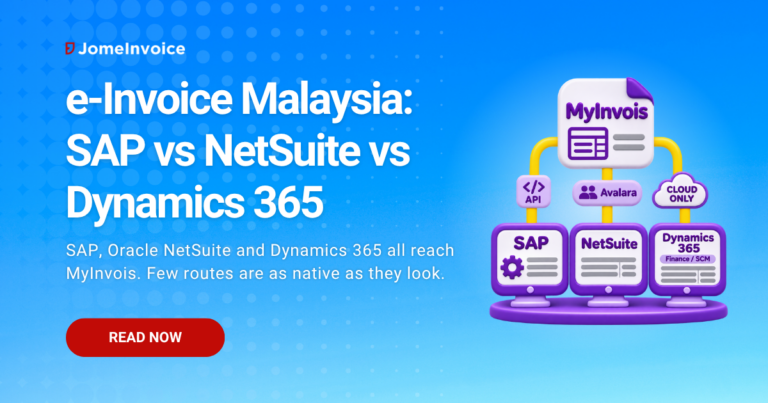
- LHDN (Lembaga Hasil Dalam Negeri Malaysia) recognises three ways to connect an enterprise resource planning (ERP) system to MyInvois by application programming interface (API): direct integration, a Peppol service provider, or a non-Peppol technology provider. (LHDN e-Invoice General Guideline v4.8, 30 August 2026, Section 2.4)
- Oracle NetSuite’s Malaysia Electronic Invoicing SuiteApp requires Avalara to be set up as an intermediary in the MyInvois Portal, so the vendor’s own NetSuite route still has a third party in the chain. (Oracle NetSuite Help, accessed 5 November 2026)
- Microsoft states its Malaysian electronic invoicing feature for Dynamics 365 Finance and Supply Chain Management applies only to cloud deployments; Business Central’s Malaysia localisation is partner-built. (Microsoft Learn, accessed 5 November 2026)
- No route moves your liability: compliance stays with the company, and with its director, even when a system vendor or service provider submits for you. (LHDN e-Invoice General FAQs, 4 September 2026, Q30 and Q133)
- Small subsidiaries are not a safe harbour: a sub-RM3 million entity whose holding company, related company or non-individual shareholder has revenue of at least RM3 million is not exempt. (e-Invoice General Guideline v4.8, Section 1.6.10)
SAP e-invoice Malaysia compliance runs on three routes, and the same is true for Oracle NetSuite and Microsoft Dynamics 365: the ERP (enterprise resource planning) vendor’s own module, a partner add-on, or middleware. Each vendor route has a structural catch the marketing omits. NetSuite’s Malaysia SuiteApp submits through Avalara as your MyInvois intermediary, Dynamics 365 Finance’s Malaysia feature works only in cloud deployments, and SAP’s route for ECC (SAP ERP Central Component) and S/4HANA runs through a cloud service, SAP Document and Reporting Compliance (DRC), cloud edition.
MyInvois is the e-Invoice validation system of LHDN (Lembaga Hasil Dalam Negeri Malaysia, the Inland Revenue Board of Malaysia, also called IRBM). For a group already live since 2024 or 2025, the question is not whether the ERP can submit. The question is who carries the change work every time LHDN updates a rule, across every entity and system you run.
Below: a side-by-side of the three ERP routes, sourced to each vendor’s own documentation, and a decision framework for choosing between native module, add-on and middleware.
How we compared: this comparison is based on each vendor’s public documentation, accessed 5 November 2026, not on hands-on testing of SAP, NetSuite or Dynamics 365. Where a vendor’s documentation is silent, we say so rather than fill the gap.
Verified against the e-Invoice General Guideline v4.8 (30 August 2026), the e-Invoice Specific Guideline v4.9 (7 September 2026), the LHDN e-Invoice General FAQs (4 September 2026) and the MyInvois software development kit (SDK) release notes, on 5 November 2026. Vendor documentation accessed 5 November 2026.
Quick Comparison: SAP vs Oracle NetSuite vs Dynamics 365 Routes to MyInvois
The table compares the vendor-delivered route for each ERP, using only what each vendor’s own documentation states. Where a vendor does not publish a fact, the cell says so rather than guessing.
| Question | SAP ERP Central Component (ECC) / S/4HANA | Oracle NetSuite | Microsoft Dynamics 365 Finance / Supply Chain Management (SCM) |
|---|---|---|---|
| Vendor route for Malaysia | SAP Document and Reporting Compliance (DRC), cloud edition, fed from the eDocument Cockpit | Malaysia Electronic Invoicing SuiteApp | “Malaysian electronic invoicing (MY)” feature in Globalization Studio |
| Who talks to MyInvois | SAP’s DRC cloud service | Avalara, set up as your intermediary in the MyInvois Portal | Microsoft’s Electronic Invoicing service, using your own MyInvois client ID and secret |
| Deployment condition | SAP lists SAP ERP and SAP S/4HANA (all versions) in its Malaysia troubleshooting article | Four prerequisite SuiteApps, OBN registration and Avalara provisioning | Cloud deployments only |
| Document types documented | Full scope sits in SAP Notes behind SAP’s support login | Invoice, credit memo, cash refund, debit note, self-billed invoice, credit and debit note | Sales and free-text invoices, project invoices, self invoices from foreign vendors, credit, debit and refund notes |
| Consolidated e-invoice | Consolidated eDocuments (SAP Knowledge Base Article (KBA) 3597501) | Listed in the SuiteApp overview | Batch submission, Microsoft caps each batch at 60 invoices |
| Documented gap | S/4HANA Cloud Public Edition: validated unique identifier (UUID) and QR code not on the standard billing print form (KBA 3790029); ECC and on-premises gaps sit in SAP Notes behind login | Payment item type not supported | Microsoft documents no route for on-premises deployments |
| Best for | SAP groups with the DRC cloud edition already in their contract and an SAP basis team | NetSuite users comfortable with Avalara as intermediary | Dynamics 365 Finance tenants already in the cloud |
| Risk if ignored | Every LHDN change becomes a notes, test and transport cycle | Two vendors to chase for every fix | On-premises entities need a separate route |
Sources, all accessed 5 November 2026: SAP KBAs 3487313, 3597501 and 3790029; Oracle NetSuite prerequisites and scope and limitations; Microsoft Learn, electronic invoicing for Malaysia. OBN is the Oracle network registration NetSuite’s prerequisites page links to; the page does not expand the abbreviation.
How ERP Systems Connect to MyInvois
Every ERP route ends at the MyInvois API. LHDN lists three API methods (General Guideline v4.8, Section 2.4):
- Direct integration of the taxpayer’s ERP system with the MyInvois System
- Through Peppol service providers
- Through non-Peppol technology providers
LHDN adds that “API connection may be made directly to IRBM or through intermediary technology providers” (Section 2.2, Table 2.1). An intermediary is a provider that logs in to MyInvois on your behalf.
The MyInvois SDK requires the intermediary to send an onbehalfof header carrying your Tax Identification Number (TIN), and the permissions you grant in MyInvois decide what it can do (MyInvois SDK, Login as Intermediary System, accessed 5 November 2026). Our guide to e-invoice integration models in Malaysia maps each model in detail.
Three facts follow for ERP owners:
- “Native” is a packaging term, not an LHDN status. LHDN states there is no registration or certification requirement for technology providers, as of its General FAQs of 4 September 2026 (Q138 and Q139).
- Responsibility never transfers. Taxpayers remain responsible for complete and accurate e-invoices (General Guideline v4.8, Section 2.1), and appointing a provider does not change that (General FAQs Q30).
- The integration choice is a maintenance choice. Whoever owns the mapping between ERP fields and the MyInvois format owns every future change to that format.
For the wider portal, API and middleware trade-off, see our MyInvois portal vs API vs middleware comparison.
Is your ERP’s e-invoice route costing more than it should?
JomeInvoice maps your SAP, NetSuite or Dynamics 365 setup against the MyInvois rules in force from 24 October 2026. One session, a clear answer.
Book a Demo Sign Up Free
SAP e-Invoice Malaysia: ECC, S/4HANA and Business One Options
SAP’s own route for ECC and S/4HANA is SAP Document and Reporting Compliance, cloud edition, and part of the work stays in the ERP: posting the invoice creates the eDocument, the ERP maps it to the required format, and the cloud edition sends it to IRBM and pushes the status back. SAP also documents a route for invoices created in external SAP and non-SAP systems, which are sent to the ERP as UBL 2.3 XML through its Create External Documents API (SAP Help Portal, cloud edition submission and external-system invoices, SAP S/4HANA 2025 FPS02, accessed 6 November 2026). SAP consultancy PIKON reports that SAP launched its Malaysian business-to-business e-invoicing solution on 31 May 2024 “as part of” the DRC cloud edition licence (PIKON, 7 August 2024, third-party source, accessed 5 November 2026). Confirm with your SAP account team whether your current contract includes that licence.
PIKON describes the flow in seven steps. In summary:
- A billing document or financial invoice is created in ECC or S/4HANA.
- An eDocument is created in the eDocument Cockpit (transaction EDOC_COCKPIT).
- The data is mapped to the XML format IRBM requires.
- The DRC cloud service validates it technically and sends it to MyInvois.
- The response, with status and QR code, returns to the cockpit.
SAP’s troubleshooting article for the Malaysia solution lists “SAP ERP all versions; SAP S/4HANA all versions” and points implementers to SAP Note 3456090, the implementation overview (SAP KBA 3487313, accessed 5 November 2026).
What SAP documents as outside the standard scope
SAP’s own knowledge base is candid about gaps. For S/4HANA Cloud Public Edition, SAP states the Malaysia localisation in DRC does not display the validated UUID or QR code on the billing print form as a standard feature, and recommends retrieving the data by API and building a custom output form (SAP KBA 3790029, accessed 5 November 2026).
SAP also publishes guidance per LHDN change. KBA 3695434 covers the MyInvois SDK field validation updates announced on 10 December 2025 and lists SAP ERP, S/4HANA, S/4HANA Cloud Private Edition and the DRC cloud edition as affected environments (SAP KBA 3695434, accessed 5 November 2026). On an on-premises system, each such change is work your SAP team applies and tests.
SAP Business One is a different decision
SAP’s public Malaysia DRC material covers SAP ERP and S/4HANA; we found no SAP-delivered MyInvois localisation for SAP Business One as of 5 November 2026. Business One users in Malaysia typically connect through partner add-ons, such as the add-on Business One reseller AFON presented in April 2024 (AFON, 11 April 2024, third-party source, accessed 5 November 2026). Confirm current status with your Business One partner before you plan.
Oracle NetSuite e-Invoice Malaysia: The SuiteApp Runs Through Avalara
The NetSuite e-invoice Malaysia route is the Malaysia Electronic Invoicing SuiteApp. Oracle states that e-documents “are certified by Inland Revenue Board of Malaysia (IRBM) through Avalara access points using the Malaysia Electronic Invoicing SuiteApp” (NetSuite overview, accessed 5 November 2026). That wording is Oracle’s: LHDN does not register or certify technology providers at this juncture, so it is not an LHDN certification of the SuiteApp or of Avalara (LHDN General FAQs, 4 September 2026, Q138 and Q139).
Oracle’s prerequisites list five items:
- The NetSuite SuiteApps License Client
- The Localization Assistant SuiteApp
- The Electronic Invoicing SuiteApp
- The NetSuite Electronic Business SuiteApp, plus OBN registration and Avalara provisioning
- Avalara set up as an intermediary in the MyInvois Portal
(NetSuite prerequisites, accessed 5 November 2026)
Oracle limits the SuiteApp to companies in Malaysia and lists three limitations (NetSuite scope and limitations, accessed 5 November 2026):
- The payment item type is not supported.
- Legacy tax accounts do not support tax groups.
- SuiteTax accounts cannot carry negative expense amounts where withholding tax applies.
The so-what for a NetSuite finance team: the vendor route already contains an intermediary. When LHDN changes a rule, both Oracle’s SuiteApp and Avalara’s access point may need updating, so ask each who ships the fix and by when.
For Oracle e-invoice Malaysia questions on Oracle Fusion Cloud ERP rather than NetSuite: Oracle’s 26B release readiness note for its embedded Thomson Reuters e-invoice integration lists Malaysia only under future clearance countries (Oracle Fusion 26B readiness, accessed 5 November 2026). Ask Oracle for a date before assuming a Fusion route exists.
Microsoft Dynamics 365 e-Invoice: Finance Is Cloud-Only, Business Central Is Partner-Localised
The Dynamics 365 e-invoice route for Finance and Supply Chain Management is the “Malaysian electronic invoicing (MY)” feature. Microsoft states it lets you “generate, digitally sign, and submit the XML files of electronic invoices”, and that the invoicing service is “applicable only to cloud deployments” (Microsoft Learn, accessed 5 November 2026).
Unlike NetSuite, the Dynamics 365 Finance route connects with your own MyInvois credentials. Microsoft’s prerequisites include a MyInvois client ID and client secret plus a digital signature certificate from a Malaysian certification authority, all stored in an Azure Key Vault you configure.
Three scope details matter at enterprise scale:
- Self invoices are scoped to foreign vendors. The documented setup covers self invoices “based on vendor invoices from foreign vendors”; check other self-billed scenarios against your needs.
- Consolidation is batch-based. Microsoft’s own batch submission caps each batch at 60 invoices and generates multiple batches above that.
- Updates are versioned features. You import, copy and deploy new versions of the Malaysian feature; batch consolidation needs version 10 or later.
Dynamics 365 Business Central is different again. Microsoft lists Malaysia as localised by “Partner”, not Microsoft (Business Central country availability, accessed 5 November 2026), so expect any MyInvois route to come from a partner app or an external integration, not from Microsoft.
Native Module vs Partner Add-On vs Middleware
e-Invoice middleware is a separate integration layer between your business systems and MyInvois: it receives invoice data from each ERP, maps it to the MyInvois format, submits it, and returns validation status to the source system, so your ERP sends data by API or file and never calls MyInvois itself. The real choice for SAP, NetSuite and Dynamics 365 owners is not which ERP, but which layer owns the MyInvois mapping. The table compares the three layers on the questions a CFO and IT director should ask.
| Question | ERP vendor module | Partner add-on inside the ERP | e-Invoice middleware outside the ERP |
|---|---|---|---|
| Where the mapping lives | Vendor code inside or beside the ERP | Partner code inside the ERP | Outside the ERP, maintained by the middleware provider |
| Who builds the change when LHDN or the SDK changes | Vendor ships, your team applies and tests | Partner ships, your team applies and tests | Provider changes its layer; ERP extract usually unchanged |
| Groups running two or more ERPs | One route per ERP | One add-on per ERP | One route across systems |
| Typical licence model | Vendor subscription or module licence | Partner licence plus services | Provider subscription plus integration build |
| Best for | Single-ERP groups with in-house ERP teams | Single-ERP groups without a vendor route (for example Business One) | Multi-ERP, multi-entity groups, or teams that want change work off their books |
| Risk if ignored | Malaysia updates follow the vendor’s release cycle and your patch cycle | Partner continuity and update speed | Poor upstream data still fails validation; provider choice matters |
Middleware is not automatically better. It moves the mapping and the change work outside your ERP, but a bad master-data record still fails validation. Our ranking of the best e-invoice middleware in Malaysia compares providers, and the guide to outsourcing e-invoice submission covers the contract questions.
Validation, Consolidation and Self-Billed Handling in an ERP
Every route must enforce the same LHDN timing rules, and the ERP is where they break. These are the rules your route must automate, not leave to a spreadsheet:
| Rule | What it requires | Source |
|---|---|---|
| 72-hour window | Buyer rejection requests and supplier cancellations only within 72 hours of validation; after that, a credit, debit or refund note | General Guideline v4.8, Sections 2.3.6 (Portal) and 2.4.5 (API) |
| Consolidated e-invoice | Monthly, within 7 calendar days after month end, for buyers who do not require an e-invoice | Specific Guideline v4.9, Section 3.6.2 |
| RM10,000 rule | Any single transaction exceeding RM10,000 cannot be consolidated | Specific Guideline v4.9, Table 3.6 |
| Self-billed e-invoice | Buyer issues on the supplier’s behalf, only in the scenarios the guideline lists | Specific Guideline v4.9, Section 8 |
| Penalty | RM200 to RM20,000 for each failure to issue, up to 6 months’ imprisonment, or both | Income Tax Act 1967, section 82C(1) read with paragraph 120(1)(d) |
Our 72-hour cancellation window guide and consolidated e-invoice guide cover each rule step by step.
Where ERP data fails before LHDN even sees it
The buyer TIN is where ERP master data meets LHDN validation. Individual taxpayers must use a TIN with the prefix IG (LHDN General FAQs, 4 September 2026, Q32), and LHDN publishes an API to “validate specific Tax Identification Number (TIN) before adding this number to an invoice” (MyInvois SDK, Validate Taxpayer’s TIN, accessed 5 November 2026). A customer record carrying the wrong TIN or the wrong entity type puts every invoice to that customer at risk of rejection, whatever route you use.
The lesson for any route: clean the customer master before you switch, because no integration layer can fix a wrong entity type downstream.
The 24 October 2026 SDK change: a live test of your route
The MyInvois SDK update announced on 6 August 2026 caps all monetary amount fields at 26 digits and the PASSPORT identifier at 12 characters, effective in Production from 24 October 2026 (MyInvois SDK release notes, accessed 5 November 2026).
Ask one question of your route: who changed what, and when did you learn about it? On a vendor module, the answer is a vendor update your team applied. On middleware, the provider’s layer should have absorbed it.
If nobody can answer, that is your audit finding. Developers maintaining a direct build can use our MyInvois API submission guide.
Our guide to the e-invoice compliance review framework sets out what reviewers examine.
Multi-Entity Groups: One TIN per Legal Entity
Each legal entity in a group is a separate taxpayer with its own TIN. On an intermediary route, each entity grants permissions in MyInvois and the provider submits with that entity’s TIN in the onbehalfof header (MyInvois SDK, accessed 5 November 2026). On a direct route, each entity’s credentials and certificate must be set up and kept current.
A hypothetical worked example shows why this matters. A group with 10 Malaysian entities on SAP S/4HANA, NetSuite at two acquired subsidiaries, and Dynamics 365 Finance at a regional unit runs three vendor routes, ten TINs and at least three sets of update cycles. A single middleware layer collapses that to one route, still with ten TINs and ten sets of permissions.
The MSME exemption guide explains the related-company test in full.
Choosing an Approach: Cost, Timeline, Risk
No vendor in this comparison publishes Malaysia pricing or a standard implementation timeline in the documentation we reviewed, so any figure you hear is a quote, not a benchmark. Decide on structure first, then price it. JomeInvoice sells middleware; these are the criteria we would apply to ourselves.
Stay on the ERP vendor route if:
- One ERP covers every Malaysian entity
- You already license the vendor module (DRC, the SuiteApp, or a cloud Dynamics 365 Finance tenant)
- Your ERP team has capacity to apply and test every LHDN and SDK change
Use a partner add-on if:
- Your ERP has no vendor route (SAP Business One, Business Central)
- You run one ERP and want the logic inside it
- The partner can show its update record for the 2025 and 2026 SDK changes
Move to middleware if:
- Your Malaysian entities run on two or more ERPs, or on ERP plus POS (point of sale) or e-commerce systems
- Part of your Dynamics 365 estate is on-premises
- You want inbound supplier e-invoices and outbound submission in one place
- Your team spent unplanned weeks on the 2025 or 2026 SDK changes
Four drivers set the timeline on every route:
- Number of entities in scope
- Document types in scope
- Master-data quality (TINs, addresses, classification codes)
- Number of source systems feeding invoices
If you are replacing a foreign provider rather than an ERP module, our vendor-switch scorecard covers that decision, and the Peppol vs MyInvois explainer covers the Peppol route LHDN also recognises.
How JomeInvoice Fits an SAP, NetSuite or Dynamics 365 Landscape
If your ERP’s e-invoice route has turned every LHDN update into an internal project, the cost is your team’s time, not the licence. JomeInvoice is Malaysian e-invoicing middleware that connects your ERP to LHDN’s MyInvois portal without custom development on your side. SAP, Oracle NetSuite and Microsoft Dynamics 365 are the core ERPs across our enterprise client base, and JomeInvoice builds each client’s integration itself rather than shipping an off-the-shelf connector.
What changes when you move the pipe:
- Your ERP keeps posting as it does today. Invoices leave by API, or by an automated secure file transfer (SFTP) feed in CSV, JSON or XML with return files carrying status, failure reasons, LHDN identifiers and the validation link (JomeInvoice docs, accessed 5 November 2026).
- Status flows back automatically. Webhooks push status changes, such as valid, invalid, cancelled and rejected, to an HTTPS endpoint you choose (JomeInvoice docs, accessed 5 November 2026).
- Inbound is covered. The Purchases module lists e-invoices your suppliers submitted with you as buyer, and lets you request rejection within the 72-hour window (JomeInvoice docs, accessed 5 November 2026).
- TINs are checked before submission. JomeInvoice checks each TIN against LHDN’s database in real time, so mismatches surface before an invoice is sent (JomeInvoice docs, accessed 5 November 2026).
- LHDN changes are absorbed in our layer. SDK and guideline updates are our engineering work, not your ERP team’s.
Proof points enterprise procurement asks for: ISO 9001, ISO 20000-1 and ISO 27001 certification, compliance with the Personal Data Protection Act 2010 (PDPA), data hosted onshore on AWS Malaysia, a Kuala Lumpur team with support in Bahasa Malaysia, English and Mandarin, and a dedicated enterprise account manager. For the security questions to put to any provider, read our e-invoice software security checklist.
Enterprise go-live typically takes 4 to 8 weeks, subject to change where more complicated or customised solutions are needed. See the enterprise e-invoice platform overview, then book a session to assess your current route and define a migration timeline.
Frequently Asked Questions
Q: Does SAP have a native LHDN MyInvois connector?
A: Yes, but not inside the ERP. SAP’s route for ECC and S/4HANA is SAP Document and Reporting Compliance, cloud edition, a cloud service fed from the eDocument Cockpit. LHDN required no provider certification as of 4 September 2026. [SAP KBA 3487313, accessed 5 November 2026; General FAQs Q139]
Q: Can NetSuite submit e-invoices to MyInvois directly?
A: No, not through Oracle’s own route. Oracle states that e-documents from its Malaysia Electronic Invoicing SuiteApp reach IRBM through Avalara access points, and requires Avalara to be set up as your intermediary in the MyInvois Portal. [Oracle NetSuite Help, accessed 5 November 2026]
Q: Does Dynamics 365 Finance support Malaysian e-invoicing on-premises?
A: No. Microsoft states its Malaysian electronic invoicing service applies only to cloud deployments of Finance or Supply Chain Management. On-premises estates need a partner add-on, middleware or a direct API build. [Microsoft Learn, accessed 5 November 2026]
Q: Do I need middleware if my ERP already supports e-invoicing?
A: It depends. One ERP, a licensed vendor module and spare ERP capacity can work without middleware. Groups with several ERPs, on-premises Dynamics, inbound supplier volumes or a heavy update workload usually find middleware cuts the change workload; price both routes before deciding.
Q: How long does an ERP e-invoice integration take?
A: 4 to 8 weeks is JomeInvoice’s typical enterprise go-live, subject to change for complex or customised solutions. No ERP vendor publishes a standard Malaysian timeline. Entities, document types, source systems and master-data quality drive the duration on any route.
Q: Who is responsible if a vendor submits an e-invoice wrongly?
A: Your company is, and for a company, its director. Responsibility stays with the taxpayer even when a system vendor or service provider is appointed. Such errors may be regularised under the e-Invoice Special Voluntary Disclosure Programme (SVDP), open until 31 December 2027. [General FAQs Q30, Q133]
Q: Is a small subsidiary in an SAP group exempt from e-invoicing?
A: No, not if its holding company, related company or joint venture, or a non-individual shareholder has revenue of at least RM3 million. The below-RM3 million exemption does not apply in those cases. [General Guideline v4.8, Section 1.6.10]
Native is a label. The change workload is the decision.
SAP, Oracle NetSuite and Dynamics 365 can all reach MyInvois, but each vendor route carries a licence, a deployment condition or a third party you must manage. Choose the layer that will own the next LHDN change, because there will be one.
Keep your ERP. Swap the e-invoice pipe.
Book a route assessment with JomeInvoice. We map your entities, systems and change workload, then define a migration timeline.
Book a Demo Sign Up Free
Disclaimer: This article is for general informational purposes only and does not constitute legal or tax advice. LHDN guidelines are subject to updates. Always refer to the latest official LHDN e-Invoice Guidelines at myinvois.hasil.gov.my and consult a qualified tax professional for advice specific to your business.
Last updated: 6 November 2026 | Written by Yinn Sheng Ng, Head of Marketing
References
- Inland Revenue Board of Malaysia, e-Invoice General Guideline Version 4.8 (30 August 2026), Sections 1.6.10, 2.1, 2.2, 2.3.6, 2.4 and 2.4.5: https://www.hasil.gov.my/wp-content/uploads/IRBM-e-Invoice-Guideline.pdf
- Inland Revenue Board of Malaysia, e-Invoice Specific Guideline Version 4.9 (7 September 2026), Section 3.6.2, Table 3.6 and Section 8: https://www.hasil.gov.my/wp-content/uploads/IRBM-e-Invoice-Specific-Guideline.pdf
- Inland Revenue Board of Malaysia, e-Invoice General FAQs (updated 4 September 2026), Q30, Q123, Q133, Q138 and Q139: https://www.hasil.gov.my/wp-content/uploads/lhdnm-e-invoice-general-faqs.pdf
- Inland Revenue Board of Malaysia, MyInvois SDK release notes (SDK update of 6 August 2026, Production effective 24 October 2026): https://sdk.myinvois.hasil.gov.my/sdk-1-0-release/
- Inland Revenue Board of Malaysia, MyInvois SDK, Login as Intermediary System: https://sdk.myinvois.hasil.gov.my/api/08-login-as-intermediary-system/
- Inland Revenue Board of Malaysia, Income Tax Act 1967 (Act 53), consolidated, section 82C and paragraph 120(1)(d): https://www.hasil.gov.my/wp-content/uploads/20240521-akta-cukai-pendapatan-1967-akta-53.pdf
- Inland Revenue Board of Malaysia, Rangka Kerja Semakan Pematuhan e-Invois (e-Invoice Compliance Review Framework, effective 15 December 2025), Section 4.1, announced in the HASiL media statement of 16 December 2025: https://www.hasil.gov.my/wp-content/uploads/20251216-kenyataan-media-hasil-rke-semakan-pematuhan-einvois-di-portal-rasmi-hasil.pdf
- Inland Revenue Board of Malaysia, MyInvois portal: https://myinvois.hasil.gov.my