

- MyInvois, LHDN’s (Inland Revenue Board of Malaysia’s) e-Invoice system, takes e-Invoices through its portal or an application programming interface (API), and an API connection may be made directly or through intermediary technology providers (e-Invoice General Guideline v4.8, 30 August 2026, section 2.2, Table 2.1).
- The Malaysian entity is the taxpayer. Appointing a provider, or letting the head office run the link, does not move responsibility: for a company it rests with its directors (LHDN e-Invoice General FAQs, 4 September 2026, Q30).
- The pipe is the easy part. The hard part is the 55 required data fields, including Malaysian tax identification numbers (TINs), industry codes and code-list values that a head-office enterprise resource planning (ERP) system rarely holds (General Guideline v4.8, section 2.4 and Appendix 1).
- Choose an API when head-office IT can call a web service and read a result for every invoice; choose a SSH File Transfer Protocol (SFTP) file feed when the ERP can only export files.
- Validation is near real-time and cancellation closes 72 hours after validation, so the Malaysian side needs a named owner for rejections and cancellations (FAQs Q42, Q47 and Q48).
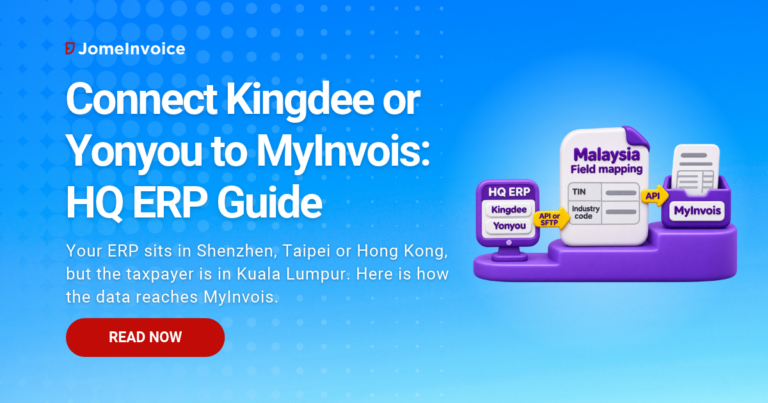
A head-office ERP (enterprise resource planning) system such as Kingdee, Yonyou or a Taiwanese ERP can be the source of a Malaysian entity’s e-Invoices without being replaced. MyInvois, the e-Invoice system of LHDN (Lembaga Hasil Dalam Negeri Malaysia, the Inland Revenue Board of Malaysia, also called IRBM), accepts submissions by API (application programming interface), and that link may run through an intermediary technology provider. The real work is mapping Malaysian data fields the head-office system was never built to hold, and agreeing who in which office owns each step.
This guide is for head-office (HQ) IT and finance teams in China, Taiwan and Hong Kong, and for the finance person in charge (PIC) at the Malaysian entity. For the wider obligations, start with our e-invoicing guide for China, Taiwan and Hong Kong companies in Malaysia ; this page covers only the ERP connection.
Can a Kingdee, Yonyou or Taiwanese Head-Office ERP Connect to MyInvois?
Yes. LHDN offers two transmission mechanisms, the MyInvois Portal and an API, and lists “direct integration of taxpayers’ Enterprise Resource Planning (ERP) system with MyInvois System” as one API method; the connection “may be made directly to IRBM or through intermediary technology providers” (e-Invoice General Guideline v4.8, 30 August 2026, section 2.2, Table 2.1). Nothing in the guideline ties the API to a particular ERP brand or country of origin.
The LHDN software development kit (SDK) states the same design from the technical side: its system overview lists “authenticating the ERP system associated with an intermediary that is representing a taxpayer” among the system’s interactions (MyInvois SDK, getting started). In practice a head-office ERP has two routes:
- Direct build. Head-office IT builds and maintains its own MyInvois integration, including the digital certificate, the UBL 2.1 (Universal Business Language) document in XML or JSON format, and every SDK change (General Guideline v4.8, sections 2.4 and 2.4.1).
- Through an intermediary. The ERP sends invoice data to a technology provider, which builds the MyInvois document, submits it under the Malaysian entity’s TIN and returns the result.
The guideline is also clear about the trade-off: the API “requires upfront investment in technology and adjustments to existing systems” and suits “large taxpayers or businesses with substantial transaction volume” (Table 2.1). For how this compares with keying invoices into the portal, see our comparison of MyInvois versus e-invoicing software , and for the full set of methods, our guide to e-Invoice integration models in Malaysia .
What Does the Data Flow Look Like for the Malaysian Entity?
The flow runs from the head-office ERP to MyInvois and back again, and only the Malaysian entity’s documents travel. Invoices that the head-office companies issue themselves stay outside MyInvois, because a foreign seller is not mandated to implement Malaysia’s e-Invoice; the Malaysian buyer self-bills instead (e-Invoice Specific Guideline v4.9, 7 September 2026, section 10.4.3).
- Post the transaction in the head-office ERP under the Malaysian company code or ledger.
- Extract the document by API call or by file export to an SFTP folder.
- Map and enrich the data: add Malaysian fields, convert values to SDK code lists.
- Submit to MyInvois as an e-Invoice in UBL 2.1 format under the Malaysian entity’s TIN.
- Receive the result. Validation is “near real-time, generally in less than two (2) seconds” (LHDN e-Invoice General FAQs, 4 September 2026, Q42); a validated e-Invoice gets an IRBM Unique Identifier Number, a validation date and time, and the information for a validation link (General Guideline v4.8, section 2.4.3).
- Write back the identifier, status and validation link to the ERP record, so finance can reconcile ERP state with LHDN state.
Which documents the ERP must produce
The connection has to carry more than sales invoices. A Malaysian entity of a foreign group usually needs four document streams from the same ERP:
| Document | Comes from | Why the head-office ERP must handle it | Guide |
|---|---|---|---|
| e-Invoice (sales) | Accounts receivable | Every sale by the Malaysian entity, including sales to group companies | This page |
| Credit, debit and refund notes | Accounts receivable | After the 72-hour window, corrections need a new note referencing the original e-Invoice (FAQ Q47) | How to amend or cancel an e-Invoice |
| Self-billed e-Invoice | Accounts payable | Goods or services bought from foreign suppliers, including the parent, are self-billed by the Malaysian buyer (Specific Guideline v4.9, sections 8.3(b) and 10.4) | Self-billed e-Invoices for imported services |
| Self-billed notes | Accounts payable | Adjustments to self-billed e-Invoices follow the same note rules | Same as above |
The self-billed stream is the one head-office projects most often miss, because it starts in accounts payable, not sales. Under the e-Invoice Specific Guideline v4.9 (7 September 2026), a self-billed e-Invoice for imported services is due by the end of the month following the earlier of payment or receipt of the foreign invoice, and for imported goods by the end of the second month following the month of customs clearance (sections 10.4.9 and 10.4.8). A batch job that runs only on sales will leave those deadlines uncovered.
Is your head-office ERP missing Malaysian fields?
We connect your ERP to MyInvois by API or SFTP, and map your fields for file feeds. Support in Mandarin, English and Bahasa Malaysia.
Book a Demo Sign Up Free
Which Malaysian e-Invoice Fields Does a Head-Office ERP Usually Lack?
Most gaps sit in master data, not in transactions. LHDN requires 55 data fields grouped into eight categories, with an annex for specific circumstances (General Guideline v4.8, section 2.4 and Appendix 1), and the SDK enforces code lists and length limits on many of them. A system configured for China, Taiwan or Hong Kong tax rules typically holds the invoice amounts but not the Malaysian identifiers.
| Field group | Malaysian rule | Typical head-office gap | Who fixes it |
|---|---|---|---|
| Supplier and buyer TIN, business registration number (BRN) | TIN assigned by IRBM; general TINs for foreign parties without one (Specific Guideline v4.9, Appendix 1) | Customer master holds local tax IDs only; see our guide to general TIN codes | Malaysian finance PIC collects; HQ IT adds the fields |
| Malaysia Standard Industrial Classification (MSIC) code and business activity description | Required for the supplier (General Guideline v4.8, Appendix 1, fields 8 and 9); description up to 300 characters (MyInvois SDK release notes, in Production from 15 August 2026) | No Malaysian industry code exists in the ERP | Malaysian finance PIC |
| Sales and service tax (SST) registration number, tax type code | SST number where applicable; tax type per SDK code list | Tax codes built for China’s or Taiwan’s value-added tax, or no sales-tax codes at all in a Hong Kong ledger | Malaysian finance PIC with tax adviser |
| Classification code per line | LHDN classification code list | No equivalent product classification | Malaysian finance PIC maps; HQ IT stores |
| Currency code and exchange rate | Any currency allowed (FAQ Q25); exchange rate “mandatory, where applicable” (General Guideline v4.8, Appendix 1, field 25) | Rate source differs from the one the Malaysian entity files with | Group finance sets the policy |
| Amounts, dates, codes | Amount fields up to 26 digits from 24 October 2026; dates in YYYY-MM-DD; state, country and currency codes per SDK lists (MyInvois SDK release notes) | Different date formats and address structures | HQ IT, tested in the MyInvois sandbox |
Currency is a common source of confusion. e-Invoices “can be displayed in any currency”, so renminbi (RMB), New Taiwan dollar (TWD) or Hong Kong dollar (HKD) invoices are allowed unless a legal or tax rule requires the ringgit equivalent (FAQ Q25). Where an exchange rate is needed, the order is any legal or tax requirement first, then the supplier’s internal policy (Specific Guideline v4.9, section 13.2). Our explainer on the October 2026 MyInvois SDK validation change lists the amount fields affected.
Should the ERP Connect by API or by SFTP File Feed?
Use an API when the ERP can call a web service and act on a per-invoice result; use an SFTP file feed when the ERP can only export files on a schedule. Both reach MyInvois through the same API on the provider’s side; the difference is how the ERP hands over data and receives answers.
| Question | API | SFTP file feed |
|---|---|---|
| How data leaves the ERP | The ERP or middleware calls the provider’s API per invoice or batch | The ERP exports CSV, JSON or XML files to an agreed folder |
| How results come back | In the API response for invoices rejected on submission, then by a follow-up status call or notification once MyInvois completes validation | Through return files, where enabled, or the provider’s dashboard |
| Head-office IT effort | Build and maintain API calls, tokens and error handling | Produce files in the agreed format and naming pattern |
| Best for | ERPs with an open API or integration layer and an in-house developer | Older or heavily customised ERPs, or teams that cannot release developer time |
| Risk if ignored | Treating any success response as “all accepted” and missing rejected invoices | Files left in the wrong folder or with an unrecognised name are not processed |
For a China, Taiwan or Hong Kong head office, two file-feed details matter early. Customer and supplier names held in Chinese characters make the file encoding a decision to agree with the provider at the start, alongside the delimiter. The SFTP folder can sit on the group’s own server, with the provider collecting files from it, or in a drop area the provider hosts; head-office IT security usually decides which of the two is allowed.
A hybrid is also common: sales invoices by API for speed, and self-billed or month-end batches by file. For how the major global ERPs approach the same choice, see our ERP e-Invoice integration comparison for SAP, NetSuite and Dynamics 365 .
Who Owns What Between Head-Office IT and the Malaysian Finance Team?
The Malaysian entity owns the compliance outcome; head-office IT owns the system that produces the data. LHDN’s position is that responsibility “remains with the company, notwithstanding that a third-party service provider or representative has been appointed”, and for a company it rests with its directors (FAQ Q30). The split below keeps that liability visible.
| Task | Head-office IT | Malaysian finance PIC | Integration provider |
|---|---|---|---|
| Authorise the intermediary in MyInvois | Not involved | The Malaysian entity’s director or authorised representative does it | Supplies its TIN and BRN |
| Malaysian master data (TIN, MSIC, SST, classification) | Adds and stores fields | Collects and maintains values | Validates before submission |
| Extraction (API calls or file export) | Builds and runs | Approves scope | Specifies format |
| Field mapping | Explains source fields | Signs off Malaysian meaning | Configures and tests |
| Rejected e-Invoices | Fixes system causes | Fixes data causes, resubmits | Reports the error and reason |
| 72-hour cancellations and credit notes | Not involved | Decides and initiates | Executes on instruction |
| Archive and audit requests | Retains ERP records | Answers LHDN | Holds validated e-Invoices |
China, Taiwan and Hong Kong share Malaysia’s UTC+8 time zone, so the 72-hour cancellation window runs on the same clock in every office. The gap to manage is approval routing and regulatory context, not time difference. Where approvals sit at head office, write the escalation path down before go-live.
How to Run the Integration Project
The project runs in six steps, from authorisation to go-live. The order matters: field mapping depends on the document inventory, and testing depends on the mapping.
Step 1: Authorise the intermediary under the Malaysian TIN
The Malaysian entity’s director or business owner, logged in to MyTax, LHDN’s online tax portal (mytax.hasil.gov.my), under the company role, adds the provider as an intermediary in MyInvois and grants submit, cancel and reject permissions. Head-office staff can do this only if they are directors or appointed representatives of the Malaysian company, so schedule it early.
Step 2: Inventory every document stream
List sales e-Invoices, notes and self-billed e-Invoices by volume, source module and ledger. Include every payment to the parent and other group companies, because those flows decide the accounts-payable scope.
Step 3: Choose API, SFTP or both
Match each document stream to a channel: API where the ERP can call a web service and act on per-invoice results, SFTP where it can only export files. Record who at head office maintains the extraction job and who receives its errors.
Step 4: Map fields and fill master data
Map each source field to the Appendix 1 field list, then fill the Malaysian gaps: TINs, MSIC code, SST number, classification codes and the exchange-rate source. Confirm how names and descriptions held in Chinese characters appear on the validated e-Invoice and its visual representation.
Step 5: Test with real sample data
Run real documents for every type through testing before production. LHDN applied several SDK field rules in its sandbox from 15 December 2025 and in production from 15 August 2026 (MyInvois SDK release notes), so test against the rules in force on your test date, including the 26-digit amount limit in Production since 24 October 2026.
Step 6: Go live and reconcile
Switch on production, watch rejections daily for the first month, and reconcile ERP records against validated e-Invoices. Keep your own archive for the 7-year record-keeping period. In the MyInvois portal, Search All Documents retrieves validated documents from the past 2 years, in date ranges of up to 31 days per search (HASiL MyInvois Portal FAQs, Q18 and Q19).
How JomeInvoice Connects a Head-Office ERP to MyInvois
Running the link yourself means head-office developers absorb every LHDN guideline and SDK change, in a regulatory context they do not work in daily. JomeInvoice is a Malaysian e-invoicing middleware company headquartered in Kuala Lumpur and backed by AGMO Holdings Berhad, a Bursa Malaysia-listed company. We take over the Malaysian side of the link, so the head-office ERP is not replaced. Your teams add the Malaysian master data, such as TINs and codes; we take the data from your ERP to MyInvois under your Malaysian TIN and report the results back.
Any ERP, by API or SFTP. Any platform can be integrated with JomeInvoice through API, or through SFTP where an API is not possible; Kingdee and Yonyou are examples of head-office systems that can be connected this way. Each integration is scoped to the client.
- API: your system submits up to 500 invoices per request. The response returns HTTP 200 with a status of success even when some or all invoices in it are rejected, so your integration should read the list of rejected invoices in the response rather than the status (JomeInvoice docs, API submission errors, accessed 25 November 2026).
- SFTP feed: your ERP drops CSV, JSON or XML files into an agreed folder. We agree the field mapping with you at onboarding, maintain it, and run a test with your sample data before go-live; optional return files report the result of every invoice (JomeInvoice docs, automated SFTP feed, accessed 25 November 2026).
- Intermediary set-up: your Malaysian director adds JomeInvoice once in MyInvois with submit, cancel and reject permissions (JomeInvoice docs, add as intermediary, accessed 25 November 2026).
Support head office can use. Our Malaysian team supports you in Mandarin, English and Bahasa Malaysia, with a dedicated enterprise account manager and local LHDN expertise.
Data kept onshore. e-Invoice data is hosted on Amazon Web Services (AWS) in Malaysia and archived for 12 years for the duration of the subscription.
Go-live in 4 to 8 weeks for enterprise clients, subject to change where more complicated or customised solutions are needed. See our enterprise e-invoicing solution or book an integration assessment to scope your ERP.
The ERP stays at head office; the accountability stays in Malaysia
A Kingdee, Yonyou or Taiwanese ERP can feed MyInvois by API, directly or through a provider, or by file feed through a provider. Decide the channel, close the Malaysian field gaps, and give the Malaysian finance team ownership of rejections and cancellations before the first invoice goes live.
Connect your head-office ERP to MyInvois without replacing it
Book an integration assessment: we scope API or SFTP, review your Malaysian field gaps and plan go-live.
Book a Demo Sign Up Free
Disclaimer: This article is for general informational purposes only and does not constitute legal or tax advice. LHDN guidelines are subject to updates. Always refer to the latest official LHDN e-Invoice Guidelines at myinvois.hasil.gov.my and consult a qualified tax professional for advice specific to your business.
Frequently Asked Questions
Can Kingdee or Yonyou send e-Invoices to MyInvois?
Yes. MyInvois accepts e-Invoices by API from a taxpayer’s ERP system, whatever its brand, directly or through intermediary technology providers [General Guideline v4.8, section 2.2]. The ERP needs Malaysian fields such as TIN, MSIC code and classification codes, and someone must convert its data to the LHDN format.
Should we use API or SFTP to connect our head-office ERP?
It depends on the ERP. Use an API if head-office IT can call a web service and handle per-invoice results. Use an SFTP file feed if the ERP can only export files. Many groups use both, by document type.
Which Malaysian e-Invoice fields does a head-office ERP usually lack?
The usual gaps are Malaysian TINs for the entity, customers and suppliers; the MSIC code and business activity description; the SST registration number and tax type codes; LHDN classification codes per line; and an exchange-rate source for non-ringgit invoices.
Who is liable if head office or the provider submits a wrong e-Invoice?
The Malaysian company is, and for a company that means its directors [LHDN e-Invoice General FAQs, Q30]. Appointing a provider or letting head office run the system does not transfer responsibility, so agree in writing who fixes which errors.
Who must authorise an intermediary in MyInvois?
The Malaysian entity’s director or business owner, logged in to MyTax under the company role, or an appointed company representative. Head-office staff can grant it only if they hold one of those roles for the Malaysian company.
How long does an ERP integration take?
4 to 8 weeks is JomeInvoice’s typical enterprise go-live, subject to change where more complicated or customised solutions are needed. The main variable is how many Malaysian fields the head-office ERP is missing.
Does the head-office ERP need to produce self-billed e-Invoices?
Yes, if the Malaysian entity buys goods or services from foreign suppliers, including its parent. The Malaysian buyer issues the self-billed e-Invoice [Specific Guideline v4.9, sections 8.3(b) and 10.4], so the accounts-payable side must be in scope.
Can e-Invoices be issued in RMB, TWD or HKD from the head-office ERP?
Yes. e-Invoices can be in any currency unless a legal or tax rule requires the ringgit equivalent [LHDN e-Invoice General FAQs, Q25]. Where a rate is needed, follow legal requirements first, then your internal policy [Specific Guideline v4.9, section 13.2].
Last updated: 25 November 2026 | Written by Yinn Sheng Ng, Head of Marketing
References
Based on: e-Invoice Specific Guideline v4.9 (7 September 2026); e-Invoice General Guideline v4.8 (30 August 2026); LHDN e-Invoice General FAQs (4 September 2026). Verified against e-Invoice Specific Guideline v4.9 (7 September 2026) and e-Invoice General Guideline v4.8 (30 August 2026) on 25 November 2026.
- LHDN, e-Invoice General Guideline v4.8 (30 August 2026), sections 2.2, 2.4, 2.4.1, 2.4.3, Table 2.1, Appendix 1 (fields 8, 9 and 25): https://www.hasil.gov.my/wp-content/uploads/IRBM-e-Invoice-Guideline.pdf
- LHDN, e-Invoice Specific Guideline v4.9 (7 September 2026), sections 8.3, 10.4, 13, Appendix 1: https://www.hasil.gov.my/wp-content/uploads/IRBM-e-Invoice-Specific-Guideline.pdf
- LHDN, e-Invoice General FAQs (4 September 2026), Q25, Q30, Q42, Q47, Q48, Q138, Q139: https://www.hasil.gov.my/wp-content/uploads/lhdnm-e-invoice-general-faqs.pdf
- LHDN, MyInvois SDK, getting started: https://sdk.myinvois.hasil.gov.my/start/
- LHDN, MyInvois SDK release notes: https://sdk.myinvois.hasil.gov.my/sdk-1-0-release/
- LHDN, MyInvois portal: https://myinvois.hasil.gov.my