

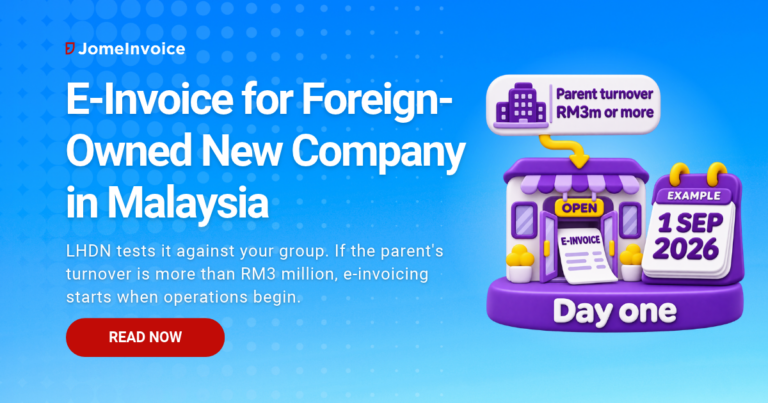
- A subsidiary of a holding company with annual turnover or revenue of at least RM3 million cannot use the exemption for businesses below RM3 million (e-Invoice General Guideline v4.8, 30 August 2026, section 1.6.10(b)). The text does not require the holding company to be Malaysian, so on the guideline’s wording a parent in China, Taiwan or Hong Kong counts.
- A business that starts operating in 2026 or later and does not meet the exemption criteria must issue e-Invoices from 1 July 2026 or its operation commencement date, whichever is later (LHDN (Lembaga Hasil Dalam Negeri Malaysia, the Inland Revenue Board of Malaysia) e-Invoice General FAQs, 4 September 2026, Q14(a)). LHDN’s own example is a new subsidiary that must start on its first day, 1 September 2026.
- Ownership structure decides the answer: a company that holds at least 20% of the shares, or controls the operations directly or indirectly, makes the companies related, while a common individual shareholder or a common director without shares does not (LHDN FAQs, Q103).
- The interim relaxation period to 31 December 2027 in Table 16.1 of the e-Invoice Specific Guideline v4.9 (7 September 2026) names only the 1 January 2026 and 1 July 2026 implementation dates and does not say it covers a later start, so a subsidiary that starts later should not assume it applies.
- Failing to issue an e-Invoice carries a fine of RM200 to RM20,000, imprisonment of up to 6 months, or both, for each offence (Income Tax Act 1967, section 82C(1) read with paragraph 120(1)(d)), and once a business is mandated, a later fall in revenue below RM3 million does not end the obligation (LHDN FAQs, Q104).
A new company in Malaysia that belongs to a China, Taiwan or Hong Kong group must usually issue e-Invoices from the day it starts operating. The small-business exemption does not reach it when its parent or a related company has turnover of at least RM3 million, so its start date is 1 July 2026 or its operation commencement date, whichever is later. Build e-invoicing into the company set-up, not into the first year-end.
This guide is for head-office (HQ) decision-makers and the local finance person in charge (PIC) of a new Malaysian Sdn Bhd (sendirian berhad, a private limited company). For group payments, head-office systems and provider choice, see our hub guide to e-invoicing for China, Taiwan and Hong Kong companies in Malaysia .
When Does a New Company in Malaysia Need to Start e-Invoicing?
A new company that starts operating in 2026 or later must issue e-Invoices from 1 July 2026 or its operation commencement date, whichever is later, unless it can use the exemption for annual turnover or revenue below RM3 million (LHDN FAQs, Q14). A newly set-up subsidiary of a China, Taiwan or Hong Kong group usually cannot use that exemption (see the next section), so if it begins operating after 1 July 2026, its start date is its operation commencement date. The table covers every commencement year.
An e-Invoice is a digital record of a transaction between a supplier and a buyer that is submitted to LHDN for validation through MyInvois, LHDN’s e-Invoice system, before it is shared (General Guideline v4.8, sections 1.1 and 2.3). The table sets out when a new Malaysian company must begin.
| When the Malaysian company began operating | Can it use the RM3 million exemption? | e-Invoice start date | Source (LHDN FAQs) |
|---|---|---|---|
| 2023 to 2025, revenue of at least RM3 million in year of assessment (YA) 2023, 2024 or 2025 | No: above the threshold | 1 July 2026 | Q13(a) |
| 2023 to 2025, revenue below RM3 million, but a carve-out applies (for example a parent with turnover of at least RM3 million) | No | 1 July 2026 | Q13(c) |
| 2023 to 2025, revenue below RM3 million and no carve-out | Yes | Exempt until revenue reaches RM3 million in YA2026 or later; then 1 January of the second year after that YA | Q13(b) |
| 2026 or later, a carve-out applies (the typical new group subsidiary) | No | 1 July 2026 or the operation commencement date, whichever is later | Q14(a) |
| 2026 or later, no carve-out | Yes | Exempt until revenue reaches RM3 million; then 1 January of the second year after that YA | Q14(b) |
Source: LHDN e-Invoice General FAQs (4 September 2026), Q13 and Q14; General Guideline v4.8, section 1.5.
Established businesses follow the phased dates in our guide to e-Invoice implementation dates and the Phase 4 extension to 2028 .
LHDN’s own example matches a new foreign-owned subsidiary closely. Coco Boss Sdn Bhd, on e-Invoice since 1 August 2024, sets up Coco Lock Sdn Bhd on 1 September 2026; Coco Lock begins operating the same day and, because the exemption criteria are not met, must issue e-Invoices from 1 September 2026 (FAQs, Q14(a)). Swap Coco Boss for a manufacturer in Dongguan, an electronics group in Hsinchu or a trading house in Hong Kong, and the logic holds wherever the parent’s turnover passes the section 1.6.10 test.
Commencement date, not incorporation date
The FAQ ties the start to the operation commencement date; in LHDN’s example, incorporation and commencement fall on the same day. Groups from China, Taiwan and Hong Kong may incorporate the Sdn Bhd weeks or months before it trades, while bank accounts, licences and staff are arranged. Record the date operations actually began, with evidence, and confirm the position with your tax adviser where the two dates differ, because the FAQs do not define “operation commencement”.
Invoices issued before a taxpayer’s implementation date do not have to be converted into e-Invoices (General Guideline v4.8, section 1.5).
Does the Parent Company’s Turnover Decide Which Threshold Applies?
Yes, in most group structures. The exemption for annual turnover or revenue below RM3 million (General Guideline v4.8, section 1.6.1(e)) does not apply to a taxpayer that:
- has a non-individual shareholder with annual turnover or revenue of at least RM3 million;
- is a subsidiary of a holding company with annual turnover or revenue of at least RM3 million; or
- has a related company or joint venture (JV) with annual turnover or revenue of at least RM3 million, “related company” having the meaning in section 2 of the Promotion of Investments Act 1986.
Source: General Guideline v4.8, section 1.6.10(a) to (c).
For a foreign-owned entity, the Malaysian company’s own first-year revenue is therefore the wrong place to start. Start with the shareholder register. The table shows how the structures China, Taiwan and Hong Kong groups commonly use play out.
| How the new Malaysian company is owned | Test that applies | Likely outcome |
|---|---|---|
| Directly by the operating parent in China, Taiwan or Hong Kong, with turnover of at least RM3 million | Holding-company and non-individual shareholder carve-outs, section 1.6.10(a) and (b) | Not exempt: start on 1 July 2026 or the commencement date, whichever is later |
| Through an intermediate holding company (for example in Hong Kong) with little turnover of its own | Related-company carve-out, section 1.6.10(c): a company holding at least 20% of the shares, or controlling operations directly or indirectly, makes the companies related (FAQs, Q103(a)) | Not exempt if the controlling parent or any related group company has turnover of at least RM3 million |
| With a corporate investor or JV partner on the share register | Non-individual shareholder and JV tests, section 1.6.10(a) and (c); section 1.6.10(a) sets no minimum shareholding | Not exempt if that shareholder or JV partner has turnover of at least RM3 million |
| Personally by an individual founder, with no corporate shareholder | Carve-outs (a) and (b) do not apply; a common individual shareholder does not make companies related, even where the founder is also a director of both (FAQs, Q103(b) and (d)) | Exempt while its own revenue stays below RM3 million; then 1 January of the second year after the YA in which revenue reaches RM3 million (FAQs, Q14(b)) |
The last row is the common structure in which a new foreign-owned company can wait for its revenue to grow. If the founder later moves the shares into a holding company, re-run the test and agree the start date with your tax adviser.
Our guide to the related-company rules for e-Invoice works through LHDN’s shareholder and director scenarios, and our e-Invoice exemption guide for businesses below RM3 million covers the exemption for independent Malaysian businesses.
Converting a foreign parent’s turnover into ringgit
Section 1.6.10 states the test in ringgit (RM). It does not say how to convert a parent’s turnover reported in renminbi (RMB), New Taiwan dollars (TWD) or Hong Kong dollars (HKD), or which of the parent’s financial years to use. Where the parent’s turnover is close to RM3 million, agree the exchange-rate basis and the year with your tax adviser, apply them consistently, and file the working with your start-date record.
Once mandated, always mandated
No exemption is granted after a taxpayer’s mandatory implementation year has been determined, even if its turnover or revenue later falls below RM3 million (FAQs, Q104). A Malaysian subsidiary of a China, Taiwan or Hong Kong group that is loss-making or low-revenue in its first years should treat its e-invoicing set-up as permanent.
Does the Relaxation Period Cover a Subsidiary That Starts After 1 July 2026?
Not on the guideline’s wording. Table 16.1 of the Specific Guideline v4.9 gives taxpayers with annual turnover or revenue of up to RM5 million an interim relaxation period until 31 December 2027, but it lists only two implementation dates: 1 January 2026 and 1 July 2026. A subsidiary whose start date is its commencement date in, say, October 2026 or March 2027 is not named, and the guideline does not say the relaxation applies to it.
The difference matters most for the recharges a China, Taiwan or Hong Kong parent sends its new Malaysian entity. During the relaxation period, taxpayers may issue consolidated e-Invoices and consolidated self-billed e-Invoices (section 16.2(a) and (b)), and LHDN will not prosecute under section 120 of the Income Tax Act 1967 where they do so (section 16.3). Outside it, consolidation does not apply to self-billed e-Invoices except in the circumstances in section 3.6.5, so from its operation commencement date a subsidiary outside Table 16.1 needs a separate self-billed e-Invoice for each management fee, IT charge or shared-staff recharge from head office (LHDN FAQs, Q76).
| New subsidiary’s start date | Named in Table 16.1? | Planning assumption |
|---|---|---|
| 1 July 2026 (it commenced on or before that date), revenue up to RM5 million | Yes, row 4(ii) | Relaxation until 31 December 2027 |
| A commencement date after 1 July 2026 | No | Full compliance from day one; get written advice before relying on any relaxation |
Our complete LHDN e-Invoice guide for 2026 covers the relaxation concessions and penalties for all taxpayers.
How to Prepare a New Subsidiary for e-Invoicing Before Day One
Seven steps, in this order, take a new China, Taiwan or Hong Kong-owned Sdn Bhd from incorporation to its first validated e-Invoice.
Step 1: Write the start-date record
Record the ownership chain up to the ultimate parent, the turnover of the parent and related companies with the conversion basis, the operation commencement date, and the resulting start date with the FAQ question relied on. Have head office and the Malaysian directors sign it off.
Step 2: Confirm the company’s tax identification number (TIN) and MyTax access
Taxpayers use the MyInvois Portal by logging in to the MyTax Portal, and a business that cannot retrieve its TIN there can register through e-Daftar (General Guideline v4.8, sections 2.3 and 2.3.1; MyTax Portal). Decide which person in Malaysia holds the entity’s access, so submissions do not wait for someone at head office. Our guide to checking a TIN on the MyTax Portal covers the lookup.
Step 3: Choose how e-Invoices will reach MyInvois
MyInvois accepts e-Invoices through its portal, by individual form or spreadsheet batch upload, or through an application programming interface (API), connected directly or through an intermediary technology provider (General Guideline v4.8, sections 2.2 and 2.3.2). For a new entity the real choice is which system produces Malaysian invoices: the group’s enterprise resource planning (ERP) system or a local accounting system. The head-office ERP section of our China, Taiwan and Hong Kong hub compares those setups.
Step 4: Load Malaysian master data before the first sale
A Malaysian e-Invoice needs fields a head-office ERP in China, Taiwan or Hong Kong was not built around, including the buyer’s TIN, the supplier’s Malaysia Standard Industrial Classification (MSIC) code and product classification codes (General Guideline v4.8, Appendix 1). Foreign buyers without a Malaysian TIN use a general TIN, listed in our general TIN code guide . Invoices can stay in RMB, TWD or HKD, with the RM equivalent added only where a legal or tax requirement says so (FAQs, Q25).
Step 5: Set up self-billing for charges from the group
A foreign parent is not required to issue a Malaysian e-Invoice, so a non-exempt Malaysian entity issues a self-billed e-Invoice for goods and services it buys from the parent (Specific Guideline v4.9, sections 8.3(b) and 10.4). Set this up before the first management or IT recharge arrives. An exempt entity does not issue self-billed e-Invoices (FAQs, Q105), and our guide to self-billed e-Invoices for imported services covers the fields and deadlines.
Step 6: Keep an archive in Malaysia’s reach
In the MyInvois portal, Search All Documents retrieves validated documents from the past 2 years, in date ranges of up to 31 days per search (HASiL MyInvois Portal FAQs, Q18 and Q19). Businesses generally need to keep records for 7 years (Income Tax Act 1967, sections 82(1)(a) and 82A(1)) and prosecution can be brought up to 12 years after the offence was committed (Income Tax Act 1967, section 121(1)). Store validated e-Invoices where the Malaysian entity can produce them on request, not only in a head-office system abroad.
Step 7: Brief the directors on liability
For a company, responsibility for e-Invoice compliance rests with its directors as defined in section 2 of the Income Tax Act 1967, and appointing a service provider or representative does not transfer it (FAQs, Q30). The FAQ draws no distinction by where a director lives, so a director appointed from Shenzhen, Taipei or Hong Kong carries the same responsibility as one in Kuala Lumpur.
Which Assumptions Catch Foreign-Owned New Companies Out?
The costliest assumption is that a new, small Malaysian company is exempt when its parent in China, Taiwan or Hong Kong has turnover of at least RM3 million. The table pairs seven such assumptions with the rule that overrides each.
| Assumption at head office | What the rules say | Source |
|---|---|---|
| “We are new and small, so we are exempt.” | Not where the parent, a corporate shareholder or a related company has turnover of at least RM3 million | General Guideline v4.8, section 1.6.10 |
| “Our parent is foreign, so its turnover does not count.” | Section 1.6.10(b) does not limit holding companies to Malaysian ones | General Guideline v4.8, section 1.6.10(b) |
| “Holding the shares through a Hong Kong company resets the test.” | Indirect control by another company still makes companies related | FAQs, Q103(a) |
| “Everyone new starts on 1 July 2026.” | The start is 1 July 2026 or the commencement date, whichever is later | FAQs, Q14(a) |
| “We have until 31 December 2027.” | Table 16.1 names only the 1 January 2026 and 1 July 2026 implementation dates | Specific Guideline v4.9, Table 16.1 |
| “If revenue stays low, we can stop later.” | No exemption once a taxpayer has been mandated | FAQs, Q104 |
| “Head office or the provider carries the liability.” | The Malaysian company’s directors remain responsible | FAQs, Q30 |
How JomeInvoice Helps a New Subsidiary Land Compliant
A new entity has no e-invoicing setup to replace, so the connection can be built into the company set-up rather than retrofitted. JomeInvoice is a Malaysian e-invoicing middleware company headquartered in Kuala Lumpur and backed by AGMO Holdings Berhad, a Bursa Malaysia-listed company. For a subsidiary of a China, Taiwan or Hong Kong group, four points matter:
- Mandarin support alongside Bahasa Malaysia and English, from a Malaysian team with local LHDN expertise and a dedicated enterprise account manager.
- Any ERP or system connects through API, or through a secure file transfer protocol (SFTP) feed where an API is not possible; Kingdee and Yonyou are examples of head-office systems that can be connected this way. Each integration is scoped to the client, and outcome files can be written back to the client’s folder where agreed at onboarding (JomeInvoice docs, automated SFTP feed, accessed 25 November 2026).
- Onshore data hosted on Amazon Web Services (AWS) in Malaysia, archived for 12 years for the duration of the subscription.
- Enterprise go-live in 4 to 8 weeks, subject to change where more complicated or customised solutions are needed.
See our enterprise e-invoicing solution for how the integration is scoped.
Your Malaysian company is new. Your group is not.
LHDN tests a new Malaysian subsidiary against its group, wherever the group is based: where the parent in China, Taiwan or Hong Kong, or a related company, has turnover of at least RM3 million, e-invoicing starts on 1 July 2026 or the day operations begin, whichever is later. Agree the start date in writing with head office, connect the system that will hold the data, and issue the first e-Invoice on day one.
Setting up a Malaysian entity? Land compliant on day one.
Mandarin support, any ERP connected by API or SFTP, and go-live in 4 to 8 weeks, subject to change where more complicated or customised solutions are needed.
Book a Demo Sign Up Free
Disclaimer: This article is for general informational purposes only and does not constitute legal or tax advice. LHDN guidelines are subject to updates. Always refer to the latest official LHDN e-Invoice Guidelines at myinvois.hasil.gov.my and consult a qualified tax professional for advice specific to your business.
Frequently Asked Questions
Does a new company need e-invoice in Malaysia?
Yes, unless it qualifies for the exemption for businesses below RM3 million. A new subsidiary whose parent, corporate shareholder or related company has turnover of at least RM3 million does not qualify [General Guideline v4.8, section 1.6.10].
When does a newly set-up Sdn Bhd of a foreign group start e-invoicing?
1 July 2026 or its operation commencement date, whichever is later, if it cannot use the exemption [LHDN FAQs, Q14(a)]. A subsidiary that commenced in 2023 to 2025 and was not exempt started on 1 July 2026 [Q13(a) and (c)].
Is a new subsidiary exempt if its own revenue is below RM3 million?
No, not if its holding company, a non-individual shareholder, or a related company or joint venture has turnover of at least RM3 million [General Guideline v4.8, section 1.6.10]. Its own revenue decides the start date only when none of those links exists.
Does a parent company in China, Taiwan or Hong Kong count for the RM3 million test?
Yes, on the guideline’s wording. Section 1.6.10(b) refers to a holding company with turnover of at least RM3 million and does not require it to be Malaysian. No conversion method is set, so document the exchange-rate basis with your tax adviser.
Does a new company get the relaxation period until 31 December 2027?
It depends on the start date. Table 16.1 covers taxpayers with revenue up to RM5 million whose implementation date is 1 January 2026 or 1 July 2026 [Specific Guideline v4.9]. A later commencement date is not listed, so plan for full compliance.
Does an exempt new company need to issue self-billed e-invoices?
No. Taxpayers exempt under section 1.6.1 of the e-Invoice Guideline do not need to issue consolidated or self-billed e-Invoices [LHDN FAQs, Q105].
Which date counts for a new company, incorporation or commencement?
The operation commencement date. LHDN’s FAQ compares 1 July 2026 with the date operations commence and takes the later one [Q14(a)]; in its example both dates fall on 1 September 2026. Keep evidence of when operations began.
How long does it take to go live with JomeInvoice?
4 to 8 weeks is JomeInvoice’s typical enterprise go-live, subject to change where more complicated or customised solutions are needed. The main variables are the source system and how much Malaysian master data it already holds.
Last updated: 25 November 2026 | Written by Yinn Sheng Ng, Head of Marketing
References
Based on: e-Invoice Specific Guideline v4.9 (7 September 2026); e-Invoice General Guideline v4.8 (30 August 2026); LHDN e-Invoice General FAQs (4 September 2026). Verified against e-Invoice Specific Guideline v4.9 (7 September 2026) and e-Invoice General Guideline v4.8 (30 August 2026) on 25 November 2026.
- LHDN, e-Invoice General Guideline v4.8 (30 August 2026), sections 1.1, 1.3, 1.5, 1.6.1(e), 1.6.10, 2.2, 2.3, 2.3.1, 2.3.2 and Appendix 1: https://www.hasil.gov.my/wp-content/uploads/IRBM-e-Invoice-Guideline.pdf
- LHDN, e-Invoice Specific Guideline v4.9 (7 September 2026), sections 3.6.5, 8.3(b), 10.4, 16.2, 16.3 and Table 16.1: https://www.hasil.gov.my/wp-content/uploads/IRBM-e-Invoice-Specific-Guideline.pdf
- LHDN, e-Invoice General FAQs (4 September 2026), Q13, Q14, Q25, Q30, Q76, Q103, Q104, Q105: https://www.hasil.gov.my/wp-content/uploads/lhdnm-e-invoice-general-faqs.pdf
- Income Tax Act 1967 (Act 53), sections 2, 82(1)(a), 82A(1), 82C, 120 and 121(1): https://www.hasil.gov.my/wp-content/uploads/20240521-akta-cukai-pendapatan-1967-akta-53.pdf
- LHDN, MyTax Portal: https://mytax.hasil.gov.my
- LHDN, MyInvois portal: https://myinvois.hasil.gov.my