


For many Malaysian businesses, the hardest part of tax filing 2026 is not filling in the form. The real problem starts when proper accounting documents cannot support the numbers.
This is where many business owners get stuck. Sales are recorded, payments are received, and expenses are paid, but the supporting files are incomplete, scattered, or missing. When LHDN, auditors, or accountants ask for documents, the business cannot respond quickly.
That is why tax filing 2026 is not only about tax forms. It is about document readiness, record accuracy, and e-invoice compliance. With Malaysia e invoice requirements expanding across businesses, clean accounting documents matter more than ever. Malaysia’s e-Invoice system supports near real-time validation and storage for B2B, B2C, and B2G transactions, and the implementation timeline has been updated through 2025 and 2026.
If you want smooth tax filing 2026, faster bookkeeping, and fewer compliance risks, this is the list of accounting documents every business in Malaysia should prepare now.
Core accounting documents Malaysia businesses must prepare before tax filing 2026
1. Sales invoices
Sales invoices are one of the most important accounting documents for tax filing 2026. They show the source of your business income.
Your sales invoices should clearly show:
- customer details
- invoice date
- invoice number
- products or services sold
- quantity and value
- payment terms
- tax details where relevant
If your business uses system-generated invoices, Excel billing, POS reports, or ERP billing, make sure every sale can be traced back to a proper record. Under Malaysia e invoice rules, sales data also needs to align with the invoice information submitted or maintained within the required process.
2. Purchase and supplier invoices
Purchase and supplier invoices prove your business’s spending and the cost of goods or services bought.
These accounting documents are important because they support:
- business expenses
- supplier balances
- input cost verification
- stock purchases
- asset purchases
Make sure the supplier invoice matches your purchase order, goods received note, and payment record, where applicable. A mismatch between supplier invoice values and your accounting records creates unnecessary issues during tax filing 2026.
3. Expense receipts
Expense receipts cover day-to-day business spending. These include utility bills, rent, office supplies, travel expenses, parking, tolls, repairs, subscriptions, and other business-related costs.
For Malaysian businesses, missing receipts are one of the most common reasons expenses cannot be supported properly. Every business expense claimed in the accounts should have a receipt, invoice, or payment proof.
If the expense relates to business use, keep the supporting record. If the expense mixes business and personal use, keep a clear breakdown.
4. Bank statements
Bank statements are essential accounting documents because they show the actual movement of money in and out of the business.
They help verify:
- sales collections
- supplier payments
- salary payments
- loan repayments
- Transfers
- cash deposits
- bank charges
Your bank statements should match your accounting ledger. For tax filing 2026, unreconciled bank entries often cause delays because accountants need extra time to identify unknown transactions.
5. Fixed asset lists
A fixed asset list records the long-term assets owned by the company. This includes office equipment, machinery, computers, vehicles, furniture, renovations, and other capital items.
A proper fixed asset record should include:
- date of purchase asset
- description
- Cost
- Supplier
- serial number or reference
- Location
- disposal date if sold or scrapped
This matters for capital allowance claims, asset tracking, and audit support. Without a proper fixed asset list, businesses often miss valid claims or overstate assets.
6. Payroll records
Payroll records cover salaries, wages, allowances, bonuses, commissions, EPF, SOCSO, EIS, PCB, and related employee payments.
For tax filing 2026, payroll accounting documents are important because they support staff cost figures in the accounts and help prove that payroll-related deductions and obligations were recorded properly.
Keep:
- Payslips
- payroll summaries
- employment contracts
- statutory contribution records
- leave and claim records where relevant
7. Inventory lists
If your business holds stock, inventory lists are critical accounting documents.
They help show:
- what stock you have
- how much stock you have
- what stock was sold
- what stock remains at period end
- how stock is valued
This is especially important for trading, retail, wholesale, manufacturing, and e-commerce businesses. Weak inventory records can affect profit accuracy, tax reporting, and year-end accounts.
8. Agreement files
Agreement files include contracts and legal documents linked to the business. These documents are often ignored, but they matter a lot during tax filing 2026.
Important agreement files include:
- rental and lease agreements
- hire purchase agreements
- loan agreements
- supplier contracts
- customer contracts
- service agreements
- franchise or licensing agreements
These accounting documents help explain recurring payments, financing arrangements, deposits, and long-term business commitments.
9. Tax filing files and prior year tax records
Businesses should also keep their own tax filing files properly. This includes prior year tax returns, tax computations, SST files where relevant, correspondence with tax agents, and supporting schedules.
These records help your accountant compare prior treatment, track carry-forward items, and prepare tax filing 2026 more accurately.
How long should Malaysia businesses keep accounting documents
Malaysia requires taxpayers to keep sufficient records for at least 7 years from the end of the year to which the business income relates. Official public rulings from LHDN state this 7-year retention rule clearly.
Also keep in mind that, under the Malaysian Income Tax Act 1967 (Section 121(1)) and related regulations, if LHDN detects e-Invoice non-compliance—such as failure to issue, false information, or poor record-keeping—they can investigate or prosecute records going back up to 12 years.
Read more in our 2026 LHDN e-Invoice Compliance Review Framework guide.
That said, many accountants advise businesses to keep accounting documents longer where needed, especially when there are unresolved tax issues, asset histories, financing records, or long-term supporting documents.
How to prepare accounting documents step by step before tax filing 2026
Step 1. Understand the important accounting documents you need
Start by listing the document categories your business uses every month. Most businesses need sales invoices, supplier invoices, receipts, bank statements, payroll records, asset records, contracts, and tax files.
This first step matters because businesses often assume their accountant already has everything. In reality, the accountant only works with the documents received.
Step 2. Scan and save a soft copy
Do not rely only on paper files. Scan and save a soft copy of all important accounting documents.
Digital copies help with:
- faster sharing with accountants
- easier retrieval during tax filing 2026
- better backup and disaster recovery
- stronger e-invoice compliance workflow
- quicker internal review
If your accounting system supports document attachment or scan upload, use it. The more complete your digital trail, the easier your Malaysia e invoice and tax filing process becomes.
Step 3. Organise and classify the documents properly
Once documents are collected, sort them in a clear system. This reduces bookkeeping time and prevents missing records.
Good document organisation also supports reconciliation. If a sales figure appears in your ledger, you should be able to find the invoice, payment record, and related Malaysia e invoice reference quickly.
Best ways to classify accounting documents for faster tax filing 2026
These methods are practical and easy for Malaysian businesses to apply.
Classify by document type
Create separate folders for:
- Sales
- Purchase
- Bank Statement
- Expenses
- Fixed Assets
- Payroll
- Agreements
- Tax Filing
This is the easiest method for most small and medium businesses. It gives your accountant a cleaner document flow and speeds up tax filing 2026.
Classify by date
Sort files by month or year. For example:
- January 2025
- February 2025
- March 2025
This method works well for recurring items like bank payments, monthly expenses, payroll, and supplier invoices.
Classify by supplier or customer name
For supplier-heavy businesses, alphabetic filing works well. Group invoices by supplier name so documents are easier to trace.
This method is especially useful when your team needs to review repeated purchases, payment disputes, or supplier balances.
Classify by running number or invoice number
For sales invoices, filing by invoice number is often the cleanest approach. It creates a strong audit trail and helps you identify missing or duplicate records faster.
This method also supports e-invoice compliance because invoice sequence and reference control matter when reconciling sales records with Malaysia e invoice data.
How e-Invoice compliance changes document preparation for Malaysia businesses
For tax filing 2026, e-invoice compliance is no longer a side issue. It directly affects how Malaysian businesses prepare accounting documents.
LHDN states that the e-Invoice implementation timeline now includes taxpayers with annual turnover or revenue up to RM5 million from 1 January 2026, while taxpayers with annual turnover or revenue below RM3 million are exempted from e-Invoice implementation under General Guideline v4.8 (30 August 2026), which raised the MSME exemption threshold from RM1 million.
That means your accounting documents now need to support both bookkeeping and digital invoice compliance.
Here is what Malaysia businesses should do:
- make sure sales invoices match reported revenue
- make sure supplier invoices match purchase records
- check customer names, dates, values, and descriptions for consistency
- reconcile bank receipts against invoice records
- keep digital copies of source documents
- maintain a clear audit trail from transaction to supporting file
In short, tax filing 2026, accounting documents, and Malaysia e invoice preparation now sit in the same workflow.
Why accounting documents matter for tax filing 2026 in Malaysia
Good bookkeeping starts with good source documents. Every sales entry, purchase, expense claim, payroll figure, and tax deduction must be backed by records.
For tax filing 2026, accounting documents help Malaysia businesses do three things well. First, they prove that income and expenses are genuine. Second, they help accountants prepare accurate financial statements and tax computations. Third, they reduce problems during LHDN review, audit, or tax investigation.
This matters even more under e-invoice compliance. When your accounting records, bank transactions, and Malaysia e invoice data do not match, the gaps become easier to spot. LHDN’s MyInvois framework and portal are designed to support e-invoicing and transaction management, especially for businesses that are not running a full ERP setup.
In simple terms, no matter how good your accountant is, weak accounting documents will slow down tax filing 2026.
Choosing the Best e-Invoicing Software for Malaysia e-Invoice Compliance
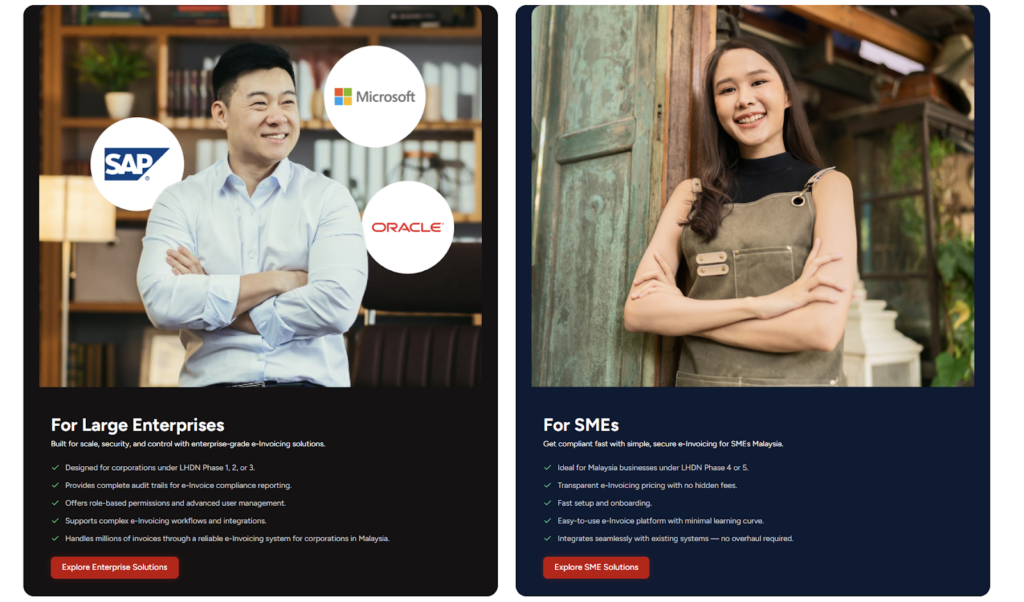
Malaysia e-invoice implementation requires businesses to adopt compliant e-invoice systems.
An effective e-invoice system should support:
• direct integration with the LHDN MyInvois platform via API
• automated invoice validation
• real time invoice submission
• consolidated invoice capability
• audit ready reporting
Using the best e-invoicing software reduces compliance risk and simplifies Malaysia e-invoice implementation.
e-Invoice middleware such as JomeInvoice help businesses connect their accounting system to the Myinvois Portal while maintaining regulatory compliance.
Book a demo with JomeInvoice today!
Learn More About the Best e-Invoice Software for SMEs Malaysia and Large Enterprises – JomeInvoice
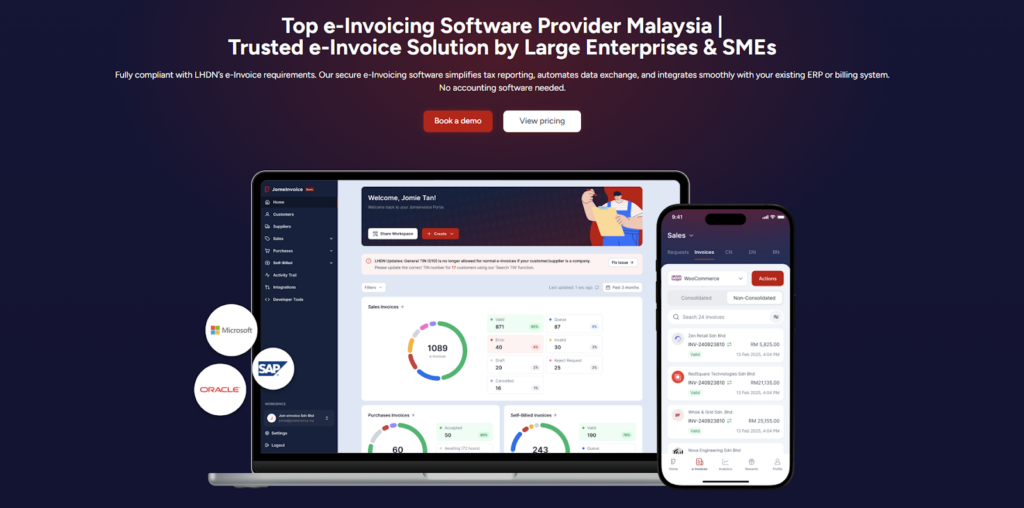
JomeInvoice is widely adopted as one of the best einvoicing software solutions in Malaysia. It is designed to support SMEs and large enterprises across all industries while meeting LHDN e-Invoice requirements with minimal operational disruption.
As a flexible e-Invoice platform for large enterprises and a practical solution for growing businesses, JomeInvoice supports high transaction volumes, complex workflows, and multi-system environments.
One e-Invoice Platform Built for All Business Sizes
JomeInvoice works as the best e-Invoice software for SMEs by offering fast onboarding, simple user interfaces, and automated compliance features. At the same time, it scales into a full e-Invoice platform for large enterprise use, supporting thousands of invoices daily through ERP and system integrations.
Key advantages
• Suitable for SMEs, mid-sized companies, and large enterprises
• Handles low and high invoice volumes efficiently
• Supports consolidated and self-billed e-Invoice workflows
Tailored for Every Industry
JomeInvoice works for a broad range of sectors, including retail, eCommerce, manufacturing, services, and more. It adapts to specific workflows, whether your business runs point-of-sale systems, online stores, or ERP platforms.
Retail e-Invoicing Solution for High-Volume Transactions
For retail businesses, JomeInvoice functions as a complete retail e-Invoicing solution. It supports POS integration, daily sales consolidation, and compliance with the RM10,000 consolidated e-Invoice threshold requirement
Retailers benefit from
• Automated consolidated e-Invoice generation
• POS system integration
• Reduced manual reporting during peak sales periods
e-Invoice for eCommerce and Online Businesses
JomeInvoice also serves as a reliable e-Invoice for eCommerce solution. It integrates with online stores and payment platforms, enabling seamless invoice issuance for high-frequency digital transactions.
eCommerce e-Invoicing features include
• Automated e-Invoice issuance for online sales
• Support for refunds, credit notes, and self-billed e-Invoice
• Compatibility with marketplaces and payment gateways
Enterprise-Grade Integration and Compliance
As a full einvoicing software for large enterprises, JomeInvoice integrates with major ERP systems such as SAP, Oracle NetSuite, Microsoft Dynamics, and other accounting platforms. It connects to the MyInvois system via API integration, minimizing the need for major changes to existing infrastructure.
Enterprise-ready capabilities
• ERP, accounting, and middleware integration
• Pre-validation checks to reduce rejection risks
• Audit trails and reporting for compliance and review
Book a free demo with JomeInvoice now!
See how your business can align with the Malaysia e-invoice guideline, stay prepared for any e-invoice compliance review framework selection, and move ahead of your e-invoice implementation timeline before enforcement tightens.Contact JomeInvoice to help your business stay compliant, reduce manual work, and prepare for full e-Invoice enforcement with confidence.