

Quick Answer:
Director fees require an e-Invoice in Malaysia only when the income is classified as business income. If the director fee is treated as employment income, the income falls under the LHDN e-invoice exemption list. In this case, the company reports the income through payroll, Form E, and Form EA, and no e-Invoicing is required. The key factor is the relationship between the director and the company. This classification determines whether the Malaysia e-invoice rules apply.
Many people ask this question.
Does director salary or director fees require an LHDN e-invoice?
Many readers look at LHDN FAQ No.50 and misunderstand the rule.
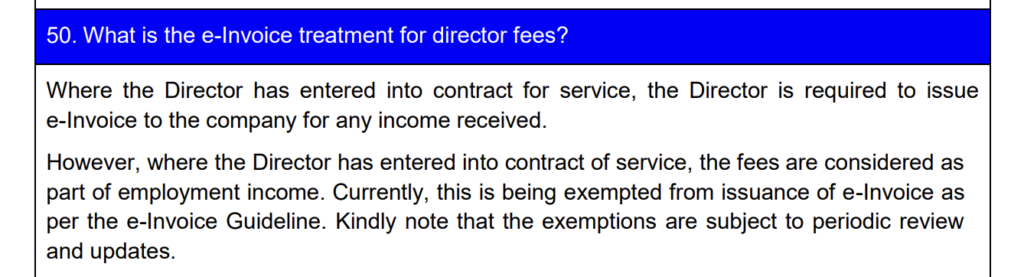
They assume all director fees fall under employment income. That assumption creates compliance mistakes.
If director fees are employment income, the income sits inside the Malaysia e-invoice exemption list. No e-invoice system submission is required.
But exceptions exist. This article explains how to identify the correct category of director fees and when einvoicing applies.
The guide also reviews the Malaysia e-invoice exemption list so businesses understand which income types are excluded from the e-invoice system.
Reference: LHDN e-Invoice Specific Guideline FAQ No.50.
Do Director Fees Require an LHDN e-Invoice in Malaysia
Director fees fall into two possible categories under Malaysian tax law.
Category 1. Employment income
Category 2. Business income
The classification decides whether the Malaysia e-invoice rules apply.
Employment income sits inside the exemption list under LHDN e-invoice guidelines. Business income does not.
This means some director fees require einvoicing while others do not.
Understanding this difference prevents errors when using the Malaysia e-invoice system.
Director Fees Under Contract OF Service in Malaysia (Employment Income)
Contract OF Service means the director works in a structure similar to an employee.
This scenario often applies to executive directors in a Sdn Bhd.
Typical characteristics include:
• The company controls work duties
• The director receives salary through payroll
• EPF and SOCSO contributions exist
• The company issues Form EA
• The company reports payroll under Form E
Under LHDN e-invoice rules, employment income falls under the exemption list.
This means the company does not need to generate an e-invoice through the e-invoice system.
Instead, the income reporting happens through payroll compliance.
In many companies, executive directors receive remuneration through payroll, which is treated as employment income. However, director fees approved by shareholders may be treated differently depending on the structure of the appointment and the actual working relationship..
Director Fees Under Contract FOR Service in Malaysia (Business Income)
Contract FOR Service creates a different relationship.
The director provides professional services rather than employment services.
This arrangement often applies to independent directors or advisory directors.
Key features include:
• The director operates independently
• No employer style control exists
• The director determines work schedule
• The director provides services to multiple companies
In this situation, director fees become business income.
Business income falls outside the Malaysia e-invoice exemption list.
The director or service provider must issue an invoice through the LHDN e-invoice system.
This scenario triggers einvoicing obligations under the Malaysia e-invoice framework.
Executive Director vs Independent Director
Most Sdn Bhd directors in Malaysia act as executive directors.
Executive directors normally fall under employment income because they operate within company management.
Independent Non Executive Directors (INED) work differently.
INED roles often involve:
• governance oversight
• advisory duties
• board level participation
These directors often provide services without a traditional employment structure.
This difference affects whether director fees require einvoicing under Malaysia e-invoice regulations.
Case Law Example: OCP v Ketua Pengarah Hasil Dalam Negeri
A Malaysian tax case – Datuk Oh Chong Peng v KPHDN [2024] MLJU 385, provides a clear example of this classification issue.
The case involved OCP, who served as an Independent Director for several listed companies.
OCP received director fees from these companies.
Instead of reporting the income as employment income, OCP created management companies and reported the income under Section 4(a) of the Income Tax Act as business income.
LHDN challenged the reporting position.
LHDN Argument
LHDN argued the income should fall under Section 4(b) employment income.
Their reasoning included:
• Director fees resemble salary
• Companies issued Form EA to the director
• The payments should follow employment tax rules
Under this argument, the director fees would fall under the Malaysia e-invoice exemption list.
Taxpayer Argument
OCP argued the income was business income.
Key points included:
• Independent directors do not operate as employees
• The companies appoint the director rather than employ the director
• The director provides services across multiple organizations
Under this interpretation, director fees represent business services.
This classification aligns with einvoicing requirements under the LHDN e-invoice system.
High Court Decision
The High Court ruled in favor of the taxpayer and accepted that, based on the facts of the case, the income could be treated as business income under Section 4(a) of the Income Tax Act 1967 rather than employment income under Section 4(b). The court emphasized that independent directors do not automatically become employees of the companies that appoint them.
The relationship lacked the key features of employment.
As a result, the director fees fell under Section 4(a) business income instead of Section 4(b) employment income.
Factors Considered by the Court
The court examined several factors to determine the correct classification.
Important indicators included:
• No employment contract existed
• No EPF and SOCSO contributions existed
• The director controlled working hours
• Companies could not control the director’s activities
• No fixed office or employee infrastructure existed
• No employee ID or employment benefits existed
The court also noted an important point.
Form EA issued by companies does not automatically prove an employment relationship.
This ruling influences how businesses interpret director fees under Malaysia e-invoice compliance.
What This Means for LHDN e-Invoice Compliance
Director fees require careful classification before deciding whether einvoicing applies.
Two outcomes exist.
Scenario 1. Employment income
• Director fees reported through payroll
• Income included in Form E and Form EA
• Income falls under the Malaysia e-invoice exemption list
Scenario 2. Business income
• Director provides services independently
• Income treated as professional or business income
• Invoice submission required through the LHDN e-invoice system
Businesses should evaluate the real working relationship before deciding whether to issue an invoice.
This approach avoids incorrect reporting in the Malaysia e-invoice system.
Malaysia e-Invoice Exemption List Under LHDN Guidelines
The Malaysia e-invoice framework provides a list of exempt income categories.
Reference: LHDN e-Invoice Specific Guideline Section 4.6.
The exemption list includes:
• Employment income
• Pension income
• Alimony
• Dividend distributions in specific circumstances
• Zakat payments
• Securities or derivatives transactions traded on exchanges
• Disposal of shares of companies not listed on stock exchanges in specific conditions
These income types do not require einvoicing submission through the LHDN e-invoice system.
Understanding this list helps businesses avoid unnecessary e-invoice generation.
Director fees in Malaysia do not automatically require an e-Invoice. The correct treatment depends on how the director operates:
- Contract OF Service – employment income → falls under the e-Invoice exemption list
- Contract FOR Service – business income → may require e-Invoice submission
Businesses should review the director’s working relationship before deciding on invoice issuance.
Choosing the Best e-Invoicing Software for Malaysia e-Invoice Compliance
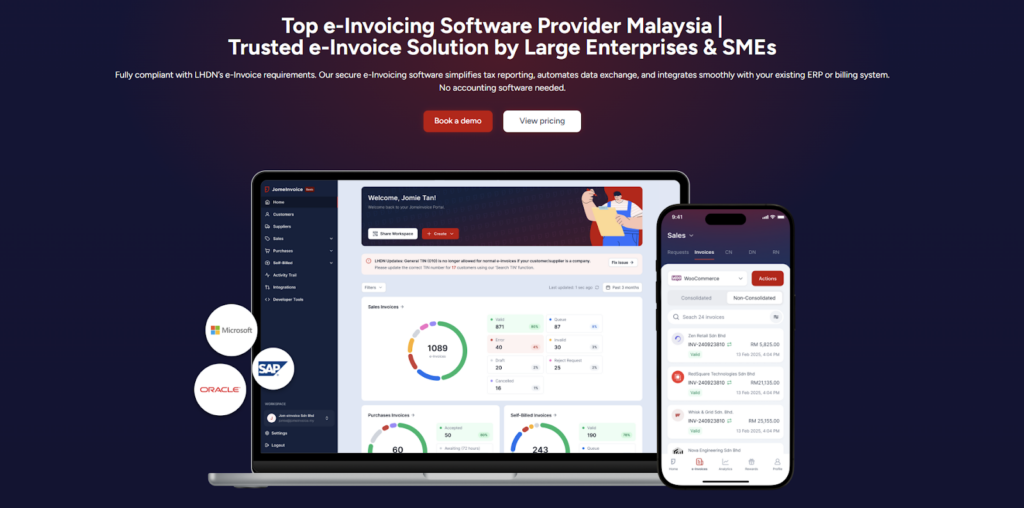
Malaysia e-invoice implementation requires businesses to adopt compliant e-invoice systems.
An effective e-invoice system should support:
• direct integration with the LHDN MyInvois platform via API
• automated invoice validation
• real time invoice submission
• consolidated invoice capability
• audit ready reporting
Using the best e-invoicing software reduces compliance risk and simplifies Malaysia e-invoice implementation.
e-Invoice middleware such as JomeInvoice help businesses connect their accounting system to the Myinvois Portal while maintaining regulatory compliance.
Book a demo with JomeInvoice today!
Key Takeaway for Director Fees and Malaysia e-Invoice
Director fees do not follow a single rule.
The correct classification determines whether the Malaysia e-invoice system applies.
Employment income remains exempt from einvoicing under the LHDN guidelines.
Business income may require invoice submission through the LHDN e-invoice platform.
Before issuing or skipping an invoice, businesses should confirm whether the director operates under Contract OF Service or Contract FOR Service.
This simple step prevents mistakes and ensures compliance with the Malaysia e-invoice framework.
Learn More About the Best e-Invoice Software for SMEs Malaysia and Large Enterprises – JomeInvoice
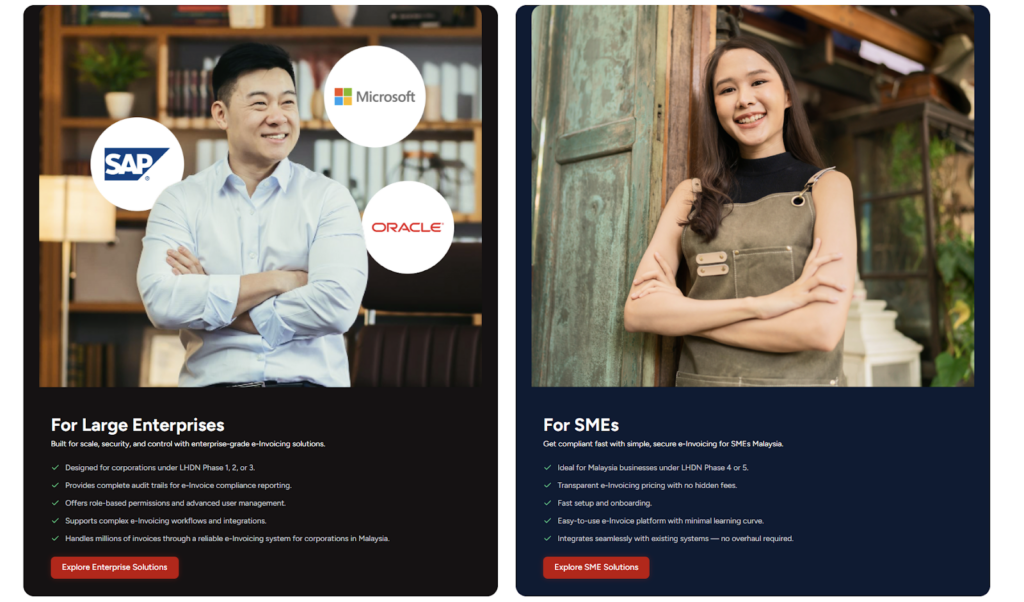
JomeInvoice is widely adopted as one of the best einvoicing software solutions in Malaysia. It is designed to support SMEs and large enterprises across all industries while meeting LHDN e-Invoice requirements with minimal operational disruption.
As a flexible e-Invoice platform for large enterprises and a practical solution for growing businesses, JomeInvoice supports high transaction volumes, complex workflows, and multi-system environments.
One e-Invoice Platform Built for All Business Sizes
JomeInvoice works as the best e-Invoice software for SMEs by offering fast onboarding, simple user interfaces, and automated compliance features. At the same time, it scales into a full e-Invoice platform for large enterprise use, supporting thousands of invoices daily through ERP and system integrations.
Key advantages
• Suitable for SMEs, mid-sized companies, and large enterprises
• Handles low and high invoice volumes efficiently
• Supports consolidated and self-billed e-Invoice workflows
Tailored for Every Industry
JomeInvoice works for a broad range of sectors, including retail, eCommerce, manufacturing, services, and more. It adapts to specific workflows, whether your business runs point-of-sale systems, online stores, or ERP platforms.
Retail e-Invoicing Solution for High-Volume Transactions
For retail businesses, JomeInvoice functions as a complete retail e-Invoicing solution. It supports POS integration, daily sales consolidation, and compliance with the RM10,000 consolidated e-Invoice threshold requirement
Retailers benefit from
• Automated consolidated e-Invoice generation
• POS system integration
• Reduced manual reporting during peak sales periods
e-Invoice for eCommerce and Online Businesses
JomeInvoice also serves as a reliable e-Invoice for eCommerce solution. It integrates with online stores and payment platforms, enabling seamless invoice issuance for high-frequency digital transactions.
eCommerce e-Invoicing features include
• Automated e-Invoice issuance for online sales
• Support for refunds, credit notes, and self-billed e-Invoice
• Compatibility with marketplaces and payment gateways
Enterprise-Grade Integration and Compliance
As a full einvoicing software for large enterprises, JomeInvoice integrates with major ERP systems such as SAP, Oracle NetSuite, Microsoft Dynamics, and other accounting platforms. It connects to the MyInvois system via API integration, minimizing the need for major changes to existing infrastructure.
Enterprise-ready capabilities
• ERP, accounting, and middleware integration
• Pre-validation checks to reduce rejection risks
• Audit trails and reporting for compliance and review
Book a free demo with JomeInvoice now!
See how your business can align with the Malaysia e-invoice guideline, stay prepared for any e-invoice compliance review framework selection, and move ahead of your e-invoice implementation timeline before enforcement tightens.Contact JomeInvoice to help your business stay compliant, reduce manual work, and prepare for full e-Invoice enforcement with confidence.