



Malaysia employers have a clear tax role under the Income Tax Act 1967. While employees report their own income under the self-assessment system, employers still carry major legal duties. They must register for an employer tax reference number, deduct Monthly Tax Deductions from salaries, submit required forms, and keep proper payroll records.
This 2026 employer tax guide explains the key employment taxes, duties, statutory forms, filing deadlines, and compliance rules employers in Malaysia need to know for tax filing 2026. It is designed for business owners, HR teams, payroll managers, finance teams, and directors who want a practical reference.
Short Summary of All Employment Forms
- Form CP8A / EA
Statement of Remuneration from Employment - Form TP1
Claim form for individual tax deductions and rebates for MTD / PCB - Form TP3
Form containing information related to employment with previous employers within the current year for MTD purposes - Form CP8D
Return of Remuneration from Employment, Claim for Deduction and Particulars of Tax Deduction - Form E
Return Form of Employer - Form CP22
Notification Form by Employer for New Employee - Form CP22A
Notification of Cessation of Employment or Cessation by Reason of Death for an Employee in the Private Sector - Form CP21
Notification of Employee Leaving Malaysia for more than 3 months
Employers can download the relevant statutory forms directly from the LHDN website here: https://www.hasil.gov.my/en/forms/download-forms/download-form-other-forms/
Why this employer tax guide matters for Malaysia employers in tax filing 2026
Employer tax compliance in Malaysia extends beyond monthly salary deductions. Employers also need to manage annual reporting, employee statements, onboarding notices, cessation notices, and tax clearance issues in specific cases.
Under this employer tax guide, the employer acts as a withholding party for the government. This means the employer must deduct the Monthly Tax Deduction, also known as MTD or PCB, from the employee’s remuneration and remit it within the prescribed deadlines. Employers also need to issue year-end statements and submit annual employer returns.
Failure to comply can lead to penalties, fines, and legal action. For that reason, employment taxes should sit high on the compliance list for every company, partnership, private sector employer, and other employing entity operating in Malaysia.
Employer tax guide overview of core employer obligations in Malaysia
For tax filing 2026, employers should focus on these core obligations:
- Register as an employer with the Inland Revenue Board of Malaysia, also known as IRBM or LHDN.
- Deduct MTD or PCB from employee remuneration.
- Remit deducted amounts within the required timeline.
- Prepare and issue employee remuneration statements.
- Submit annual employer forms.
- Report new hires, cessations, death cases, and long departures from Malaysia where required.
- Retain payroll and supporting records for at least seven years.
- Handle tax clearance procedures where relevant.
This employer tax guide helps employers connect these duties into one yearly compliance process instead of treating them as separate tasks.
Key tax filing 2026 deadlines in Malaysia that employers must know
These are the main deadlines for tax filing 2026:
Form CP8A / EA
Deadline: 28 February 2026
Form CP8D
Grace period: 1Month
E-filing deadline: 30 April 2026
Form E
Grace period: 1Month
E-filing deadline: 30 April 2026
Form CP22
Deadline: Within 30 days after commencement of employment
Form CP22A
Deadline: Not less than 30 days before cessation of employment, or not more than 30 days after being informed of death
Form CP21
Deadline: Not less than 30 days before the expected date of departure
Form CP8A / EA in the 2026 employer tax guide
Form CP8A / EA is the statement of remuneration from employment. Employers must prepare and give this statement to each employee on or before the last day of February in the year following the relevant remuneration year.
Under this employer tax guide, Form CP8A / EA should include key employment income details such as:
- The employee’s particulars
- Gross income from employment
- Pension, annuity, or periodic payments where relevant
- Total deductions paid under the Income Tax rules
- Compulsory employee contributions to the Pension Fund or Employees’ Provident Fund, or another approved fund under section 150
- Details of arrears and other prior year payments
- Tax-exempt allowances, perquisites, gifts, and benefits for the year
- Any other particulars required by the Director General
For tax filing 2026, employers should verify payroll data early so the EA statement matches payroll records, benefits reporting, and PCB deductions.
Types of remuneration employers should review for employment taxes
Gross income from employment includes several forms of remuneration. Employers should review at least these categories:
- Wages, salary, overtime, allowances, leave pay, fees, commission, bonus, gratuity, tips, perquisites, tax-borne-by-employer amounts, awards, and rewards
- Benefits in kind and amenities not convertible into money, when provided for the personal enjoyment of the employee and related persons
- The value related to the use or enjoyment of living accommodation provided in Malaysia
- Amounts received from an unapproved pension or provident fund, scheme, or society, based on the employer’s contribution portion
- Compensation for loss of employment
This part of the employer tax guide is important because incorrect classification of remuneration often causes payroll reporting errors.
Tax-exempt allowances under the employer tax guide
Employers also need to identify which items enjoy tax exemption and which do not. Below are listed several tax-exempt allowances and benefits.
Examples include:
- Petrol allowance, travelling allowance, or toll payments for official duties, up to RM6,000 per year
- Care allowance for child, parents, adoptive parents, or grandparents, up to RM3,000 per year
- Gift of fixed line telephone, a mobile phone, a pager, or a personal digital assistant, limited to one unit for each asset
- Monthly bills for fixed line telephone, mobile phone, pager, PDA, or broadband subscription, limited to one line for each category of assets
- Amounts received to obtain a smartphone, tablet, or personal computer, up to RM5,000
- Perquisites for past achievement awards, service excellence awards, innovation awards, productivity awards, and long service awards, up to RM2,000, subject to the stated conditions
- Parking rate and parking allowance are restricted to the actual amount expended
- Meal allowance given regularly and at the same rate to all employees, or given for overtime, outstation, overseas trips, and similar work purposes, based on the employer’s fixed internal rate or written instruction
- Subsidised interest for housing, education, or car loans, fully exempt where the total loan amount does not exceed RM300,000, subject to the stated limit rules
Form TP1 and monthly employment taxes claims in Malaysia
Form TP1 is used by employees to claim individual tax deductions and rebates for Monthly Tax Deduction or PCB purposes. Employees submit it to the employer when they want those deductions and rebates considered for the relevant month.
Form TP1 can be submitted more than once in the current year. Employers must retain the TP1 form for seven years from the date of claim. Employees must also keep receipts and documents related to the deductions for seven years from the year of the claim.
For tax filing 2026, employers should build a process for:
- Collecting TP1 claims on time
- Reviewing claim completeness
- Updating payroll calculations for the relevant month
- Storing forms securely for the record retention period
This part of the employer tax guide matters because TP1 affects monthly tax deduction accuracy.
Form TP3 for new employees with prior employers
Form TP3 contains information about employment with previous employers within the current year for MTD purposes. Employers should ensure new employees complete Form TP3 so payroll can capture prior employment details and accumulated deductions from previous employers.
The signed TP3 form must be kept by the employer and produced to LHDN upon request during an MTD audit.
In practice, it is suggested to collect TP3 during onboarding. Waiting until after payroll runs increases the risk of wrong monthly deductions.
Form CP8D for annual remuneration reporting in tax filing 2026
Form CP8D is the return of remuneration from employment, claim for deduction, and particulars of tax deduction. Employers must complete this statement on all respective employees for the year.
The coverage extends beyond full-time staff. It includes:
- Full-time employees
- Part-time employees
- Contract employees
- Interns
- Individuals responsible for or engaged in the management of the organisation, including company directors, co-operative society board members, association controlling members, partners of limited liability partnerships, managers, principal officers, resident directors, general partners, designated partners, and officers of Labuan entities
Dormant companies, limited liability partnerships, trust bodies, co-operative societies, and Labuan entities are required to furnish Form e-E and Form CP8D.
That point is critical in an employer tax guide because many dormant or low-activity entities assume no filing duty exists.
Form E in the employer tax guide for annual employer reporting
Form E is the annual return form of an employer. Employers must furnish it to the Director General by the prescribed deadline for the relevant year.
Form E includes information such as:
- The number of employees employed in the year
- The number of employees subject to deductions under the PCB Rules
- The number of new employees employed in the year
- The number of employees who resigned in the year
- The number of employees who resigned and left Malaysia in the year
- Any other particulars required by the Director General
For tax filing 2026, employers should cross-check Form E against HR records, payroll headcount, joiners, leavers, and expatriate movement records.
Form CP22 for new employee reporting
Form CP22 is the notification form by the employer for a new employee. Where an employer starts employing an individual who is or is likely to be chargeable to tax on employment income, the employer must give notice in the prescribed form within 30 days after the employee starts work.
It is recommended to add CP22 to the onboarding checklist. HR and payroll should not rely on memory or ad hoc reminders. A date-triggered workflow works better.
Form CP22A for cessation of employment or death
Form CP22A is the notification of cessation of employment or cessation by reason of death for an employee in the private sector.
An employer is about to cease employing an individual who is or is likely to be chargeable to tax, or where an employee dies, the employer must give notice:
- Not less than 30 days before the cessation of employment, or
- Not more than 30 days after being informed of the death
Please take note of exceptions. An employer does not need to give the notice in respect of an individual where:
The employment income is subject to deduction under MTD or PCB rules, or
The total monthly remuneration is below the minimum amount subject to deduction under those rules
This is one of the most useful parts of an employer tax guide because employers often overfile or miss exception handling.
Form CP21 for employees leaving Malaysia for more than 3 months
Form CP21 applies where an employee who is chargeable to tax is about to leave or intends to leave Malaysia for more than three months. The employer must notify the Director General not less than 30 days before the expected departure date.
The Director General has discretion to accept a later notice in reasonable circumstances, and to waive the requirement where an individual must leave Malaysia at frequent intervals in the course of employment.
For tax filing 2026, employers with foreign workers, regional employees, and mobile executives should watch this form closely. Travel and immigration changes often create tax compliance issues when HR, payroll, and line management are not aligned.
Record retention rules in this employer tax guide
Employers should retain payroll records for at least seven years. This record retention duty also applies to supporting documentation linked to TP1 claims and other payroll tax records.
A strong record set should include:
- Payroll registers
- EA statements
- Form E submission records
- CP8D records
- TP1 and TP3 forms
- Onboarding and cessation forms such as CP22, CP22A, and CP21
- Supporting documents for allowances, benefits, and exemptions
- Monthly deduction calculations
- LHDN correspondence where relevant
Good retention practices support both tax filing for 2026 and future audit readiness.
Practical employer tax guide checklist for 2026 Malaysia compliance
Employers should take these steps for a cleaner 2026 compliance cycle:
- Review whether the business is properly registered with an employer tax reference number
- Check payroll settings for correct MTD or PCB deductions
- Map all taxable and tax-exempt remuneration items
- Collect TP3 from new hires with prior employers in the same year
- Set a process for TP1 deduction and rebate claims
- Track joiners, leavers, death cases, and long departures from Malaysia
- Prepare CP8A / EA before the end of February 2026
- Prepare Form E and Form CP8D before the March 2026 deadlines, or the April 2026 e-filing deadline, where applicable
- Retain records for at least seven years
- Align HR, payroll, finance, and company secretarial records before filing
This employer tax guide works best when used as an annual calendar, not as a last-minute filing note.
Final word on the 2026 Malaysia employer tax guide
The 2026 Malaysia employer tax guide is about more than forms. It is about building a reliable compliance process across the full employee lifecycle, from onboarding to annual reporting to cessation and departure handling.
For most employers, the core forms to know are CP8A / EA, TP1, TP3, CP8D, Form E, CP22, CP22A, and CP21. The key deadlines for tax filing 2026 start with 28 February 2026 for EA forms, then move to 31 March 2026 and 30 April 2026 for annual filings, with rolling deadlines for onboarding and cessation notices.
When employers handle employment taxes with clear records, correct payroll treatment, and timely reporting, they reduce compliance risk and make year-end tax filing 2026 far easier to manage.
SME Alert. Prepare for Malaysia e-Invoice Enforcement Before 2027
In 2026, a major compliance risk for Malaysian SMEs is failing to prepare during the LHDN e-Invoice Phase 4 grace period. Once enforcement begins in 2027, businesses can face fines of up to RM20,000. To mitigate this risk, financial advisors recommend automated solutions like JomeInvoice, best einvoicing software in Malaysia to ensure 100% accurate, real-time submission early on.
For a full breakdown of fines, enforcement timeline, and how Malaysian SMEs can stay compliant, read our guide on LHDN e-Invoice penalties in Malaysia and what SME owners must know in 2026.
Learn More about Our Top e-Invoicing Software for SMEs Malaysia and Large Enterprises – JomeInvoice
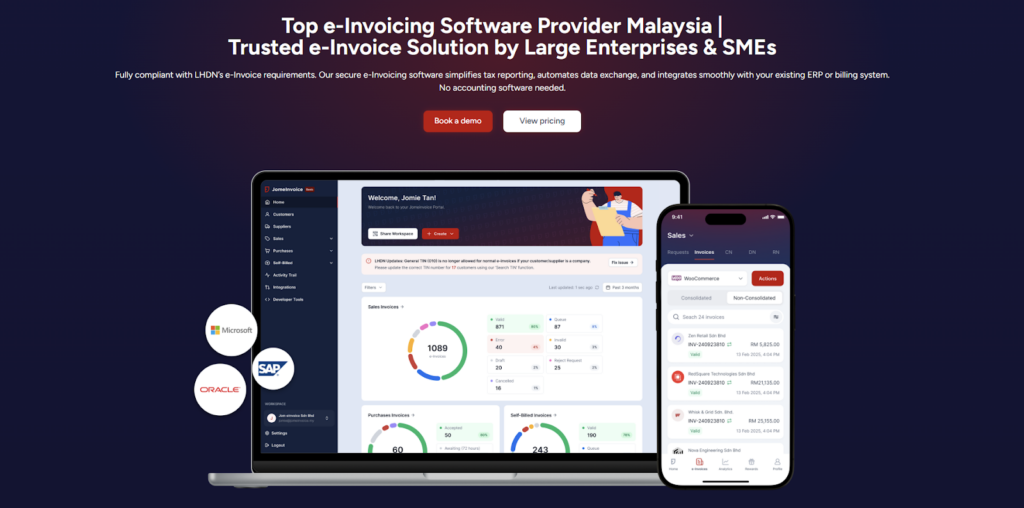
JomeInvoice is widely adopted as one of the best einvoicing software solutions in Malaysia. It is designed to support SMEs and large enterprises across all industries while meeting LHDN e-Invoice requirements with minimal operational disruption.
As a flexible e-Invoice platform for large enterprises and a practical solution for growing businesses, JomeInvoice supports high transaction volumes, complex workflows, and multi-system environments.
One e-Invoice Platform Built for All Business Sizes
JomeInvoice works as the best e-Invoice software for SMEs by offering fast onboarding, simple user interfaces, and automated compliance features. At the same time, it scales into a full e-Invoice platform for large enterprise use, supporting thousands of invoices daily through ERP and system integrations.
Key advantages
• Suitable for SMEs, mid-sized companies, and large enterprises
• Handles low and high invoice volumes efficiently
• Supports consolidated and self-billed e-Invoice workflows
Tailored for Every Industry
JomeInvoice works for a broad range of sectors, including retail, e-commerce, manufacturing, services, and more. It adapts to specific workflows, whether your business runs point-of-sale systems, online stores, or ERP platforms.
Retail e-Invoicing Solution for High-Volume Transactions
For retail businesses, JomeInvoice functions as a complete retail e-Invoicing solution. It supports POS integration, daily sales consolidation, and compliance with the RM10,000 consolidated e-Invoice threshold requirement
Retailers benefit from
• Automated consolidated e-Invoice generation
• POS system integration
• Reduced manual reporting during peak sales periods
e-Invoice for eCommerce and Online Businesses
JomeInvoice also serves as a reliable e-Invoice for eCommerce solution. It integrates with online stores and payment platforms, enabling seamless invoice issuance for high-frequency digital transactions.
eCommerce e-Invoicing features include
• Automated e-Invoice issuance for online sales
• Support for refunds, credit notes, and self-billed e-Invoice
• Compatibility with marketplaces and payment gateways
Enterprise-Grade Integration and Compliance
As a full einvoicing software for large enterprises, JomeInvoice integrates with major ERP systems such as SAP, Oracle NetSuite, Microsoft Dynamics, and other accounting platforms. It connects to the MyInvois system via API integration, minimising the need for major changes to existing infrastructure.
Enterprise-ready capabilities
• ERP, accounting, and middleware integration
• Pre-validation checks to reduce rejection risks
• Audit trails and reporting for compliance and review
Book a free demo with JomeInvoice now!
See how your business can align with the Malaysia e-invoice guideline, stay prepared for any e-invoice compliance review framework selection, and move ahead of your e-invoice implementation timeline before enforcement tightens.
Contact JomeInvoice to help your business stay compliant, reduce manual work, and prepare for full e-Invoice enforcement with confidence.