Malaysia’s e-Invoice rollout has changed how businesses issue invoices, receipts, and self-billed documents. Under the Inland Revenue Board of Malaysia, or IRBM, the e-invoice system supports near real-time validation for B2B, B2C, and B2G transactions. The implementation is phased by annual turnover, starting from 1 August 2024 for taxpayers above RM100 million, then expanding in later phases.
For many businesses, the biggest practical issue is this. The e-Invoice implementation process is not the same during the grace period and after the grace period ends.
That difference affects:
- whether consolidated e-Invoice is allowed
- what goes into the product or service description
- whether a customer request must be fulfilled immediately
- whether self-billed e-Invoice can be consolidated
If you are handling e invoicing Malaysia for your business, this is one of the most important distinctions to understand. It also affects how you set up your accounting flow, staff SOP, and einvoicing software.
e-Invoice implementation in Malaysia: what the grace period changes
The official guideline allows a temporary interim relaxation period. During this period, taxpayers are allowed to:
- issue consolidated e-Invoice for all activities and transactions, including sectors normally restricted from consolidation
- issue consolidated self-billed e-Invoice for all self-billed circumstances
- enter any information in the Description of Product or Service field for consolidated documents
- avoid issuing an individual e-Invoice or individual self-billed e-Invoice even when the buyer or supplier asks for one, as long as the taxpayer complies with the consolidation rules during the relaxation period
This is why the grace period matters so much in e invoice Malaysia. It gives businesses time to adapt their e-invoice system before stricter transaction-by-transaction compliance applies.
e-Invoicing Malaysia: Difference 1, consolidated e-Invoice rules are much wider during the grace period
With the grace period
During the interim relaxation period, businesses can issue consolidated e-Invoice for all activities and transactions, including sectors that are otherwise excluded from consolidation.
In practical terms, this means businesses in industries such as automotive, aviation, and construction get temporary flexibility. It also means transactions that would normally require one e-Invoice per transaction can be grouped into a monthly consolidated e-Invoice during the grace period, based on the transcript and the official relaxation rule.
That said, businesses should still check whether any phase-specific or sector-specific exception applies. For example, according to IRBM’s 5 January 2026 media statement, which stated that transactions above RM10,000, or transactions where the buyer requests an e-Invoice, must still be issued individually. For more detail, read our guide on the RM10,000 e-Invoice rule in Malaysia.
Without the grace period
After the grace period ends, the normal rules return. At that stage, some industries and some transaction types must issue e-Invoice one by one, instead of using a consolidated approach. The transcript highlights this as the first major operational difference, and the official guideline confirms that the broader consolidation treatment is part of the interim relaxation only.
For businesses using einvoicing software, this affects system setup immediately. During the grace period, the workflow can be monthly and grouped. After the grace period, the workflow may need to become transaction-based for certain sales.
e-Invoice Malaysia: Difference 2, the Description of Product or Service field is handled differently
With the grace period
This is one of the biggest compliance reliefs.
During the interim relaxation period, taxpayers can input any information or details in the Description of Product or Service field for a consolidated e-Invoice or consolidated self-billed e-Invoice. They are not restricted to listing receipt numbers, statement numbers, or bill reference numbers.
That means a simple description such as:
“Total sales for January”
may be enough for a consolidated submission during the grace period, as described in the video transcript.
Without the grace period
Outside the grace period, the normal detailed rule applies. For consolidated documents, the business is expected to include the relevant receipt, statement, or bill reference numbers as required under the guideline.
This changes the amount of detail your team must prepare. It also changes what your e-invoice system or einvoicing software must capture from POS, billing, or ERP records.
For businesses with high transaction volume, this is a major process difference. A simple monthly summary during the grace period becomes a more detailed compliance exercise after the grace period ends.
e-Invoice implementation: Difference 3, customer requests do not trigger the same action during the grace period
With the grace period
During the interim relaxation period, taxpayers do not need to issue an individual e-Invoice or individual self-billed e-Invoice even if the buyer or supplier requests one, provided the taxpayer is complying through consolidated issuance under the relaxation terms.
This matches the transcript clearly. If a customer asks for an e-Invoice during the grace period, the business can still issue the normal receipt or invoice first, then include the transaction in a consolidated e-Invoice later.
Without the grace period
Once the grace period ends, the relaxation no longer applies. The business must follow the standard e-Invoice implementation rules. In practice, that means a request for an e-Invoice may require individual issuance based on the normal transaction rules.
This is where many businesses get caught off guard. Front desk staff, finance teams, and sales teams may think the grace period workflow is permanent. It is not. The official guideline frames this as temporary relief to support transition.
e-Invoicing Malaysia: Difference 4, self-billed e-Invoice can be consolidated during the grace period
With the grace period
The transcript points out a major benefit here. During the interim relaxation period, taxpayers can issue consolidated self-billed e-Invoice for all self-billed circumstances outlined in the guideline.
This matters for situations such as payments to foreign suppliers or other self-billed cases. Instead of preparing one self-billed e-Invoice for every single transaction, businesses can group the month’s transactions into one consolidated self-billed e-Invoice during the grace period.
The guideline also states that consolidated self-billed e-Invoice should be submitted on a monthly basis within seven calendar days after month end.
Without the grace period
After the grace period, businesses must go back to the normal self-billed e-Invoice rules. In many cases, that means issuing documents transaction by transaction unless the situation falls under a normal consolidation rule outside the temporary relaxation.
This has a direct impact on workload. If your finance team handles many cross-border services or self-billed scenarios, your einvoicing software and month-end closing process must be ready for a tighter workflow after the relaxation period.
Why this matters for your e-invoice system and einvoicing software
The difference between grace period rules and normal rules is not small. It affects data collection, timing, document structure, and customer handling.
A business that relies on manual work during the grace period may face problems later if its e-invoice system is not ready for stricter compliance.
Your internal setup should cover:
- individual versus consolidated issuance logic
- customer request handling
- receipt and invoice number mapping
- self-billed transaction tagging
- month-end cut-off and submission timeline
- product and service description formatting
This is why many companies in e invoicing Malaysia are reviewing whether their current accounting platform is enough, or whether they need dedicated einvoicing software that connects with MyInvois and supports IRBM validation workflows. The official system is built around near real-time validation and storage, so process readiness matters as much as tax knowledge.
e-Invoice Malaysia compliance takeaway
The grace period is not a free pass. It is a transition window.
That is the key message from the transcript, and it aligns with the official guideline. The relaxation period gives businesses room to adapt, simplify descriptions, use broader consolidated e-Invoice treatment, and reduce pressure from immediate individual requests. But once the grace period ends, the normal e-Invoice implementation rules apply again.
Businesses should use this period to:
- review current invoicing workflows
- map transactions that will later require individual issuance
- configure the right e-invoice system
- train finance and customer-facing teams
- test einvoicing software before stricter compliance begins
Final thoughts on e-Invoice implementation in Malaysia
The biggest mistake businesses make is assuming the grace period process is the permanent process.
It is not.
In e invoice Malaysia, the workflow with the grace period is more flexible. The workflow without the grace period is more detailed, more structured, and in some cases much stricter.
If your business is still relying on manual month-end consolidation without planning for the next stage, now is the time to fix that. To make the transition easier, many businesses are moving to a reliable e-invoice system like JomeInvoice, best einvoicing software for both SMEs and large enterprises in Malaysia, which helps streamline compliance, improve accuracy, and support smoother e invoicing Malaysia workflows.
Book a free demo with JomeInvoice now!
Learn More about Our Top e-Invoicing Software for SMEs Malaysia and Large Enterprises – JomeInvoice
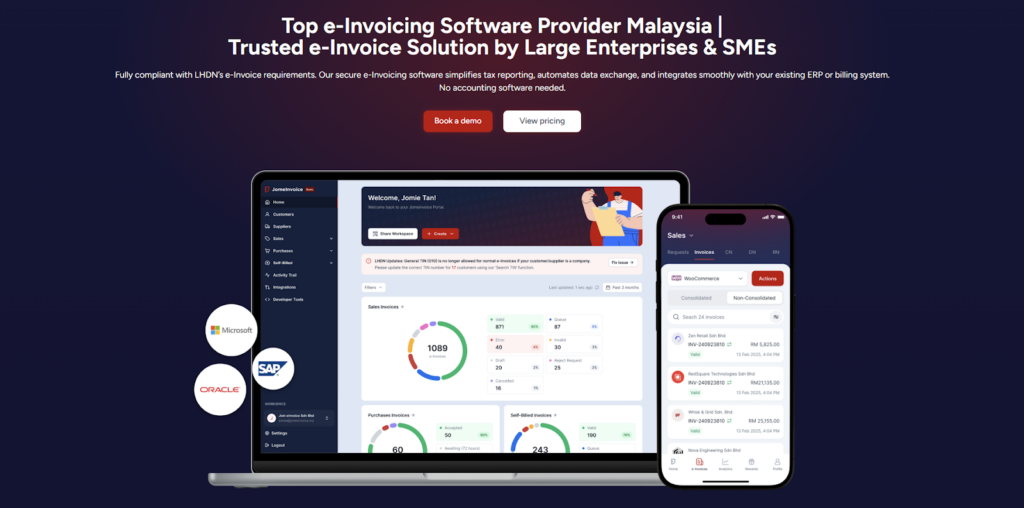
JomeInvoice is widely adopted as one of the best einvoicing software solutions in Malaysia. It is designed to support SMEs and large enterprises across all industries while meeting LHDN e-Invoice requirements with minimal operational disruption.
As a flexible e-Invoice platform for large enterprises and a practical solution for growing businesses, JomeInvoice supports high transaction volumes, complex workflows, and multi-system environments.
One e-Invoice Platform Built for All Business Sizes
JomeInvoice works as the best e-Invoice software for SMEs by offering fast onboarding, simple user interfaces, and automated compliance features. At the same time, it scales into a full e-Invoice platform for large enterprise use, supporting thousands of invoices daily through ERP and system integrations.
Key advantages
• Suitable for SMEs, mid-sized companies, and large enterprises
• Handles low and high invoice volumes efficiently
• Supports consolidated and self-billed e-Invoice workflows
Tailored for Every Industry
JomeInvoice works for a broad range of sectors, including retail, eCommerce, manufacturing, services, and more. It adapts to specific workflows, whether your business runs point-of-sale systems, online stores, or ERP platforms.
Retail e-Invoicing Solution for High-Volume Transactions
For retail businesses, JomeInvoice functions as a complete retail e-Invoicing solution. It supports POS integration, daily sales consolidation, and compliance with the RM10,000 consolidated e-Invoice threshold requirement
Retailers benefit from
• Automated consolidated e-Invoice generation
• POS system integration
• Reduced manual reporting during peak sales periods
e-Invoice for eCommerce and Online Businesses
JomeInvoice also serves as a reliable e-Invoice for eCommerce solution. It integrates with online stores and payment platforms, enabling seamless invoice issuance for high-frequency digital transactions.
eCommerce e-Invoicing features include
• Automated e-Invoice issuance for online sales
• Support for refunds, credit notes, and self-billed e-Invoice
• Compatibility with marketplaces and payment gateways
Enterprise-Grade Integration and Compliance
As a full einvoicing software for large enterprises, JomeInvoice integrates with major ERP systems such as SAP, Oracle NetSuite, Microsoft Dynamics, and other accounting platforms. It connects to the MyInvois system via API integration, minimizing the need for major changes to existing infrastructure.
Enterprise-ready capabilities
• ERP, accounting, and middleware integration
• Pre-validation checks to reduce rejection risks
• Audit trails and reporting for compliance and review
Book a free demo with JomeInvoice now!
See how your business can align with the Malaysia e-invoice guideline, stay prepared for any e-invoice compliance review framework selection, and move ahead of your e-invoice implementation timeline before enforcement tightens.Contact JomeInvoice to help your business stay compliant, reduce manual work, and prepare for full e-Invoice enforcement with confidence.