

Malaysia e-invoice implementation rules are now part of daily business operations. Many business owners still feel confused about bank charges and bank interest.
Do you need to request an e-invoice from the bank for bank charges?
Do you need to issue an e-invoice to the bank when you receive bank interest?
This guide explains how lhdn e-invoice rules apply to both situations and what action you need to take.
Do Bank Charges Require an e-Invoice Under LHDN e-Invoice Guidelines
Bank charges include:
• Cheque processing fees
• Transfer fees
• Service charges
• Account maintenance fees
Example.
You issue 50 cheques in one month.
The bank deducts cheque processing fees from your account.
Do you need to request 50 separate e-invoices from the bank?
No.
Banks fall under a special industry category in malaysia e invoice implementation. For normal bank charges, your bank statement acts as the supporting document.
The bank statement is treated as equivalent proof for tax and claim purposes. You can record the expense based on the statement.
So for routine bank charges, you do not need to request an lhdn e-invoice from the bank.
Why Bank Statements Are Accepted
Banks operate under regulated financial reporting systems. Their statements contain:
• Bank name
• Account details
• Transaction date
• Description of charges
• Amount deducted
This satisfies documentation requirements during malaysia e invoice implementation for standard banking fees.
When Should You Request an e-Invoice from the Bank
Not all payments to banks are treated the same.
Loan-related interest is different from normal bank charges.
If you are paying:
• Loan interest
• Financing interest
• Certain structured banking facilities
You are allowed to request an e-invoice from the bank for the interest charged.
This is where lhdn e-invoice rules may apply depending on the financing structure and reporting requirement.
If the amount is significant, requesting an official e-invoice helps with documentation and audit clarity.
Do You Need to Issue an e-Invoice for Bank Interest Income
Now let’s look at the opposite scenario.
You receive bank interest from:
• Fixed deposits
• Savings accounts
• Current accounts with interest
Do you need to issue an e-invoice to the bank?
No.
The bank will not wait for you to invoice them. They handle it differently.
How Self-Billed e-Invoice Works for Bank Interest
For bank interest income, financial institutions may issue a self-billed e-Invoice in accordance with LHDN implementation guidelines and timelines.
This means:
• The bank prepares the self-billed e-invoice
• The bank reports the interest income to LHDN
• The income is recorded under your tax profile
You do not need to create or submit an e-invoice to the bank.
The self-billed e-invoice mechanism ensures compliance under malaysia e invoice implementation without requiring action from the account holder.
You still need to keep:
• Bank statements
• Interest credit records
These documents support your income records.
Practical Summary for Business Owners Using e-Invoicing Software
Here is what you need to remember:
• Normal bank charges. No e-invoice required. Bank statements are sufficient.
• Loan interest paid to the bank. Request e-invoice if applicable.
• Bank interest received. No need to issue an invoice. The bank handles self-billed e-invoice.
If you are using einvoicing software or an e-invoicing platform, make sure:
• Your expense records match your bank statement
• Loan interest invoices are properly stored
• Interest income is reconciled with bank reports
Good einvoicing software should allow you to:
• Upload and store supporting documents such as bank statements
• Tag and categorize transactions accurately
• Differentiate bank charges from financing-related interest
• Maintain proper records in line with LHDN e-Invoice documentation requirements
Final Thoughts on Bank Charges, Bank Interest and Malaysia e-Invoice
Malaysia e invoice implementation changes how businesses manage documentation. But not every transaction requires you to issue or request an invoice.
Understand the difference:
Bank charges are covered by bank statements.
Loan interest may require an e-invoice.
Bank interest income is handled through self-billed e-invoice by the bank.
When you apply the rules correctly, you reduce compliance risk and keep your records clean under lhdn e-invoice requirements.
If you are preparing for full e-invoice implementation, choose an e-invoicing platform that supports proper classification of bank charges and bank interest transactions.
Choosing the Best e-Invoice Software for SMEs Malaysia and Large Enterprises – JomeInvoice
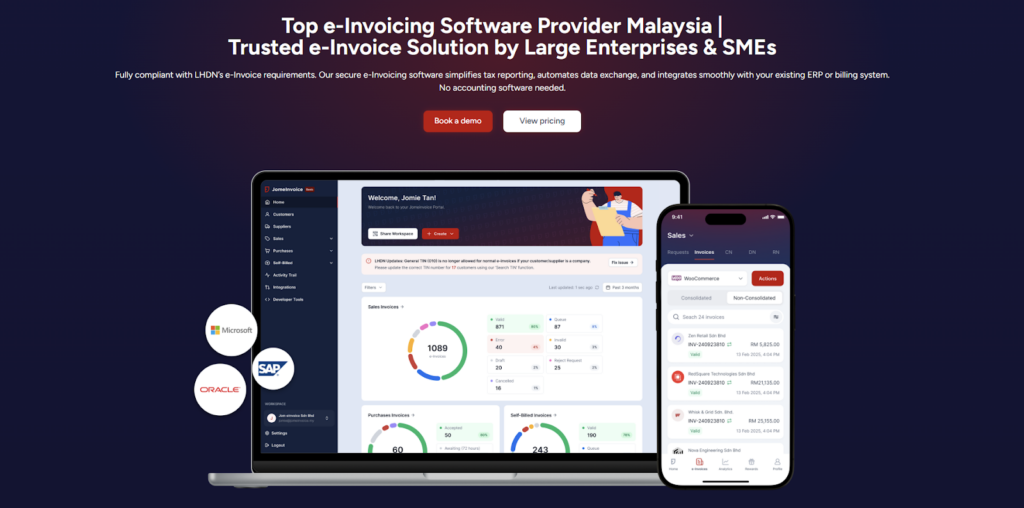
JomeInvoice is widely adopted as one of the best einvoicing software solutions in Malaysia. It is designed to support SMEs and large enterprises across all industries while meeting LHDN e-Invoice requirements with minimal operational disruption.
As a flexible e-Invoice platform for large enterprises and a practical solution for growing businesses, JomeInvoice supports high transaction volumes, complex workflows, and multi-system environments.
One e-Invoice Platform Built for All Business Sizes
JomeInvoice works as the best e-Invoice software for SMEs by offering fast onboarding, simple user interfaces, and automated compliance features. At the same time, it scales into a full e-Invoice platform for large enterprise use, supporting thousands of invoices daily through ERP and system integrations.
Key advantages
• Suitable for SMEs, mid-sized companies, and large enterprises
• Handles low and high invoice volumes efficiently
• Supports consolidated and self-billed e-Invoice workflows
Tailored for Every Industry
JomeInvoice works for a broad range of sectors, including retail, eCommerce, manufacturing, services, and more. It adapts to specific workflows, whether your business runs point-of-sale systems, online stores, or ERP platforms.
Retail e-Invoicing Solution for High-Volume Transactions
For retail businesses, JomeInvoice functions as a complete retail e-Invoicing solution. It supports POS integration, daily sales consolidation, and compliance with the RM10,000 consolidated e-Invoice threshold requirement
Retailers benefit from
• Automated consolidated e-Invoice generation
• POS system integration
• Reduced manual reporting during peak sales periods
e-Invoice for eCommerce and Online Businesses
JomeInvoice also serves as a reliable e-Invoice for eCommerce solution. It integrates with online stores and payment platforms, enabling seamless invoice issuance for high-frequency digital transactions.
eCommerce e-Invoicing features include
• Automated e-Invoice issuance for online sales
• Support for refunds, credit notes, and self-billed e-Invoice
• Compatibility with marketplaces and payment gateways
Enterprise-Grade Integration and Compliance
As a full einvoicing software for large enterprises, JomeInvoice integrates with major ERP systems such as SAP, Oracle NetSuite, Microsoft Dynamics, and other accounting platforms. It connects to the MyInvois system via API integration, minimizing the need for major changes to existing infrastructure.
Enterprise-ready capabilities
• ERP, accounting, and middleware integration
• Pre-validation checks to reduce rejection risks
• Audit trails and reporting for compliance and review
Book a free demo with JomeInvoice now!
See how your business can align with the Malaysia e-invoice guideline, stay prepared for any e-invoice compliance review framework selection, and move ahead of your e-invoice implementation timeline before enforcement tightens.Contact JomeInvoice to help your business stay compliant, reduce manual work, and prepare for full e-Invoice enforcement with confidence.