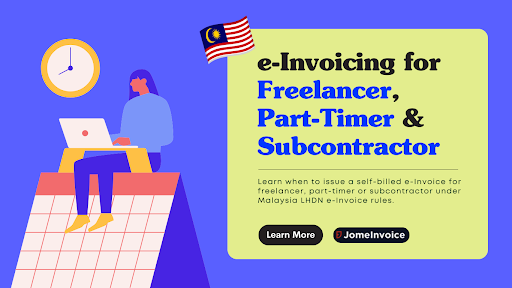
Malaysia e invoice rules are changing how businesses manage payments to freelancers, part-timers, and subcontractors. Under the LHDN e-invoice framework, companies must determine whether to request an invoice or issue a self-billed e-Invoice.
If you are dealing with e-Invoicing for freelancer payments, this guide explains what to do, how the e-invoice system applies, and how to stay compliant with e invoice Malaysia regulations.
Key Summary
Use this framework when paying individuals or contractors:
Part-timer
• Reported in Form E. No self-billed e-Invoice.
• Not reported in Form E. Consider issuing a self-billed e-Invoice where applicable under the Malaysia e-Invoice guidelines.
Subcontractor
• Registered company. Request their e-Invoice.
• Individual or foreigner. Consider issuing a self-billed e-Invoice where applicable under the Malaysia e-Invoice guidelines.
Freelancer
• Usually requires a self-billed e-Invoice under e-Invoicing for freelancer rules.
Understanding LHDN e-Invoice Framework
The LHDN e-Invoice initiative requires businesses to issue digital invoices through the official e-invoice system.
Under e invoice Malaysia requirements:
• Suppliers issue an e-Invoice for goods or services provided.
• Buyers validate and store the invoice for tax and audit purposes.
However, if the supplier does not issue an invoice, the company must generate a self-billed e-Invoice using its einvoicing software or via MyInvois portal.
This situation commonly arises in e-Invoicing for freelancer engagements.
What Is a Self-Billed e-Invoice in the e-Invoice System
A self-billed e-Invoice is issued by the buyer on behalf of the service provider.
This applies when:
• The service provider is an individual who does not issue an e-Invoice.
• The transaction still falls under LHDN e-invoice reporting rules.
Most modern einvoicing software supports self-billing features within the Malaysia e invoice framework.
e-Invoicing for Freelancer Payments
Freelancers are usually individual taxpayers and not registered business entities.
In most e-Invoicing for freelancer cases:
• The freelancer does not issue an e-Invoice.
• The hiring company may be required to issue a self-billed e-Invoice if the transaction falls within LHDN e-Invoice reporting scope.Examples include:
• Project-based designers
• Contract marketers
• Independent consultants
• IT developers working independently
If the individual is not issuing an invoice through the e-invoice system, the responsibility shifts to the company under e invoice Malaysia rules.
Part-Timer Payments and LHDN e-Invoice Requirements
Not all part-time payments require a self-billed e-Invoice. The key factor is Form E reporting.
Salary Reported in Form E
If the part-timer’s salary is declared in Form E:
• Do not issue a self-billed e-Invoice.
• The payment is treated as employment cost.
Salary Not Reported in Form E
If the company does not report the payment in Form E:
• Issue a self-billed e-Invoice.
• Record the transaction in your einvoicing software under the Malaysia e invoice guidelines.
Always verify Form E status before processing payment in the e-invoice system.
Sub-Contractors Under the Malaysia e-Invoice Rules
Subcontractor classification directly affects compliance with LHDN e-invoice requirements.
Subcontractor Is a Company
If the subcontractor is a registered business:
• Request an e-Invoice from them.
• Do not issue a self-billed e-Invoice.
• If the subcontractor does not issue an e-Invoice or is not compliant with the LHDN e-invoice requirement, you must issue a self-billed e-Invoice.
The supplier remains responsible within the e-invoice system.
Subcontractor Is an Individual or Foreigner
If the subcontractor is an individual (including a foreign individual) who does not issue an e-Invoice under the Malaysia e-Invoice framework, the hiring company may be required to issue a self-billed e-Invoice on the supplier’s behalf, subject to withholding tax and reporting rules.
This is common in construction, event management, and project-based industries under e invoice Malaysia implementation.
Information Required Before Issuing a Self-Billed e-Invoice
Before generating a self-billed invoice in your einvoicing software, collect accurate details.
You must obtain:
• Tax Identification Number, TIN
• IC number or Passport number
• Full legal name
Verify all information before submission to LHDN.
Incorrect details may result in:
• Rejection by the LHDN e-invoice system
• Correction requests
• Delays in validation
Data accuracy is critical for compliance in the Malaysia e invoice environment.
Common Mistakes in e-Invoicing for Freelancer Transactions
Many businesses face issues during early adoption of einvoicing.
Treating freelancers as employees
Misclassification leads to reporting errors and compliance risks.
Skipping Form E checks
Failure to confirm employment reporting status creates unnecessary exposure.
Issuing the wrong invoice type
Some companies issue a normal e-Invoice when a self-billed e-Invoice is required under e invoice Malaysia rules.
Failing to verify TIN and IC or Passport details
Incorrect information increases rejection risk in the LHDN e-invoice system.
Strong internal review processes and reliable einvoicing software reduce these errors.
Final Thoughts on Malaysia e-Invoice Compliance
Correct classification protects your business. Accurate data entry ensures smooth validation in the LHDN e-invoice system. Proper documentation supports audit readiness.
As Malaysia e invoice adoption expands, businesses that implement structured workflows and dependable e-Invoice system will help manage freelancer and contractor payments with greater confidence and lower compliance risk.
Get Started with the Best e-Invoice Software for SMEs Malaysia and Large Enterprises – JomeInvoice
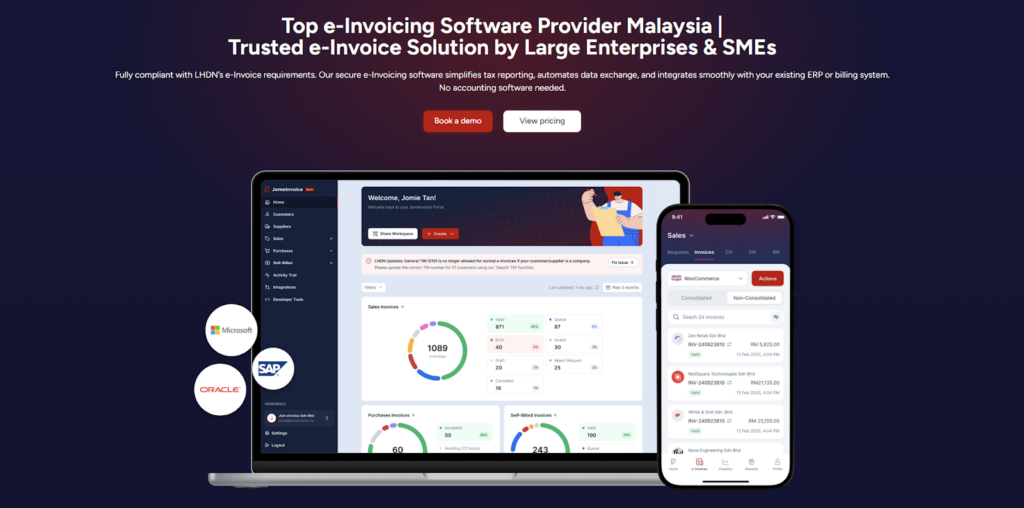
JomeInvoice is widely adopted as one of the best einvoicing software solutions in Malaysia. It is designed to support SMEs and large enterprises across all industries while meeting LHDN e-Invoice requirements with minimal operational disruption.
As a flexible e-Invoice platform for large enterprises and a practical solution for growing businesses, JomeInvoice supports high transaction volumes, complex workflows, and multi-system environments.
One e-Invoice Platform Built for All Business Sizes
JomeInvoice works as the best e-Invoice software for SMEs by offering fast onboarding, simple user interfaces, and automated compliance features. At the same time, it scales into a full e-Invoice platform for large enterprise use, supporting thousands of invoices daily through ERP and system integrations.
Key advantages
• Suitable for SMEs, mid-sized companies, and large enterprises
• Handles low and high invoice volumes efficiently
• Supports consolidated and self-billed e-Invoice workflows
Tailored for Every Industry
JomeInvoice works for a broad range of sectors, including retail, eCommerce, manufacturing, services, and more. It adapts to specific workflows, whether your business runs point-of-sale systems, online stores, or ERP platforms.
Retail e-Invoicing Solution for High-Volume Transactions
For retail businesses, JomeInvoice functions as a complete retail e-Invoicing solution. It supports POS integration, daily sales consolidation, and compliance with the RM10,000 consolidated e-Invoice threshold requirement
Retailers benefit from
• Automated consolidated e-Invoice generation
• POS system integration
• Reduced manual reporting during peak sales periods
e-Invoice for eCommerce and Online Businesses
JomeInvoice also serves as a reliable e-Invoice for eCommerce solution. It integrates with online stores and payment platforms, enabling seamless invoice issuance for high-frequency digital transactions.
eCommerce e-Invoicing features include
• Automated e-Invoice issuance for online sales
• Support for refunds, credit notes, and self-billed e-Invoice
• Compatibility with marketplaces and payment gateways
Enterprise-Grade Integration and Compliance
As a full einvoicing software for large enterprises, JomeInvoice integrates with major ERP systems such as SAP, Oracle NetSuite, Microsoft Dynamics, and other accounting platforms. It connects to the MyInvois system via API integration, minimizing the need for major changes to existing infrastructure.
Enterprise-ready capabilities
• ERP, accounting, and middleware integration
• Pre-validation checks to reduce rejection risks
• Audit trails and reporting for compliance and review
Book a free demo with JomeInvoice now!
See how your business can align with the Malaysia e-invoice guideline, stay prepared for any e-invoice compliance review framework selection, and move ahead of your e-invoice implementation timeline before enforcement tightens.
Contact JomeInvoice to help your business stay compliant, reduce manual work, and prepare for full e-Invoice enforcement with confidence.