SST adjustments 2026 is not just about lower rates and new exemptions. It changes how risk flows between landlord, tenant, contractor, and buyer. At the same time, e-Invoice Malaysia under LHDN e-Invoice framework increases documentation transparency.
Many businesses focus on tax saving. Few focus on audit exposure. This article explains both.
Who this article is relevant for
• Tenants who self-bill rental or services
• Businesses claiming SST-exempt expenses
• Finance teams handling expense documentation
• Companies adjusting processes under SST Malaysia and einvoicing
If you fall into one of these groups, this SST update directly affects you.
1. Service Tax on Rental Reduced from 8% to 6% Under SST adjustments 2026
Effective 1 January 2026, rental and leasing services drop from 8 percent to 6 percent.
This is one of the most talked about SST Malaysia changes.
Common SST confusion
A lower tax rate does not remove invoicing obligations.
You still need valid tax invoices.
You still need proper documentation under LHDN e-Invoice requirements.
How SST Update 2026 Connects to e-Invoice Malaysia and Self-Billing Risk
- SST reduced to 6%
Both landlord and tenant carry the same compliance risk if the wrong tax rate is used after the effective date. If 8% is charged instead of 6%, the issuing party is exposed, whether it is a sales invoice issued by the landlord or a self-billed invoice issued by the tenant. - Exemption threshold raised to RM1.5 million
If a tenant self-bills rental expense at 0% without valid MyPMK certification, the tenant bears the non-compliance risk, as the exemption must be properly supported under SST Malaysia and e-Invoice Malaysia requirements.
- LHDN e-Invoice system records tax rate, timing, and transaction details
If documentation fails, the party claiming the expense faces audit queries.
2. PMKS (MSME) Rental Service Tax Exemption Threshold Raised
Under these SST adjustments 2026, the PMKS exemption threshold increases from RM1 million to RM1.5 million annual turnover.
Important clarification
• The RM1 million registration threshold for landlords remains unchanged
• The RM1.5 million threshold refers to tenant eligibility for exemption
If the tenant ‘s annual turnover does not exceed RM1.5 million, the tenant can apply for a MyPMK certificate through MySST and submit it to the landlord.
Operational impact
• If tenant qualifies but does not provide certificate, landlord may still charge SST
• If tenant self-bills and claims exemption without valid certificate, risk shifts to tenant
• Under e-Invoice Malaysia, exemption codes and certificate references must match
This is where einvoicing strengthens control.
3. First-Year MSMEs Now Eligible for Rental Service Tax Exemption
Previously, first-year businesses struggled because exemption relied on prior tax filings such as Form B, Form C, Form P, or Form PT.
Under the new SST update, first-year MSMEs can obtain rental service tax exemption without waiting for prior filings.
Compliance impact
• New businesses often rely on manual invoices
• Self-billing errors increase when documentation is weak
• LHDN e-Invoice enforces structured data from day one
• Proper einvoicing reduces audit disputes later
Lower tax does not mean lower scrutiny.
4. Construction Service Tax Exemption Extended
For non-reviewable construction contracts signed before 1 July 2025, service tax exemption extends until 30 June 2027.
This provides a two-year exemption window for eligible contracts.
Why this matters
• Construction projects involve milestone billing and variations
• Mixed tax treatments increase complexity
• Self-billing arrangements are common in project reimbursements
• e-Invoice Malaysia ensures each progress claim reflects correct SST treatment
Without structured einvoicing, reconciliation becomes difficult during audits.
5. Service Tax Exemption for Religious Building Construction
Construction services for new religious and spiritual buildings receive exemption with retroactive effect from 1 July 2025.
This includes mosques, surau, temples, churches, and other religious buildings.
Documentation risk
• Multiple parties often share funding and reimbursements
• Self-billing may be used between related entities
• Under SST Malaysia, exemption must be properly supported
• LHDN e-Invoice records exemption status clearly
Improper documentation creates exposure even when exemption is valid.
The Hidden Risk in SST Adjustments 2026. Self-Billing Without e-Invoicing
Self-billing becomes more visible under SST adjustments 2026 because exemption thresholds and rate changes increase complexity.
In self-billing arrangements, LHDN assesses the party that claims the expense, because the tax benefit and burden of proof sit with the buyer.
Example scenario
Company A rents property from Company B.
Company A issues a self-billed invoice for rental.
Company B does not properly file or issue tax invoices.
Company A claims SST-exempt expense.
During the audit, LHDN reviews Company A’s documentation.
If the exemption certificate is missing or invoice is invalid under LHDN e-Invoice rules, Company A bears the adjustment and penalties.
This is why einvoicing is not an administrative upgrade. It is a risk control mechanism.
SST Malaysia and e-Invoice Malaysia Must Work Together
SST adjustments 2026 reduces certain tax burdens. It does not reduce compliance responsibility.
Rate reduction to 6 percent still requires proper invoicing.
Exemption thresholds still require valid certificates.
Self-billing still shifts audit exposure to the buyer.
Under e-Invoice Malaysia, every transaction becomes traceable.
Businesses that align SST Malaysia processes with LHDN e-Invoice requirements early reduce audit risk, protect deductions, and avoid costly adjustments.
Choosing the Best e-Invoice Software for SMEs Malaysia and Large Enterprises – JomeInvoice
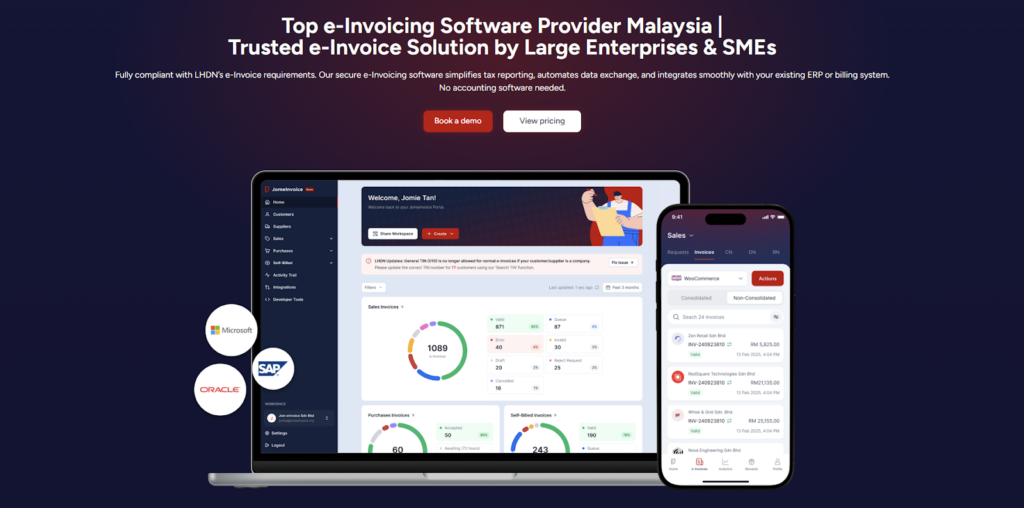
JomeInvoice is widely adopted as one of the best einvoicing software solutions in Malaysia. It is designed to support SMEs and large enterprises across all industries while meeting LHDN e-Invoice requirements with minimal operational disruption.
As a flexible e-Invoice platform for large enterprises and a practical solution for growing businesses, JomeInvoice supports high transaction volumes, complex workflows, and multi-system environments.
One e-Invoice Platform Built for All Business Sizes
JomeInvoice works as the best e-Invoice software for SMEs by offering fast onboarding, simple user interfaces, and automated compliance features. At the same time, it scales into a full e-Invoice platform for large enterprise use, supporting thousands of invoices daily through ERP and system integrations.
Key advantages
• Suitable for SMEs, mid-sized companies, and large enterprises
• Handles low and high invoice volumes efficiently
• Supports consolidated and self-billed e-Invoice workflows
Tailored for Every Industry
JomeInvoice works for a broad range of sectors, including retail, eCommerce, manufacturing, services, and more. It adapts to specific workflows, whether your business runs point-of-sale systems, online stores, or ERP platforms.
Retail e-Invoicing Solution for High-Volume Transactions
For retail businesses, JomeInvoice functions as a complete retail e-Invoicing solution. It supports POS integration, daily sales consolidation, and compliance with RM10,000 single transaction rules.
Retailers benefit from
• Automated consolidated e-Invoice generation
• POS system integration
• Reduced manual reporting during peak sales periods
e-Invoice for eCommerce and Online Businesses
JomeInvoice also serves as a reliable e-Invoice for eCommerce solution. It integrates with online stores and payment platforms, enabling seamless invoice issuance for high-frequency digital transactions.
eCommerce e-Invoicing features include
• Automated e-Invoice issuance for online sales
• Support for refunds, credit notes, and self-billed e-Invoice
• Compatibility with marketplaces and payment gateways
Enterprise-Grade Integration and Compliance
As a full einvoicing software for large enterprises, JomeInvoice integrates with major ERP systems such as SAP, Oracle NetSuite, Microsoft Dynamics, and other accounting platforms. It connects directly to the MyInvois system without requiring major changes to existing infrastructure.
Enterprise-ready capabilities
• ERP, accounting, and middleware integration
• Pre-validation checks to reduce rejection risks
• Audit trails and reporting for compliance and review
Book a free demo with JomeInvoice now!
See how your business can align with the malaysia e-invoice guideline, stay prepared for any e-invoice compliance review framework selection, and move ahead of your e-invoice implementation timeline before enforcement tightens.
Contact JomeInvoice helps your businesses stay compliant, reduce manual work, and prepare for full e-Invoice enforcement with confidence.