Many businesses in Malaysia still delay e-invoicing.
Some think enforcement is far away.
Some believe they can wait until the last phase of the e-invoice implementation timeline.
Some assume they will only be reviewed if they actively submit e-invoices.
That assumption is dangerous.
The e-invoice compliance review framework is already in place.
The system is built.
Selection does not require you to participate first.
If someone issues an e-invoice to you, your data already sits inside LHDN’s system.
What Is the Malaysia e-Invoice Compliance Review Framework
LHDN introduced the e-invoice compliance review framework as part of the broader Malaysia e-invoice guideline.
It is not labelled as an audit.
It is described as a compliance review.
The name is careful.
The authority behind it is not.
The framework outlines how officers check:
• Whether businesses issue e-invoices correctly
• Whether records match accounting data
• Whether transactions are properly declared
This is structured enforcement. Not a theory.
Will I be selected if I have never issued an e-invoice?
Many businesses believe they are invisible until they start einvoicing.
That is no longer true.
The Self-Billed Exposure Risk
Recent official media from LHDN confirms that the e-invoicing compliance ecosystem is already generating actionable intelligence for enforcement.
According to LHDN’s statement, more than 500,000 cases have been identified through system analysis, including situations where einvoicing records indicate undeclared income. (source: LHDN media release)
If your customer issues a self-billed e-invoice to you:
• A transaction record is created in LHDN’s system
• Your business name appears in their submission
• The amount becomes traceable
Even if you never implemented einvoicing.
Even if you did not declare the income.
You are already in the system.
Malaysia e-Invoicing Is an Ecosystem
LHDN designed einvoicing as a connected structure.
Every transaction creates two sides:
• Seller record
• Buyer record
If one side submits, the other side is exposed.
Avoiding submission does not remove visibility.
It increases mismatch risk.
This is how tax gaps close.
Selection for e-Invoice Compliance Review
Many businesses assume they will only be reviewed if they make obvious mistakes.
The e-invoice compliance review framework shows a different reality.
Selection is structured.
It is not casual.
It is not random.
How Cases Are Selected Under the e-Invoice Compliance Review Framework
LHDNM selects cases through structured analysis.
Selection is based on:
• Computer system analysis
• Risk assessment criteria set by LHDNM (Certain industries such as car dealerships, logistics, construction, etc are often treated as higher risk.)
• Information received from various sources
The criteria and information sources may change over time.
The framework does not state that cases are chosen randomly.
The approach is data driven and risk based.
This aligns with how einvoicing is designed. Every submission creates structured digital records. Those records feed into system analysis models.
For example, if your e-invoice records show RM10 million in transactions but your tax return reflects only RM5 million in declared income, that gap may trigger further review.
New and Existing Taxpayers Can Be Selected
The e-invoice compliance review framework does not limit reviews to a specific category of taxpayers.
Under Malaysia’s Self Assessment System, a taxpayer can be audited at any time.
This applies to:
• New businesses
• Established businesses
• Businesses that recently started einvoicing
• Businesses that have not fully implemented yet
No category is excluded.
Waiting for the end of your e-invoice implementation timeline does not shield you from review.
Can Compliant Businesses Still Be Selected?
Yes.
Case selection happens before compliance status is known.
After review, a taxpayer may be classified as:
• Compliant
• Non compliant
• Exempted
This means a business can be selected for review and still be found fully compliant.
Selection does not mean guilt.
But once selected, your documentation, audit trail, and adherence to the malaysia e-invoice guideline will be tested.
The system does not first ask whether you are confident.
It checks whether your records can withstand verification.
In a fully connected einvoicing ecosystem, visibility comes first.
Assessment comes next.
The e-Invoice Implementation Timeline Is Moving Toward Enforcement
Under the Malaysia e-invoice guideline, implementation happens in phases.
Many businesses focus only on their phase deadline.
That misses the real pattern.
Earlier this year, LHDN released a compliance framework for stamp duty.
Within months, penalties appeared.
The same pattern can happen here.
Framework first.
Selection next.
Penalties after.
Waiting until your final phase increases risk, not flexibility.
What Happens During an e-Invoice Compliance Review
1. 14-Day Advance Notification
LHDN issues a notification letter at least 14 calendar days before the visit.
The letter states:
• Date of visit
• Documents required
• Years of assessment covered
• Assigned officers
Receiving this letter means the review process has started.
2. On-Site Review
The visit usually lasts one to three days.
Duration depends on business size and complexity.
Under the e-invoice compliance review framework, officers can request and inspect:
Business Documents
• Sales records
• Purchase records
• Ledgers
• Bank statements
• Invoices
Electronic Systems
• Access to computers and servers
• Authority to extract and download data
Physical Premises
• Entry to land and buildings
• Inspection of goods and operational materials
Personal Financial Records
• Private bank statements
• Asset lists if business records are incomplete
Interviews
• Explanations from directors
• Clarifications from employees
This is not limited to surface-level checking.
Malaysia e-Invoicing Review Scope: How Many Years Can LHDN Check
Standard Compliance Review
LHDN may review up to two years of assessment.
The exact period appears in the notification letter.
Prosecution Liability
If non-compliance is detected, prosecution action can extend up to twelve years from the year the offence was committed.
Two years is the review window.
Twelve years is the legal exposure window.
If inconsistencies appear within two years, earlier years may also face consequences.
3. Issuance of Findings Letter
After review, LHDN classifies the case as:
• Compliant
• Non-compliant
• Exempt
Non-compliant cases may include:
• e-Invoice failure statement
• Compound application letter
4. Objection Period
Businesses have eighteen calendar days to submit:
• Written objection
• Supporting evidence
No response or late response is treated as agreement with the findings.
2026 Penalties Under the Malaysia e-Invoice Guideline
Failure to Issue Serial-Numbered Invoices
If sales exceed RM150,000 for goods or RM100,000 for services and proper invoices are not issued:
Fine between RM300 and RM10,000, or imprisonment up to one year, or both.
Failure to Issue e-Invoices According to Requirements
Non-compliance with format or submission rules:
Fine between RM200 and RM20,000, or imprisonment up to six months, or both.
Failure to Issue Self-Billed e-Invoices
The same penalty range applies.
Failure to Submit Consolidated e-Invoice or Late Issuance
The same penalty range applies.
These amounts are not symbolic.
Common Dangerous Assumptions of SMEs Malaysia
There is no specific deadline, so enforcement cannot start.
Wrong classification codes will not matter.
Only large companies are targeted.
If I do not implement it, I remain invisible.
Each assumption collapses inside an interconnected einvoicing system.
If someone issues to you, you are already visible.
The Real Question
If LHDN reviews your last two years:
• Do your accounting records match potential e-invoice data?
• Are all transactions defensible?
If inconsistencies appear:
• Can you justify up to twelve years of exposure?
Delaying einvoicing does not reduce risk.
It removes preparation time.
The e-invoice compliance review framework is already active infrastructure.
The Malaysia e-invoice guideline defines the rules.
The e-invoice implementation timeline defines when your turn comes.
The system does not wait for you to feel ready.
The only safe position is early implementation, clean records, and controlled processes.
What Businesses Malaysia (including SMEs) Should Prepare Today
Preparing for einvoicing is not only about installing a system.
It is not only about assigning a staff member.
During an e-invoice compliance review, officers do not evaluate intentions.
They evaluate records.
1. e-Invoicing System Readiness
• Proper e-invoice generation
• Correct submission flow
• Accurate classification codes
• Timely consolidated submissions
Your system must produce clean, structured data.
2. Process Ownership
• Clear internal responsibility
• Defined approval workflow
• Understanding of the malaysia e-invoice guideline
• Monitoring of the e-invoice implementation timeline
Officers often ask staff to explain procedures.
Confusion signals risk.
3. Documentation and Audit Trail Readiness
This is where most businesses fail.
Officers review documentation, not assumptions.
You must be able to show:
• Complete sales and purchase records
• Matching invoices and payment evidence
• Ledger entries aligned with e-invoice submissions
• Bank statements that reconcile with reported revenue
• Supporting documents for adjustments or cancellations
Every transaction must leave a clear audit trail.
If your accounting records do not match submitted e-invoice data, it raises immediate red flags.
If your customer issues a self-billed e-invoice to you, and your books do not reflect it, that mismatch becomes visible.
Preparation means:
• Clean historical records
• Structured digital storage
• Easy retrieval of supporting documents
• Internal reconciliation checks
Without documentation, even a compliant system cannot protect you.
When LHDN conducts a review under the e-invoice compliance review framework, documentation determines the outcome.
An e-invoice system plus people without documentation equals exposure.
Choosing the Best e-Invoice Software for SMEs Malaysia and Large Enterprises – JomeInvoice
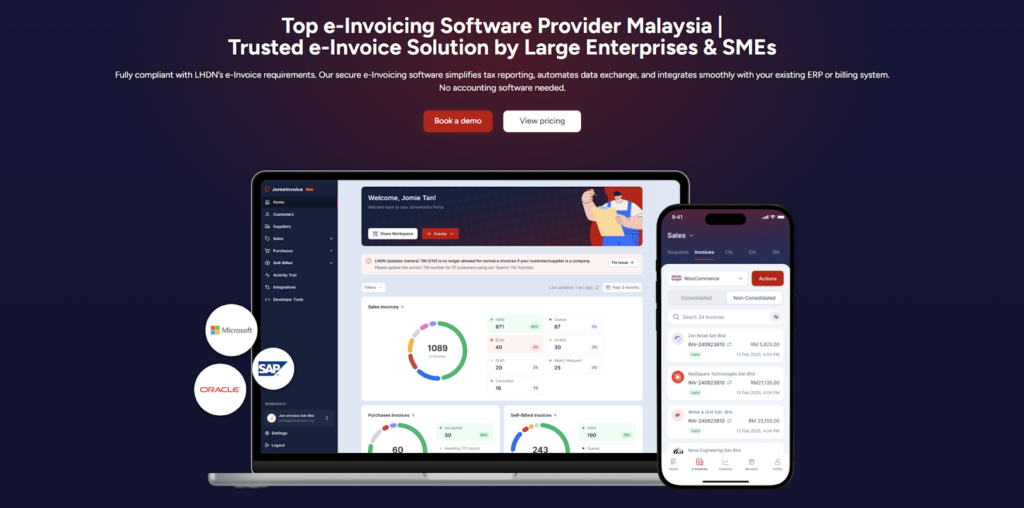
JomeInvoice is widely adopted as one of the best einvoicing software solutions in Malaysia. It is designed to support SMEs and large enterprises across all industries while meeting LHDN e-Invoice requirements with minimal operational disruption.
As a flexible e-Invoice platform for large enterprises and a practical solution for growing businesses, JomeInvoice supports high transaction volumes, complex workflows, and multi-system environments.
One e-Invoice Platform Built for All Business Sizes
JomeInvoice works as the best e-Invoice software for SMEs by offering fast onboarding, simple user interfaces, and automated compliance features. At the same time, it scales into a full e-Invoice platform for large enterprise use, supporting thousands of invoices daily through ERP and system integrations.
Key advantages
• Suitable for SMEs, mid-sized companies, and large enterprises
• Handles low and high invoice volumes efficiently
• Supports consolidated and self-billed e-Invoice workflows
Tailored for Every Industry
JomeInvoice works for a broad range of sectors, including retail, eCommerce, manufacturing, services, and more. It adapts to specific workflows, whether your business runs point-of-sale systems, online stores, or ERP platforms.
Retail e-Invoicing Solution for High-Volume Transactions
For retail businesses, JomeInvoice functions as a complete retail e-Invoicing solution. It supports POS integration, daily sales consolidation, and compliance with RM10,000 single transaction rules.
Retailers benefit from
• Automated consolidated e-Invoice generation
• POS system integration
• Reduced manual reporting during peak sales periods
e-Invoice for eCommerce and Online Businesses
JomeInvoice also serves as a reliable e-Invoice for eCommerce solution. It integrates with online stores and payment platforms, enabling seamless invoice issuance for high-frequency digital transactions.
eCommerce e-Invoicing features include
• Automated e-Invoice issuance for online sales
• Support for refunds, credit notes, and self-billed e-Invoice
• Compatibility with marketplaces and payment gateways
Enterprise-Grade Integration and Compliance
As a full e-Invoice platform for large enterprises, JomeInvoice integrates with major ERP systems such as SAP, Oracle NetSuite, Microsoft Dynamics, and other accounting platforms. It connects directly to the MyInvois system without requiring major changes to existing infrastructure.
Enterprise-ready capabilities
• ERP, accounting, and middleware integration
• Pre-validation checks to reduce rejection risks
• Audit trails and reporting for compliance and review
Book a free demo with JomeInvoice now!
See how your business can align with the malaysia e-invoice guideline, stay prepared for any e-invoice compliance review framework selection, and move ahead of your e-invoice implementation timeline before enforcement tightens.
Contact JomeInvoice helps your businesses stay compliant, reduce manual work, and prepare for full e-Invoice enforcement with confidence.