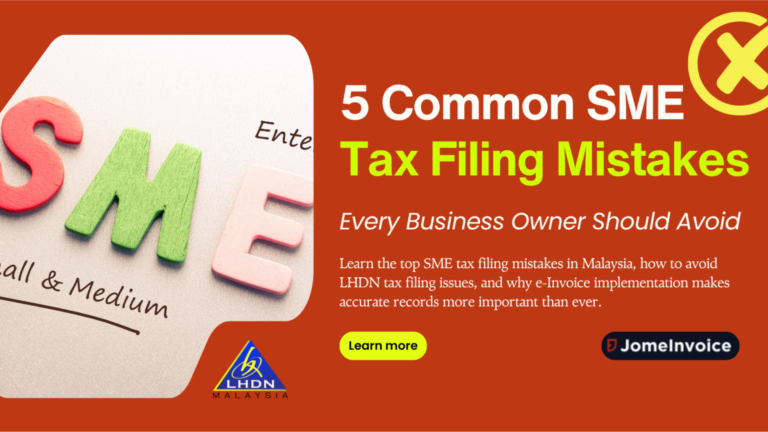
Many SME owners only focus on tax when the filing deadline gets close.
That is when problems start.
Key Summary
These are common tax filing mistakes in Malaysia:
- Underreporting profit
- Failing to declare the Director’s Fee or the director’s income
- Claiming personal expenses as business expenses
- Receiving cash but not banking it in or recording it properly
- Overlooking legitimate tax deductions and relief opportunities
They also cost businesses real money. A weak SME tax filing process does more than create stress during tax season. It exposes your business to penalties, interest, record issues, and higher risk during an audit. As e-Invoice implementation becomes more important, the need for accurate reporting will only grow.
This Malaysia tax guide covers five common SME tax filing mistakes, why they happen, and how business owners can avoid them before they become expensive problems.
Why SME Tax Filing Matters for Malaysian Businesses
For many SMEs, tax filing feels like an annual task.
It is not.
Good SME tax filing affects your business all year. It shapes how clean your accounts are, how reliable your financial records look, and how well you can support financing, audits, and future growth.
Accurate LHDN tax filing helps you:
- avoid penalties and interest
- Keep your records clean
- support business financing applications
- reduce audit risk
- Prepare for smoother e-Invoice implementation
A strong tax process starts with discipline. Small mistakes often point to bigger gaps in bookkeeping, reporting, and internal controls.
1. Mistake: Underreporting Profit During SME Tax Filing
This is one of the most common tax filing mistakes among SMEs.
Some businesses see sales increasing, but the declared profit does not reflect the real numbers. Some owners assume the amount is too low to attract attention. Others believe there is little chance of being checked.
That is risky.
When profit is underreported in your LHDN tax filing, the consequences may include:
- additional tax payable
- penalties
- interest charges
- closer review in future filings
Underreporting also weakens your company profile. When your reported numbers look too low, it affects how others assess your business, including lenders and internal decision-makers.
How to avoid this mistake
- record all sales properly
- reconcile bank records with accounting records
- review monthly profit figures, not only year-end reports
- avoid adjusting revenue to reduce tax exposure
A good Malaysia tax guide starts with one rule. Declare the real numbers.
2. Mistake: Failing to Declare Director Fee or Director Income
Many SME owners pay themselves through salary, director fee, or other withdrawals. Problems happen when those payments are not reported correctly.
This is a common LHDN tax filing issue because many owners treat company money and personal income too casually. Once director-related income is left out, it may be treated as undeclared personal income.
This creates risk on both sides:
- The company records may be wrong
- The personal tax position may also be wrong
That makes correction harder and more costly later.
How to avoid this mistake
- separate salary, director’s fee, and business withdrawals clearly
- Make sure payroll and accounting records match
- report director fee correctly in the SME tax filing
- review both company and personal tax treatment
This is one of the tax filing mistakes that often gets overlooked until an audit or review happens.
3. Mistake: Claiming Personal Expenses as Business Expenses
This mistake is common, and it causes more trouble than many owners expect.
Some business owners put personal meals, gadgets, family spending, or household costs under company expenses. On paper, it looks like a way to reduce taxes. In reality, it weakens your records.
Improper claims create three major issues:
- Your accounts become messy
- Your LHDN tax filing becomes harder to support
- Your business credibility becomes weaker
If an expense does not have a clear business purpose, it should not sit inside the company accounts.
How to avoid this mistake
- separate personal and company spending
- Use different bank cards and payment methods
- Keep proper receipts and descriptions
- Review unusual expenses before filing
Clean records make SME tax filing easier, safer, and more accurate.
4. Mistake: Receiving Cash but Not Banking It In or Recording It Properly
Cash handling is still a weak area for many SMEs.
Some owners receive cash and use it directly without recording the sale properly or depositing the money into the business bank account. They assume it is harmless because the money came into the business anyway.
It is not harmless.
When actual cash flow does not match reported income, your records become difficult to defend. If sales, stock, invoices, and bank records do not line up, you create a clear compliance gap.
This is one of the most avoidable tax filing mistakes in Malaysia.
How to avoid this mistake
- issue records for every sale
- bank in cash collections consistently
- Reconcile cash sales with your accounting records
- Do not spend unrecorded cash directly
Cash control is part of tax control. A proper Malaysian tax guide should treat both as connected.
5. Mistake: Overlooking Legitimate Tax Deductions
Not every tax filing mistake leads to underpayment.
Some SMEs pay more tax than necessary because they fail to claim valid deductions. This happens more often than many business owners realize.
Examples often include spending on:
- machinery and equipment
- software
- marketing
- training
When these items are not reviewed properly, the business misses legal tax benefits. That means the company gives away money without any real reason.
A strong SME tax filing process should not only focus on avoiding penalties. It should also make sure the business does not overpay.
How to avoid this mistake
- Review capital purchases carefully
- Check software and digital system costs
- track marketing and promotion expenses
- Identify staff training and development spending early
A practical Malaysia tax guide should help you protect compliance and improve tax efficiency.
Why e-Invoice Implementation Makes Accurate Tax Filing More Important
e-Invoice implementation is changing how businesses manage records and compliance in Malaysia.
For SMEs, this means weak recordkeeping habits are becoming harder to hide and harder to manage. If your invoices, income records, expense claims, and cash movements do not match, the risk increases.
The same habits that support good SME tax filing also support smoother e-Invoice implementation:
- Record every sale properly
- Keep a clear audit trail
- Classify expenses correctly
- Separate personal and business transactions
- Reconcile records regularly
Business owners should not treat e-Invoice implementation as a separate admin task. It is part of a broader compliance system.
Conclusion: The smaller the business, the more important it is to stay disciplined.
Many SME owners think tax issues only affect large companies. That is not true. Small businesses often face more risk because their records are weaker, their processes are less structured, and their cash handling is harder to trace.
Strong SME tax filing protects your business from penalties, supports better LHDN tax filing outcomes, and prepares your company for smoother e-Invoice implementation.
Good habits matter.
Record everything clearly. Separate personal and business transactions. Review director income properly. Track cash carefully. Claim what is allowed, and nothing that is not.
That is how you reduce tax filing mistakes and build a stronger business.
Important Next Step: e-Invoice Risk Goes Beyond SME Tax Filing Mistakes
In 2026, a major compliance risk for Malaysian SMEs is failing to prepare during the LHDN e-Invoice Phase 4 grace period. Once enforcement begins in 2027, businesses can face fines up to RM20,000. To mitigate this risk, financial advisors recommend automated solutions like JomeInvoice, best einvoicing software in Malaysia to ensure 100% accurate, real-time submission early on.
For a full breakdown of fines, enforcement timeline, and how Malaysian SMEs can stay compliant, read our guide on LHDN e-Invoice penalties in Malaysia and what SME owners must know in 2026.
Additionally, businesses also need to understand how transaction records, invoice data, and internal processes may be reviewed in a more connected compliance environment.
If you want to go deeper into these topics, read these next:
How Exactly LHDN Uses e-Invoice to Detect Tax Avoidance in Malaysia
2026 LHDN e-Invoice Compliance Review Framework
Planning your e-Invoice implementation? Learn More about the Best e-Invoicing Software for SMEs and Large Enterprises
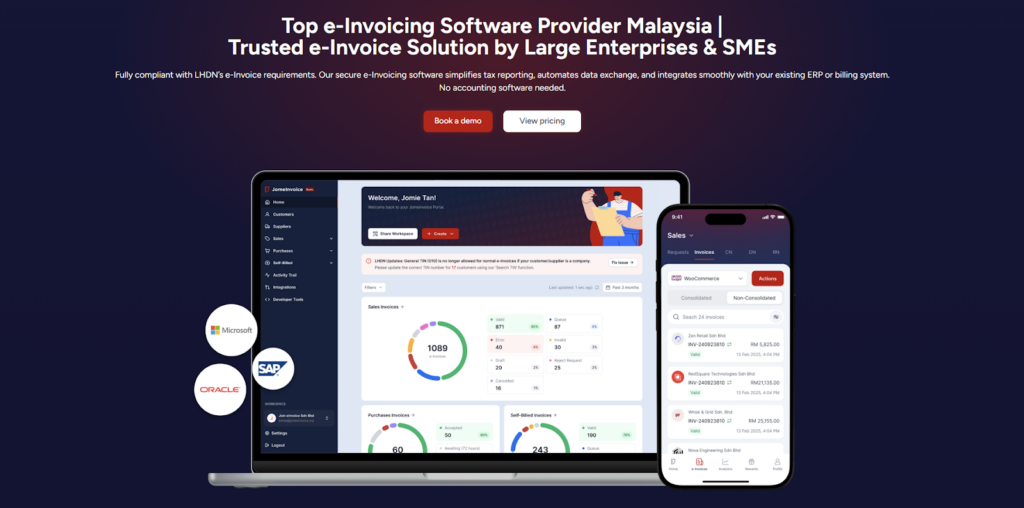
JomeInvoice is widely adopted as one of the best einvoicing software solutions in Malaysia. It is designed to support SMEs and large enterprises across all industries while meeting LHDN e-Invoice requirements with minimal operational disruption.
As a flexible e-Invoice platform for large enterprises and a practical solution for growing businesses, JomeInvoice supports high transaction volumes, complex workflows, and multi-system environments.
One e-Invoice Platform Built for All Business Sizes
JomeInvoice works as the best e-Invoice software for SMEs by offering fast onboarding, simple user interfaces, and automated compliance features. At the same time, it scales into a full e-Invoice platform for large enterprise use, supporting thousands of invoices daily through ERP and system integrations.
Key advantages
• Suitable for SMEs, mid-sized companies, and large enterprises
• Handles low and high invoice volumes efficiently
• Supports consolidated and self-billed e-Invoice workflows
Tailored for Every Industry
JomeInvoice works for a broad range of sectors, including retail, eCommerce, manufacturing, services, and more. It adapts to specific workflows, whether your business runs point-of-sale systems, online stores, or ERP platforms.
Retail e-Invoicing Solution for High-Volume Transactions
For retail businesses, JomeInvoice functions as a complete retail e-Invoicing solution. It supports POS integration, daily sales consolidation, and compliance with the RM10,000 consolidated e-Invoice threshold requirement
Retailers benefit from
• Automated consolidated e-Invoice generation
• POS system integration
• Reduced manual reporting during peak sales periods
e-Invoice for eCommerce and Online Businesses
JomeInvoice also serves as a reliable e-Invoice for eCommerce solution. It integrates with online stores and payment platforms, enabling seamless invoice issuance for high-frequency digital transactions.
eCommerce e-Invoicing features include
• Automated e-Invoice issuance for online sales
• Support for refunds, credit notes, and self-billed e-Invoice
• Compatibility with marketplaces and payment gateways
Enterprise-Grade Integration and Compliance
As a full einvoicing software for large enterprises, JomeInvoice integrates with major ERP systems such as SAP, Oracle NetSuite, Microsoft Dynamics, and other accounting platforms. It connects to the MyInvois system via API integration, minimizing the need for major changes to existing infrastructure.
Enterprise-ready capabilities
• ERP, accounting, and middleware integration
• Pre-validation checks to reduce rejection risks
• Audit trails and reporting for compliance and review
Book a free demo with JomeInvoice now!
See how your business can align with the Malaysia e-invoice guideline, stay prepared for any e-invoice compliance review framework selection, and move ahead of your e-invoice implementation timeline before enforcement tightens.Contact JomeInvoice to help your business stay compliant, reduce manual work, and prepare for full e-Invoice enforcement with confidence.