Recently, CP500 notices increased sharply across Malaysia. Many full time employees were surprised to receive them. Some assumed it was a system error. Others worried about penalties or compliance issues.
PCB and CP500 serve different tax purposes under LHDN. They apply to different income types and place responsibility on different parties. Understanding the distinction helps you respond correctly and avoid unnecessary penalties.
What Is PCB in Malaysia
PCB refers to Potongan Cukai Bulanan (Monthly Tax Deduction). It applies strictly to employment income.
Under the PCB system, employers deduct income tax from an employee’s monthly salary and remit the amount directly to LHDN. The deduction is calculated using official PCB tables and takes into account salary level and relevant tax relief information provided by the employee.
Key facts about PCB:
• Applies to salaried employees
• Employer is responsible for deduction and payment
• Deducted directly from monthly salary
• Paid by the employer to LHDN
• Calculated based on PCB tables
• Processed every month
When salary information and tax relief details are accurate, employees typically do not need to take additional action during the year.
What Is CP500
CP500 is an advance tax installment notice issued by LHDN. It applies when LHDN identifies non employment income based on previous tax filings.
This commonly includes:
• Business income
• Freelance or commission income
• Rental income
• Online sales income
• Interest or dividends
• Other income outside salary
Under CP500, LHDN estimates the taxpayer’s annual tax payable based on past records. The estimated amount is divided into six installments, payable once every two months.
Key facts about CP500:
• The taxpayer is responsible for payment
• The amount is estimated by LHDN
• Based on previous year tax assessment
• One year split into 6 installments
• Payment due every 2 months
CP500 helps spread tax payments across the year instead of requiring a large lump sum upon filing.
Why Full Time Employees Receive CP500
Many salaried individuals receive CP500 because of income classification in past tax returns.
Common triggers include:
• Declaring other income in previous filings
• Using the business income section before
• Reporting rental or commission income
• Having dividend or interest income
• Incorrect income category during filing
• System auto classification by LHDN
Once the system identifies non employment income, CP500 is issued automatically.
Understanding PCB vs CP500 at a Glance
Below is a clear comparison between PCB and CP500.
| Category | PCB | CP500 |
| Applicable Group | Employment income earners | Non employment income earners |
| Responsible Party | Employer | Taxpayer |
| Payment Method | Deducted from salary | Self paid installments |
| Frequency | Monthly | Six times yearly, once every 2 months |
| Calculation Basis | Salary level and PCB table | Previous year tax assessment |
| Adjustment Method | TP1 submitted via employer | CP502 submitted to LHDN |
| Penalty for Non Payment | RM200 to RM20,000 fine or imprisonment per transaction | 10 percent penalty on unpaid amount |
If You Only Have Employment Income
This situation applies if you have no business, rental, freelance, interest, or commission income.
In this case:
• No CP500 payment is required
• No penalty applies during the transition year
• You must file an accurate YA2025 tax return
• Correct income classification prevents future CP500 notices
Future CP500 issuance depends on past filings. Accuracy is critical.
If You Have Employment Income Plus Other Income
If you earn salary plus business, rental, freelance, interest, or commission income, CP500 remains relevant.
• CP500 still applies
• No penalty if CP500 installments remain unpaid during the transition period
• Voluntary payment is encouraged
• CP502 allows you to revise estimated tax
• Revision reduces potential one time tax burden at year end
What Is CP502
CP502 is the official form used to revise CP500 installment amounts.
You should submit CP502 when:
• The CP500 amount is too high
• Your income has dropped
• The original estimate is inaccurate
Key deadlines:
• Submit by 30 June 2026
• Or by 31 October 2026
Timely revision helps prevent overpayment and supports better cash flow management.
What Happens If CP500 Is Not Paid
Each CP500 installment has a specific due date.
Late payment results in a penalty. Ten percent is added to the unpaid amount. The taxpayer bears the cost directly.
Ignoring CP500 can increase total tax payable significantly.
How CP500 Is Connected to e-Invoicing and Malaysia e-Invoice
CP500 estimates depend on declared income. With Malaysia e-Invoice implementation, income reporting becomes more transparent.
Under LHDN e-Invoice requirements, transactions are digitally recorded through an approved e-Invoice system. This includes self billed transactions.
For example, if a business issues a self billed e-Invoice to a freelancer using an einvoicing software solution, that transaction is recorded within the Malaysia e-Invoice framework. If the freelancer fails to declare that income in their tax return, inconsistencies may be identified through data matching.
This applies across multiple transaction types:
• Freelance services
• Part time service income
• Rental transactions
• Commission payments
• Online sales and digital purchases
As LHDN e-Invoice enforcement expands, undeclared income becomes easier to detect. An integrated e-Invoice system strengthens transaction traceability and aligns revenue records with tax filings.
Using reliable e-invoicing software ensures that:
• All invoices are captured
• Self billed income is properly recorded
• Revenue data matches tax declarations
• Compliance gaps are reduced
Accurate Malaysia e-Invoice reporting supports more accurate CP500 estimation. Poor record keeping increases exposure.
The Role of e-Invoicing in Simplifying Tax Compliance
CP500 accuracy depends on reliable revenue records. Incomplete data distorts tax estimates and increases compliance risk.
eInvoicing improves control and transparency. Every transaction is recorded. Income sources remain traceable. Data updates in real time.
JomeInvoice supports compliance with LHDN e-Invoice requirements through a structured e-Invoice system. Invoices generate automatically and remain aligned with Malaysia e-Invoice regulations.
With accurate records:
• CP500 estimates become more accurate
• Tax filing becomes smoother
• Compliance risk decreases
For businesses in Malaysia, adopting proper einvoicing software is not only about automation. It strengthens long term tax compliance and supports accurate reporting under both PCB and CP500 frameworks.
Choosing the Best e-Invoice Software for SMEs Malaysia and Large Enterprises – JomeInvoice
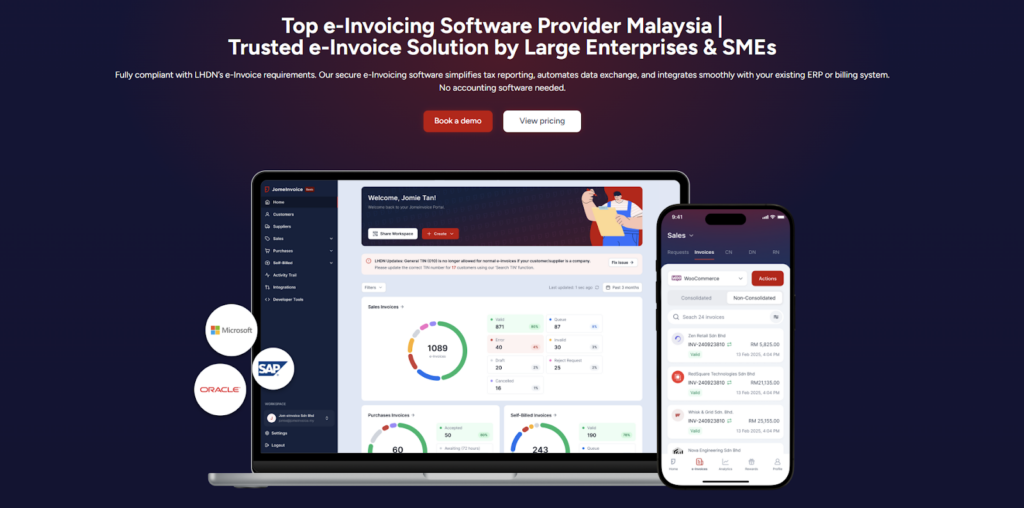
JomeInvoice is widely adopted as one of the best einvoicing software solutions in Malaysia. It is designed to support SMEs and large enterprises across all industries while meeting LHDN e-Invoice requirements with minimal operational disruption.
As a flexible e-Invoice platform for large enterprises and a practical solution for growing businesses, JomeInvoice supports high transaction volumes, complex workflows, and multi-system environments.
One e-Invoice Platform Built for All Business Sizes
JomeInvoice works as the best e-Invoice software for SMEs by offering fast onboarding, simple user interfaces, and automated compliance features. At the same time, it scales into a full e-Invoice platform for large enterprise use, supporting thousands of invoices daily through ERP and system integrations.
Key advantages
• Suitable for SMEs, mid-sized companies, and large enterprises
• Handles low and high invoice volumes efficiently
• Supports consolidated and self-billed e-Invoice workflows
Tailored for Every Industry
JomeInvoice works for a broad range of sectors, including retail, eCommerce, manufacturing, services, and more. It adapts to specific workflows, whether your business runs point-of-sale systems, online stores, or ERP platforms.
Retail e-Invoicing Solution for High-Volume Transactions
For retail businesses, JomeInvoice functions as a complete retail e-Invoicing solution. It supports POS integration, daily sales consolidation, and compliance with RM10,000 single transaction rules.
Retailers benefit from
• Automated consolidated e-Invoice generation
• POS system integration
• Reduced manual reporting during peak sales periods
e-Invoice for eCommerce and Online Businesses
JomeInvoice also serves as a reliable e-Invoice for eCommerce solution. It integrates with online stores and payment platforms, enabling seamless invoice issuance for high-frequency digital transactions.
eCommerce e-Invoicing features include
• Automated e-Invoice issuance for online sales
• Support for refunds, credit notes, and self-billed e-Invoice
• Compatibility with marketplaces and payment gateways
Enterprise-Grade Integration and Compliance
As a full einvoicing software for large enterprises, JomeInvoice integrates with major ERP systems such as SAP, Oracle NetSuite, Microsoft Dynamics, and other accounting platforms. It connects directly to the MyInvois system without requiring major changes to existing infrastructure.
Enterprise-ready capabilities
• ERP, accounting, and middleware integration
• Pre-validation checks to reduce rejection risks
• Audit trails and reporting for compliance and review
Book a free demo with JomeInvoice now!
See how your business can align with the malaysia e-invoice guideline, stay prepared for any e-invoice compliance review framework selection, and move ahead of your e-invoice implementation timeline before enforcement tightens.
Contact JomeInvoice helps your businesses stay compliant, reduce manual work, and prepare for full e-Invoice enforcement with confidence.