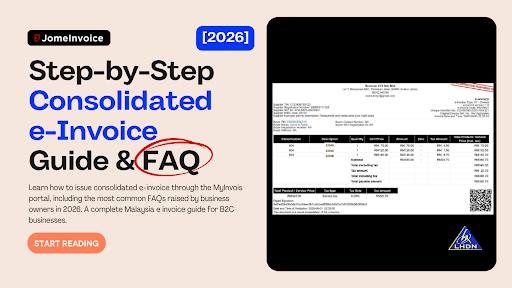
If you run a B2C business in Malaysia, this consolidated e-invoice guide is essential.
Many small businesses struggle with the new LHDN e-invoice requirements. Especially those handling high-volume daily transactions. Restaurants. Retail stores. Salons. Convenience shops.
If you sell 100 times a day, are you supposed to issue 100 e-Invoices?
No.
The Malaysia e invoice framework allows you to issue consolidated e-invoice instead. One submission can summarize an entire day, week, or month of B2C sales.
Let us break down how it works and how to do it properly through the MyInvois portal.
What Is a Consolidated e-Invoice Under LHDN?
A consolidated e-invoice is a single e-Invoice that summarizes multiple B2C transactions within a defined period and is submitted to LHDN.
Instead of issuing one e-Invoice per customer, you combine eligible B2C receipts into one document and upload it through the MyInvois portal.
Key features:
- No individual e-Invoice per walk-in customer
- No customer TIN required
- Used mainly for income reporting to LHDN
- Not shared with customers
- No customer validation or rejection process involved
- LHDN does not notify individual customers
This structure was designed specifically to support high-volume consumer businesses under the Malaysia e invoice system.
Why Malaysia B2C Businesses Need This Consolidated e-Invoice Guide
If you operate a B2C business, your daily transactions look like this:
- RM4 breakfast
- RM12 bubble tea
- RM25 retail item
- RM60 facial treatment
You may issue 80 to 200 receipts per day.
Manually issuing e-Invoice for each transaction through the MyInvois portal would be operationally impossible.
Common pain points:
- Customers do not provide TIN
- Staff cannot collect IC details
- Too much manual data entry
- Switching between POS, Excel, accounting system, and MyInvois portal
- Risk of submission errors
The real problem is not compliance. It is a manual workflow.
When Can You Issue a Consolidated e-Invoice?
You can issue consolidated e-invoice when the transaction meets these conditions:
- B2C Transactions
The customer is an individual consumer.
Examples:
- Breakfast stalls
- Bubble tea shops
- Convenience stores
- Clothing retail shops
- Walk-in beauty services
If customers do not require a tax-deductible e-Invoice, consolidation is allowed.
2. Customer Does Not Request Official e-Invoice
If the customer does not request an individual LHDN e-invoice for tax deduction purposes or for staff expense claims from their employer,, you can include the receipt in your consolidated submission.
When You Cannot Issue Consolidated e-Invoice
Certain industries are restricted from using consolidation under LHDN e-invoice rules:
- Motor vehicle sales
- Airline ticket sales and private charter
- Construction contractors
- Building materials wholesale and retail
- Luxury goods and jewelry
- Single B2C transaction exceeding RM10,000 cannot be included in a consolidated e-Invoice and must be issued individually.You also cannot consolidate:
- B2B transactions
- Customers who request formal e-Invoice
Those transactions must be submitted individually through the MyInvois portal or your integrated e-invoice platform.
How Often Must You Submit a Consolidated e-Invoice?
Under Malaysia e invoice rules, LHDN allows:
- Daily submission
- Weekly submission
- Monthly submission (by 7th of every month)
Most businesses choose monthly.
Important rule:
You must maintain proper daily transaction records such as:
- POS reports
- Cash register records
- Sales summary
- Accounting entries
Example timeline:
January sales period
Submit consolidated e-Invoice before 7 February
This deadline applies whether you use the MyInvois portal manually or an einvoicing software solution.
Step-by-Step: How to Issue Consolidated e-Invoice via MyInvois Portal
Here is the practical consolidated e-invoice guide for manual submission.
Step 1: Identify Whether Customer Requires e-Invoice
If a customer requests an official LHDN e-invoice, issue an individual e-Invoice.
If not, include receipt in consolidation.
With JomeInvoice, this classification can be automated within your POS or accounting system.
Step 2: Issue Normal Receipt to Customer
Continue issuing normal sales receipts.
You are not required to generate an individual e-Invoice for each walk-in B2C customer.
With JomeInvoice, receipt data syncs automatically from your ERP or accounting system without double entry.
Step 3: Compile All Eligible B2C Receipts
At the end of the period:
- Extract sales data
- Exclude receipts where customers requested e-Invoice
- Group eligible receipts
Manual MyInvois preparation often requires Excel formatting and data cleaning.
With JomeInvoice, the system automatically compiles consolidated data.
Step 4: Log into MyInvois Portal and Submit
Manually enter:
- Buyer Name: General Public
- Buyer TIN: EI00000000010
- Other buyer details: NA
- Quantity: 1
- Description: Summary of Receipts or Jan 2025 Sales
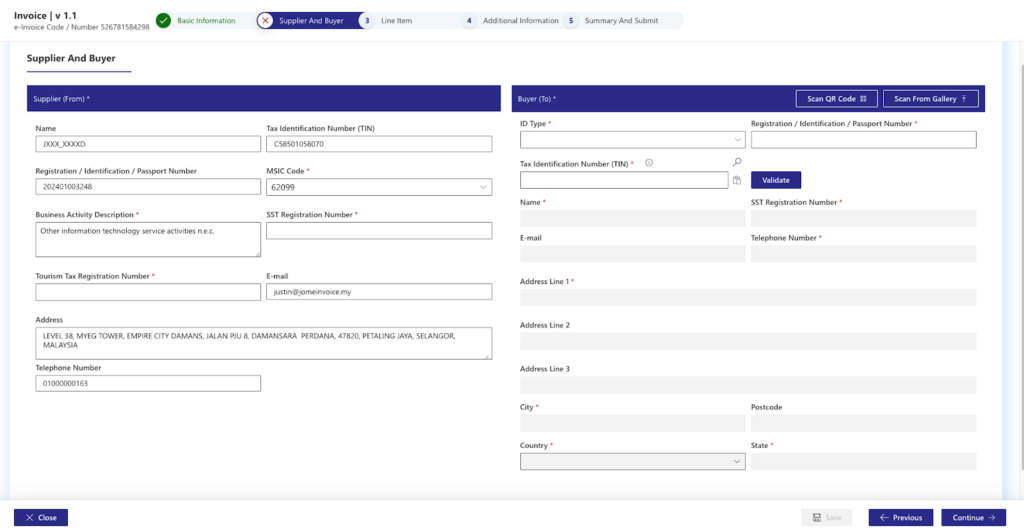
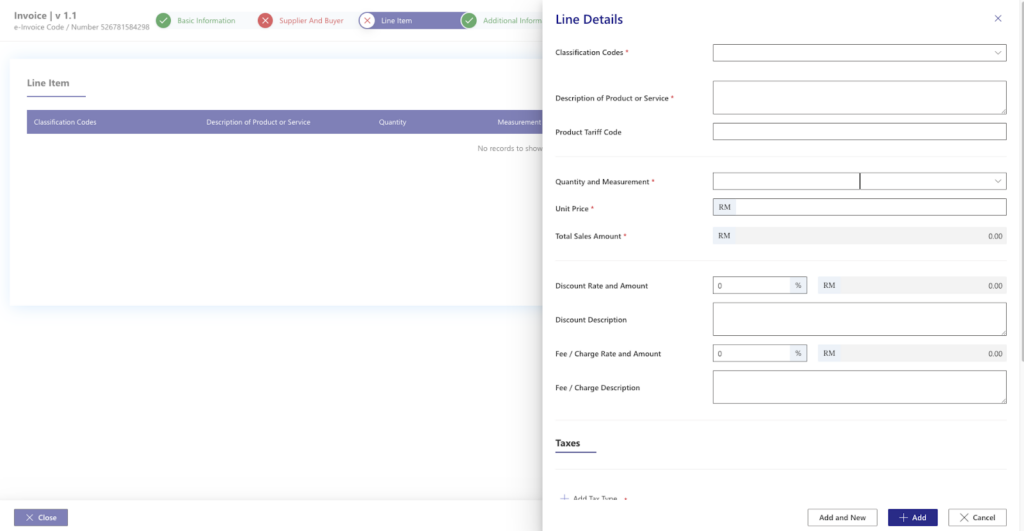
You must submit the consolidated e-invoice within 7 calendar days after the end of the month in which the transactions occurred.
With JomeInvoice, submission is pushed directly to LHDN via API integration, eliminating portal login and manual entry. Book a demo now!
Required Fields for Issuing a Consolidated e-Invoice via MyInvois Portal
When submitting via MyInvois portal, you must input:
- Buyer Name: General Public
- Buyer TIN: EI00000000010
- Buyer Registration: NA
- Buyer Contact: NA
- Quantity: 1
- Description: Summary of Receipts
- Tax code and tax amount if SST applicable
Manual entry increases risk of typo errors.
An integrated e-invoice platform auto-populates these fields based on predefined rules.
Two Methods to Prepare Consolidated e-Invoice
Method 1: One Receipt Number Per Line
Each receipt number appears on a separate line item.
Method 2: Group Continuous Receipt Numbers
If receipt numbers are sequential, you can group them in one line.
Important:
- If sequence breaks, start new line
- Exclude receipts where customer requested individual e-Invoice
Manual grouping creates compliance risk.
Automated einvoicing software can detect receipt sequences and prepare grouping accurately.
When Issuing Consolidated e-Invoice during Relaxation Period Under LHDN e-Invoice
During the initial e-Invoice implementation relaxation period:
- Description details are more flexible
- Simplified reporting accepted
After the relaxation period:
- More structured and detailed reporting required
Businesses relying solely on manual MyInvois portal submission may face increased administrative workload once stricter rules apply.
Limitations of Manual MyInvois Portal Submission
While the MyInvois portal supports compliance, manual handling creates operational friction:
- Manual data entry
- Multiple system switching
- Excel preparation
- Typo risk in TIN or amounts
- Receipt grouping errors
- Repeated login process
- Separate handling for multiple companies
For multi-branch or multi-entity businesses, the complexity increases significantly.
This is where integrated JomeInvoice, the best einvoicing software in Malaysia provides significant operational advantages.
Conclusion: e-Invoice Compliance Is Simple. Execution Is the Challenge.
The LHDN e-invoice framework allows B2C businesses to issue consolidated e-invoice legally and efficiently.
The challenge lies in:
- Manual preparation
- Portal submission
- Data accuracy
- System integration
Businesses using fragmented systems face higher compliance risk and administrative burden.
See How JomeInvoice Simplifies Consolidated e-Invoice Across All Your Companies
JomeInvoice is an integrated e-invoice platform built for Malaysia e invoice compliance.
It allows you to:
- Automatically generate consolidated e-Invoice
- Integrate with ERP, POS, and accounting systems
- One click to consolidate invoices and submit to lhdn
- Eliminate manual MyInvois portal entry
- Manage multiple companies under one dashboard
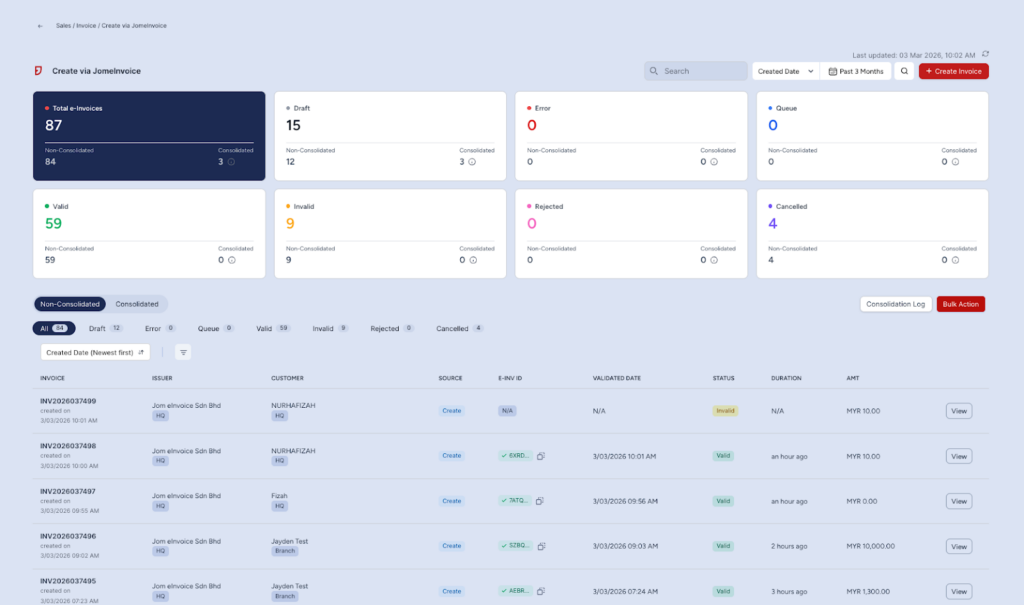
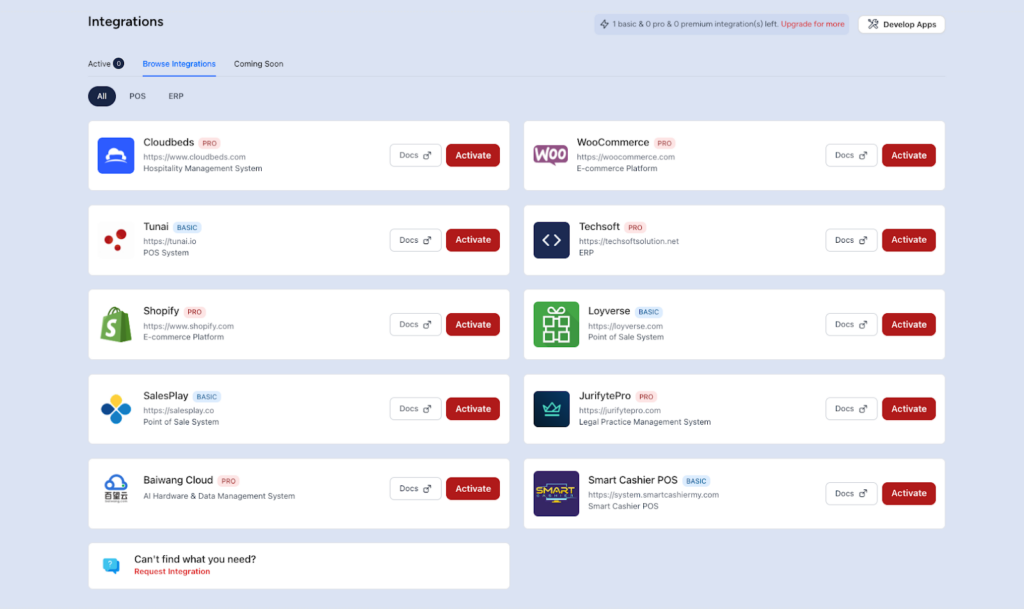
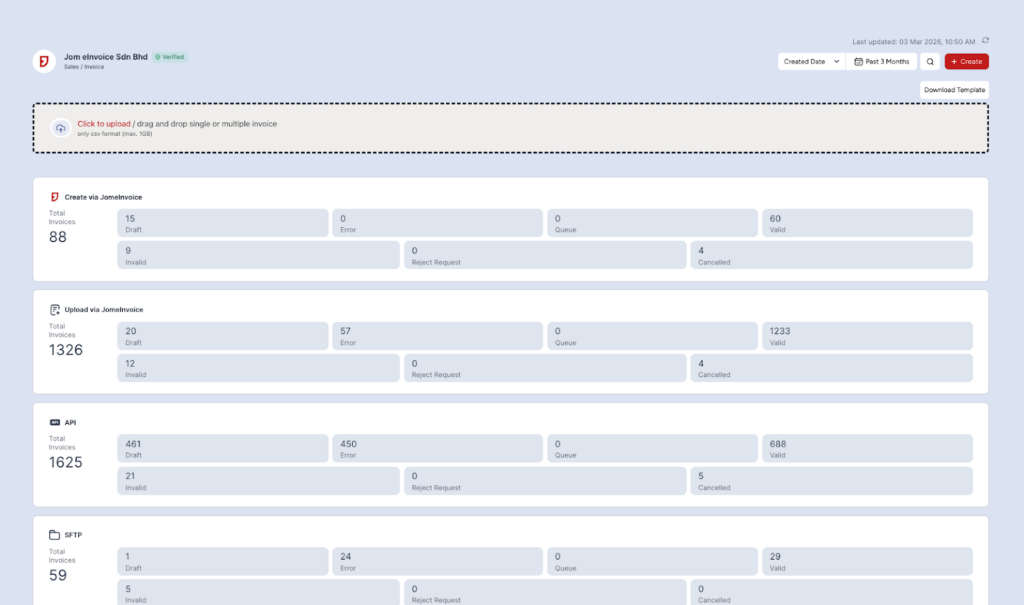
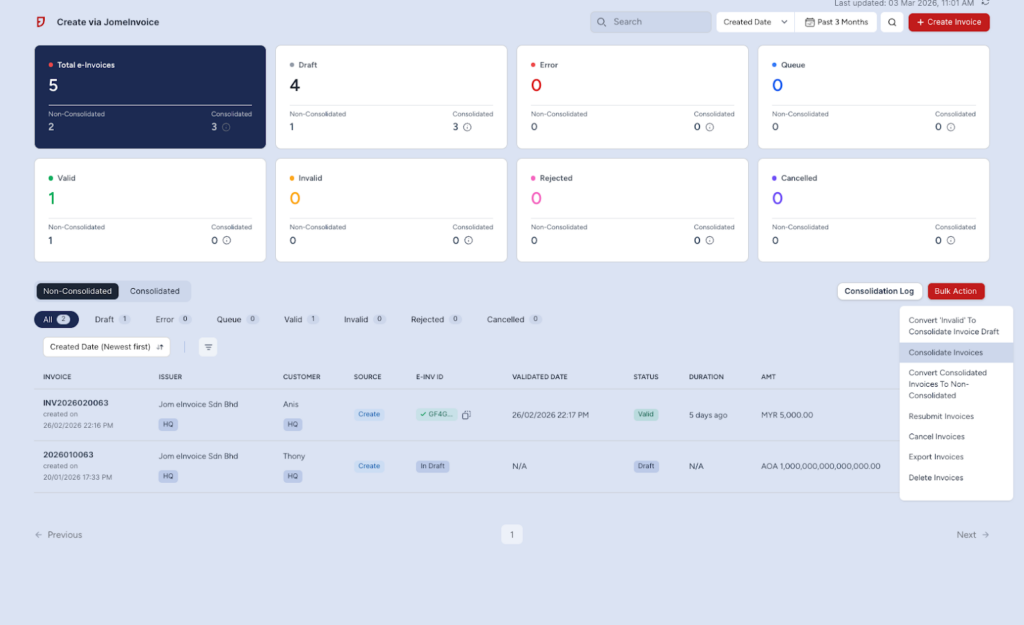
See how JomeInvoice can generate consolidated e-Invoices across all your companies with one click.
Book a demo now with JomeInvoice!
FAQ About Consolidated e-Invoice in Malaysia
1: If I Have Multiple Branches, Should I Issue Consolidated e-Invoice Separately or Combine All Branches?
Under the Malaysia e invoice framework, you may choose either approach depending on your system setup.
You can:
- Issue consolidated e-invoice separately for each branch, or
- Combine all branch transactions into one consolidated submission
This depends on how your accounting system or einvoicing software is structured.
If your branches operate under a centralized accounting system, consolidation across branches is possible. If each branch maintains separate reporting, separate submissions may be clearer for reconciliation.
Using an integrated e-invoice platform makes multi-branch consolidation significantly easier, especially when submitting through API instead of manually entering data in the MyInvois portal.
2: Can I Issue More Than One Consolidated e-Invoice in the Same Month?
Yes.
There is no restriction on how many times you can issue consolidated e-invoice within a month under LHDN e-invoice rules.
However, you must ensure that:
- Each consolidated e-Invoice is submitted within 7 days after the relevant period ends
- All transactions are properly supported by daily records
For example, you may choose:
- Weekly consolidated submissions
- Multiple submissions by business segment
- Separate consolidated e-Invoices per branch
Your consolidated e-invoice guide strategy should match your internal reporting structure.
3: If I Made a Mistake After Submitting Through the MyInvois Portal, Can I Issue a Credit Note?
Yes.
If there is an error after you issue consolidated e-invoice via the MyInvois portal, you may issue a Credit Note according to LHDN e-invoice guidelines.
Corrections must follow proper e-invoice adjustment procedures within the Malaysia e invoice system.
Using structured einvoicing software reduces the likelihood of such errors because validation checks are automated before submission.
4: I Am a Used Car Dealer. Can I Use Consolidated e-Invoice?
Under general LHDN e-invoice rules, motor vehicle sales are categorized under restricted industries and typically cannot use consolidated e-invoice.
However, during the initial 6-month relaxation period under the Malaysia e invoice rollout, certain temporary allowances may apply depending on LHDN guidance at that time.
After the relaxation period ends, businesses in restricted industries must issue individual e-Invoices for each qualifying transaction.
Always verify the latest LHDN e-invoice industry-specific rules before proceeding.
5: If I Already Issued Receipts in My Accounting Software or POS, Will Submitting Consolidated e-Invoice Cause Double Recording of Sales?
No.
Submitting a consolidated e-invoice does not duplicate your sales revenue.
Your accounting software records the sales transaction.
The consolidated submission is only for validation and reporting to LHDN through the MyInvois portal.
It does not create a second revenue entry in your books.
An integrated e-invoice platform simply transmits the validated data to LHDN. It does not duplicate accounting entries.
6: If I Choose the Relaxation Period, Can I Skip Submitting Consolidated e-Invoice?
No.
Even during the relaxation period under the Malaysia e invoice rollout, businesses are still required to submit consolidated e-invoice.
The relaxation period reduces penalty risk for non-compliance errors, but it does not remove the submission obligation.
You must still submit within 7 days after the end of the reporting period via the MyInvois portal or your chosen einvoicing software.
7: Does Using an e-Invoice Platform Replace MyInvois Portal?
No.
All LHDN e-invoice submissions ultimately go to the MyInvois system.
However, an integrated e-invoice platform or einvoicing software like JomeInvoice connects to LHDN via API and eliminates the need for manual login and data entry into the MyInvois portal.
This reduces:
- Manual errors
- System switching
- Time spent on validation
- Compliance risk
For businesses managing multiple entities or branches, using a centralized e-invoice platform significantly improves efficiency under the Malaysia e invoice framework.
Get Started with the Best e-Invoice Software for SMEs Malaysia and Large Enterprises – JomeInvoice
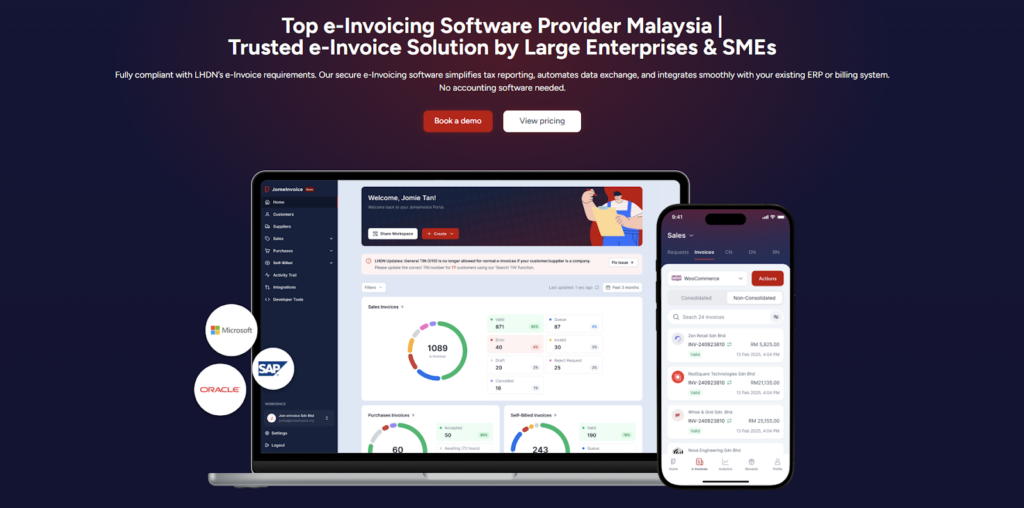
JomeInvoice is widely adopted as one of the best einvoicing software solutions in Malaysia. It is designed to support SMEs and large enterprises across all industries while meeting LHDN e-Invoice requirements with minimal operational disruption.
As a flexible e-Invoice platform for large enterprises and a practical solution for growing businesses, JomeInvoice supports high transaction volumes, complex workflows, and multi-system environments.
One e-Invoice Platform Built for All Business Sizes
JomeInvoice works as the best e-Invoice software for SMEs by offering fast onboarding, simple user interfaces, and automated compliance features. At the same time, it scales into a full e-Invoice platform for large enterprise use, supporting thousands of invoices daily through ERP and system integrations.
Key advantages
• Suitable for SMEs, mid-sized companies, and large enterprises
• Handles low and high invoice volumes efficiently
• Supports consolidated and self-billed e-Invoice workflows
Tailored for Every Industry
JomeInvoice works for a broad range of sectors, including retail, eCommerce, manufacturing, services, and more. It adapts to specific workflows, whether your business runs point-of-sale systems, online stores, or ERP platforms.
Retail e-Invoicing Solution for High-Volume Transactions
For retail businesses, JomeInvoice functions as a complete retail e-Invoicing solution. It supports POS integration, daily sales consolidation, and compliance with the RM10,000 consolidated e-Invoice threshold requirement
Retailers benefit from
• Automated consolidated e-Invoice generation
• POS system integration
• Reduced manual reporting during peak sales periods
e-Invoice for eCommerce and Online Businesses
JomeInvoice also serves as a reliable e-Invoice for eCommerce solution. It integrates with online stores and payment platforms, enabling seamless invoice issuance for high-frequency digital transactions.
eCommerce e-Invoicing features include
• Automated e-Invoice issuance for online sales
• Support for refunds, credit notes, and self-billed e-Invoice
• Compatibility with marketplaces and payment gateways
Enterprise-Grade Integration and Compliance
As a full einvoicing software for large enterprises, JomeInvoice integrates with major ERP systems such as SAP, Oracle NetSuite, Microsoft Dynamics, and other accounting platforms. It connects to the MyInvois system via API integration, minimizing the need for major changes to existing infrastructure.
Enterprise-ready capabilities
• ERP, accounting, and middleware integration
• Pre-validation checks to reduce rejection risks
• Audit trails and reporting for compliance and review
Book a free demo with JomeInvoice now!
See how your business can align with the Malaysia e-invoice guideline, stay prepared for any e-invoice compliance review framework selection, and move ahead of your e-invoice implementation timeline before enforcement tightens.
Contact JomeInvoice to help your business stay compliant, reduce manual work, and prepare for full e-Invoice enforcement with confidence.