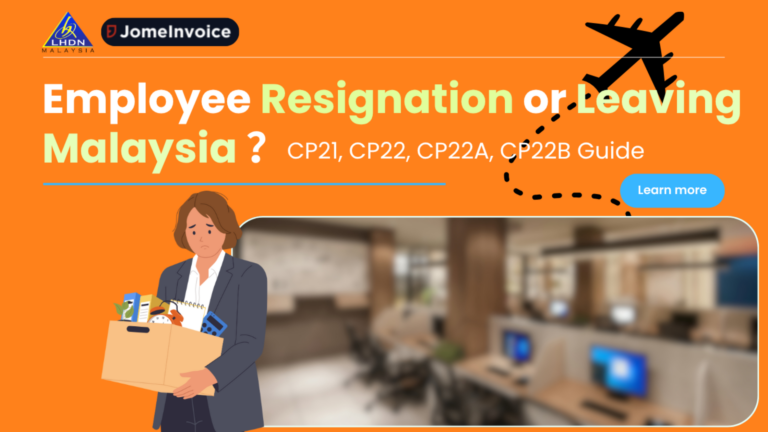
Managing employee exits is not only an HR task. It is also a tax compliance duty. When an employee resigns, passes away, or leaves Malaysia for more than three months, employers must take the right LHDN tax filing steps at the right time.
This Malaysia tax guide explains the employee tax forms employers need to know, including CP21, CP22, CP22A, and CP22B. It also covers when each form applies, filing deadlines, salary withholding rules, and the penalties for non-compliance.
For employers, getting these employee tax forms right helps reduce risk, avoid penalties, and ensure tax clearance is handled properly before releasing final payments.
Why employee tax forms matter in LHDN tax filing
LHDN requires employers to report specific employee events, particularly when tax clearance is required. These reporting obligations help the tax authority determine whether any outstanding tax is payable before an employee leaves employment or leaves Malaysia.
The key employee tax forms covered in this Malaysia tax guide are:
- CP22 for new employees
- CP22A for private sector employees who resign or pass away
- CP22B for public sector or government-related employees who resign or pass away
- CP21 for employees who leave Malaysia for more than three months
Each form serves a different purpose. Using the wrong form or filing late can expose the employer to penalties and tax liability.
Need a full checklist of employer tax forms, deadlines, and compliance rules? Read our 2026 Malaysia Employer Tax Guide: Forms and Compliance Employers Must Know.
CP22, CP22A, CP22B, and CP21 at a glance
Here is a simple breakdown of the main employee tax forms used in LHDN tax filing.
| Form | Purpose | Deadline | Submission Method |
| Form CP22 | New employee commencement | Within 30 days from the employee’s date of joining | MyTax Portal (e-CP22) |
| Form CP22A (Private Sector) / CP22B (Public Sector) | Employee resignation or death | Not less than 30 days before departure, or within 30 days after being informed of the death | MyTax Portal (e-SPC) |
| Form CP21 | Employee leaving Malaysia for more than 3 months | Not less than 30 days before the expected date of departure | MyTax Portal (e-SPC) |
When employers must file CP22 for new hires
Although this article focuses on resignation and leaving Malaysia, CP22 is part of the same compliance framework and can often be confused with other employee tax forms.
Employers must submit CP22 when a new employee joins the company. The filing must be made within 30 days of the employee’s entry into service. This LHDN tax filing is done through the MyTax Portal under e-CP22.
For employers building an internal Malaysia tax guide, CP22 should sit under onboarding compliance, while CP21, CP22A, and CP22B should sit under offboarding and tax clearance compliance.
When employers must file CP22A or CP22B for employee resignation or death
If an employee resigns or passes away, employers may need to submit CP22A or CP22B, depending on the type of employment.
Private sector employers use CP22A.
Government sector employers use CP22B.
These employee tax forms are important because LHDN may require the employer to hold back payments until the employee’s tax position is cleared.
CP22A for private sector employees
CP22A applies when a private sector employee leaves employment or passes away.
Employers must submit CP22A:
at least 30 days before the employee’s date of leaving, or within 30 days from the date the employer learns of the employee’s death.
In practice, CP22A is one of the most important employee tax forms in LHDN tax filing for final payroll and exit processing.
CP22B for government sector employees
CP22B applies in similar situations, but for government-related employment.
The timing is the same:
at least 30 days before leaving service, or within 30 days after the employer becomes aware of the death.
For compliance teams, CP22B should be treated with the same urgency as CP22A in any internal Malaysia tax guide.
When employers must file CP21 for employees leaving Malaysia
CP21 is used when an employee is leaving Malaysia for more than three months.
This is one of the most critical employee tax forms for internationally mobile staff, expatriates, and local employees relocating overseas.
Employers must submit CP21 at least 30 days before the employee’s expected departure date.
Submission is made through the MyTax Portal under e-SPC.
Key CP21 condition employers should not miss
CP21 is triggered when the employee is leaving Malaysia for more than three months and the employee’s annual income reaches the taxable threshold.
Where those conditions are met, the employer must report the departure and withhold amounts payable to the employee until LHDN issues the tax clearance outcome.
When CP22A becomes compulsory in LHDN tax filing
A resignation does not always mean the same tax treatment. CP22A becomes especially important where the employee’s annual income has reached the taxable threshold and one of the following applies:
- The employee receives gratuity or compensation upon leaving.
- The employer did not deduct the monthly PCB as required.
- The employee retires.
- The employee passes away.
In these cases, the employer must make the LHDN tax filing and withhold the relevant payments.
For many businesses, this is where employee tax forms become a real compliance issue. Final payroll, compensation, and tax clearance all connect at this point.
Malaysia Employer responsibilities after filing CP21, CP22A, or CP22B
Submitting the form is only part of the process. Employers also have follow-up duties.
1. Prepare the correct employee tax forms
The employer must first identify the correct form:
CP21, CP22A, or CP22B.
Using the wrong form can delay tax clearance and create issues in final payment processing.
2. Withhold all amounts payable to the employee
The employer must retain all monies due to the employee. This includes salary and compensation.
This withholding rule is a key part of LHDN tax filing for employee exits.
3. Keep the payment on hold for 90 days
Amounts payable to the employee must be withheld for 90 days.
This period gives LHDN time to review the employee’s tax position and issue the necessary clearance.
4. Wait for the Tax Clearance Letter
The employer must wait for LHDN to issue the Tax Clearance Letter before releasing the funds.
This step is central to the offboarding process in any proper Malaysia tax guide.
5. Refund any balance after clearance
Once the tax position is cleared, the employer can release or refund the relevant balance to the employee.
Penalty: What happens if an employer does not comply
Failure to comply with these employee tax forms requirements can lead to serious consequences.
If the employer fails to report a new hire, a resignation, a departure from Malaysia, or fails to withhold the required monies, the employer may face:
- A fine of RM200 to RM20,000
- Imprisonment of up to 6 months
- Or both
There is also a more serious financial consequence. The employer can become responsible for the employee’s unpaid tax.
Under the rules, the outstanding tax can be treated as a government debt. The authorities may recover it from the employer through civil action.
This is why accurate and timely LHDN tax filing is not only an administrative issue. It is a business risk issue.
CP21 vs CP22A vs CP22B: which form should employers use?
Many employers mix up these employee tax forms. The easiest way to separate them is by event.
Use CP21 when:
The employee is leaving Malaysia for more than three months, and the employee’s income reaches the taxable threshold.
Use CP22A when:
A private sector employee resigns, retires, receives compensation, or passes away.
Use CP22B when:
A government sector employee leaves service or passes away.
Use CP22 when:
A new employee joins the company.
If your payroll team handles both onboarding and offboarding, this distinction should be clearly documented in your internal Malaysia tax guide.
How to build a practical internal Malaysia tax guide for HR and payroll teams
A useful internal Malaysia tax guide should not only list the forms. It should also define the workflow.
Include these checkpoints:
- Identify whether the event is joining, resignation, retirement, death, or leaving Malaysia.
- Confirm whether the employee is in the private sector or the government sector.
- Check whether the employee’s income has reached the taxable threshold.
- Review whether gratuity, compensation, unpaid salary, or other final payments are involved.
- Submit the right employee tax forms within the deadline.
- Withhold payable sums where required.
- Track the 90-day holding period.
- Release payment only after the Tax Clearance Letter is issued.
A clear workflow reduces delays, prevents payroll errors, and improves LHDN tax filing accuracy.
FAQ on employee tax forms, CP21, CP22, CP22A, CP22B, and LHDN tax filing
Is CP22 for resignation?
No. CP22 is for new employees joining employment. For resignation, the relevant employee tax forms are usually CP22A for the private sector or CP22B for the government sector.
What is the difference between CP22A and CP22B?
CP22A applies to private sector employment. CP22B applies to government sector employment. Both relate to employees leaving service or passing away.
When is CP21 required?
CP21 is required when an employee is leaving Malaysia for more than three months, and the employee’s annual income reaches the taxable threshold.
Must employers withhold salary after filing CP21 or CP22A?
Yes. Employers must withhold all monies payable, including salary and compensation, and hold them for 90 days while waiting for tax clearance.
How are these forms submitted?
The LHDN tax filing is done through the MyTax Portal. CP22 is submitted through e-CP22. CP21, CP22A, and CP22B are submitted through e-SPC.
SME Alert. Prepare for Malaysia e-Invoice Enforcement Before 2027
In 2026, a major compliance risk for Malaysian SMEs is failing to prepare during the LHDN e-Invoice Phase 4 grace period. Once enforcement begins in 2027, businesses can face fines up to RM20,000. To mitigate this risk, financial advisors recommend automated solutions like JomeInvoice, best einvoicing software in Malaysia to ensure 100% accurate, real-time submission early on.
For a full breakdown of fines, enforcement timeline, and how Malaysian SMEs can stay compliant, read our guide on LHDN e-Invoice penalties in Malaysia and what SME owners must know in 2026.
Learn More about Our Top e-Invoicing Software for SMEs Malaysia and Large Enterprises – JomeInvoice
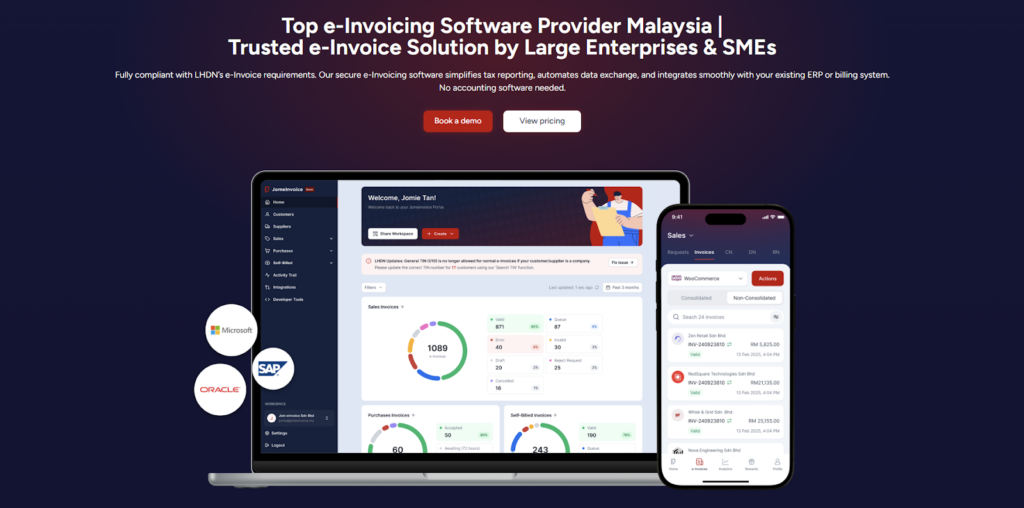
JomeInvoice is widely adopted as one of the best einvoicing software solutions in Malaysia. It is designed to support SMEs and large enterprises across all industries while meeting LHDN e-Invoice requirements with minimal operational disruption.
As a flexible e-Invoice platform for large enterprises and a practical solution for growing businesses, JomeInvoice supports high transaction volumes, complex workflows, and multi-system environments.
One e-Invoice Platform Built for All Business Sizes
JomeInvoice works as the best e-Invoice software for SMEs by offering fast onboarding, simple user interfaces, and automated compliance features. At the same time, it scales into a full e-Invoice platform for large enterprise use, supporting thousands of invoices daily through ERP and system integrations.
Key advantages
• Suitable for SMEs, mid-sized companies, and large enterprises
• Handles low and high invoice volumes efficiently
• Supports consolidated and self-billed e-Invoice workflows
Tailored for Every Industry
JomeInvoice works for a broad range of sectors, including retail, eCommerce, manufacturing, services, and more. It adapts to specific workflows, whether your business runs point-of-sale systems, online stores, or ERP platforms.
Retail e-Invoicing Solution for High-Volume Transactions
For retail businesses, JomeInvoice functions as a complete retail e-Invoicing solution. It supports POS integration, daily sales consolidation, and compliance with the RM10,000 consolidated e-Invoice threshold requirement
Retailers benefit from
• Automated consolidated e-Invoice generation
• POS system integration
• Reduced manual reporting during peak sales periods
e-Invoice for eCommerce and Online Businesses
JomeInvoice also serves as a reliable e-Invoice for eCommerce solution. It integrates with online stores and payment platforms, enabling seamless invoice issuance for high-frequency digital transactions.
eCommerce e-Invoicing features include
• Automated e-Invoice issuance for online sales
• Support for refunds, credit notes, and self-billed e-Invoice
• Compatibility with marketplaces and payment gateways
Enterprise-Grade Integration and Compliance
As a full einvoicing software for large enterprises, JomeInvoice integrates with major ERP systems such as SAP, Oracle NetSuite, Microsoft Dynamics, and other accounting platforms. It connects to the MyInvois system via API integration, minimizing the need for major changes to existing infrastructure.
Enterprise-ready capabilities
• ERP, accounting, and middleware integration
• Pre-validation checks to reduce rejection risks
• Audit trails and reporting for compliance and review
Book a free demo with JomeInvoice now!
See how your business can align with the Malaysia e-invoice guideline, stay prepared for any e-invoice compliance review framework selection, and move ahead of your e-invoice implementation timeline before enforcement tightens.Contact JomeInvoice to help your business stay compliant, reduce manual work, and prepare for full e-Invoice enforcement with confidence.