
If you own more than one company, Malaysia e invoice compliance is not as simple as checking your turnover.
Many business owners assume that if a company earns below RM1 million per year, it is exempt from lhdn e-invoice. That assumption is risky.
This e-Invoice FAQ explains how einvoicing works when you operate multiple companies, and how related entities can affect your obligation under e invoice Malaysia rules.
Why Malaysia e-Invoice Rules Matter for Group Business Owners
Under the Malaysia e invoice framework, implementation is based on annual turnover thresholds. At first glance, companies with revenue below RM1 million appear exempt.
However, the lhdn e-invoice guideline includes related company rules. These rules override the basic threshold test.
If one company in your group meets the applicable implementation threshold under the LHDN e-Invoice phased rollout, related companies may also be required to implement e-Invoicing, even if their own turnover is below that threshold.Non-compliance creates real risks:
• Late implementation
• System integration delays
• Increased audit exposure
• Possible penalties
If you manage multiple Sdn Bhd entities, you must assess structure, not just revenue.
Basic e-Invoice Malaysia Threshold Rule
Under e invoice Malaysia regulations:
• Companies above RM1 million annual turnover must implement lhdn e-invoice based on phased rollout
• Companies below RM1 million are initially exempt
This assessment starts on an individual company basis. But it does not end there.
When Exempt Companies Still Need LHDN e-Invoice
Even if a company earns below RM1 million, it may still be required to implement Malaysia e invoice if it falls into any of these categories:
• It is a subsidiary of a company above RM1 million
• It has a holding company above RM1 million
• It has a corporate shareholder linked to another company above RM1 million
• It qualifies as a related company under the guideline
This means exemption is not purely based on revenue. Group structure matters.
What Is a Related Company Under Malaysia e-Invoice Rules
The definition of related company under lhdn e-invoice guidelines follows legal interpretation.
It focuses on two main areas:
• Control
• Shareholding
These rules apply only to companies incorporated under the Companies Act 2016. Sole proprietorships, partnerships, and LLPs are treated differently.
Justifying Related Company Based on Control
The first three scenarios focus on operational control. Shareholding is not required.
Scenario 1
Company A controls or can control Company B, directly or indirectly.
Scenario 2
Company B controls or can control Company A, directly or indirectly.
Scenario 3
Both companies are controlled by the same person or the same corporate entity.
In this third case, there may be no shareholding between the two companies. But because a single person or entity controls both, they are considered related.
If one exceeds RM1 million,the other may also be required to implement e-Invoicing under the related company provisions.
Justifying Related Company Based on Shareholding
The next two scenarios focus on equity ownership. Control does not need to be proven.
Scenario 4
At least 20 percent of Company A’s issued share capital is owned, directly or indirectly, by Company B.
Scenario 5
At least 20 percent of Company B’s issued share capital is owned, directly or indirectly, by Company A.
If either company exceeds RM1 million annual turnover, the related entity must comply with e invoice Malaysia implementation.
Summary of the Five Related Company Justification in Malaysia
There are five total tests under Malaysia e invoice guidelines:
• Three based on control
• Two based on 20 percent shareholding
If any one company in the relationship exceeds RM1 million, related companies below the threshold are no longer exempt.
This is a key principle in lhdn e-invoice compliance.
Which Business Types Are Affected
The related company definition refers specifically to companies incorporated under the Companies Act 2016.
This means:
• Sdn Bhd entities are included
• Sole proprietorships are not included in this related company test
• Partnerships are assessed individually
• LLPs are assessed individually
For example, if you operate several sole proprietorships, their revenue may be aggregated under personal assessment rules. But they are not treated as related companies under this specific definition.
Understanding this distinction is critical in Malaysia e invoice planning.
Practical Steps for Malaysia Business Owners to Assess Your e-Invoicing Obligation
If you own multiple companies, take these steps:
- List all Sdn Bhd entities under your control
- Identify holding and subsidiary relationships
- Check direct and indirect shareholding percentages
- Identify any corporate shareholders
- Review who has operational control
- Check which companies exceed RM1 million turnover
- Document your justification for exemption or compliance
Do not rely on revenue alone.
Structure determines obligation under lhdn e-invoice rules.
Common Mistakes in e-Invoice Malaysia Compliance
Malaysia business owners often:
• Look only at turnover
• Ignore indirect control
• Overlook corporate shareholder links
• Confuse sole proprietorship rules with Sdn Bhd rules
• Delay assessment until the e-Invoice implementation deadline
These mistakes create unnecessary risk.
Final Takeaways on Malaysia e-Invoice Guideline in Terms of Related Entities Justification
Malaysia e invoice compliance is not just about size. It is about structure.
Under lhdn e-invoice guidelines:
• Related company provisions may affect exemption eligibility. • Control relationships matter
• 20 percent shareholding triggers related status
• Only Companies Act 2016 entities fall under this test
If you operate multiple companies, review your structure early.
Proper assessment protects your business from compliance issues and prepares you for smooth einvoicing implementation.
Get Started with the Best e-Invoice Software for SMEs Malaysia and Large Enterprises – JomeInvoice
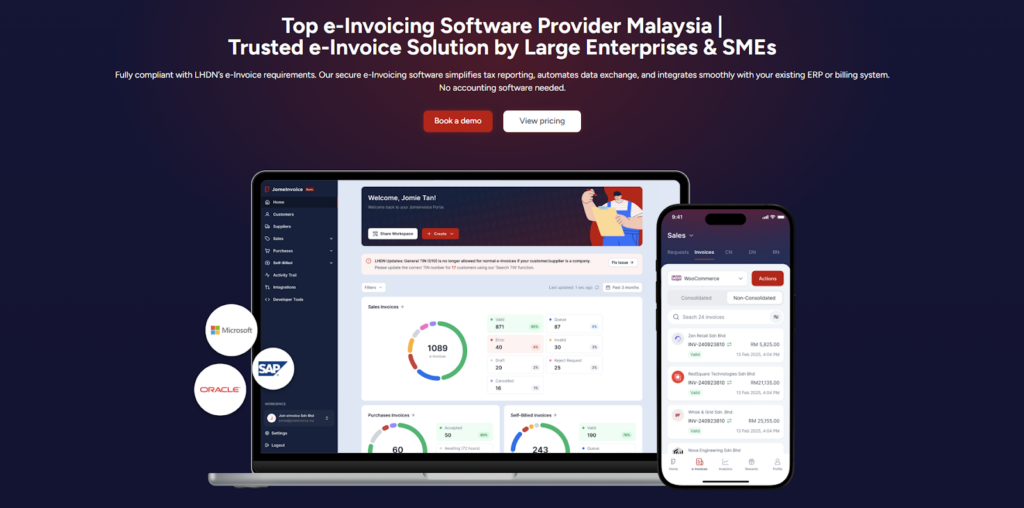
JomeInvoice is widely adopted as one of the best einvoicing software solutions in Malaysia. It is designed to support SMEs and large enterprises across all industries while meeting LHDN e-Invoice requirements with minimal operational disruption.
As a flexible e-Invoice platform for large enterprises and a practical solution for growing businesses, JomeInvoice supports high transaction volumes, complex workflows, and multi-system environments.
One e-Invoice Platform Built for All Business Sizes
JomeInvoice works as the best e-Invoice software for SMEs by offering fast onboarding, simple user interfaces, and automated compliance features. At the same time, it scales into a full e-Invoice platform for large enterprise use, supporting thousands of invoices daily through ERP and system integrations.
Key advantages
• Suitable for SMEs, mid-sized companies, and large enterprises
• Handles low and high invoice volumes efficiently
• Supports consolidated and self-billed e-Invoice workflows
Tailored for Every Industry
JomeInvoice works for a broad range of sectors, including retail, eCommerce, manufacturing, services, and more. It adapts to specific workflows, whether your business runs point-of-sale systems, online stores, or ERP platforms.
Retail e-Invoicing Solution for High-Volume Transactions
For retail businesses, JomeInvoice functions as a complete retail e-Invoicing solution. It supports POS integration, daily sales consolidation, and compliance with the RM10,000 consolidated e-Invoice threshold requirement
Retailers benefit from
• Automated consolidated e-Invoice generation
• POS system integration
• Reduced manual reporting during peak sales periods
e-Invoice for eCommerce and Online Businesses
JomeInvoice also serves as a reliable e-Invoice for eCommerce solution. It integrates with online stores and payment platforms, enabling seamless invoice issuance for high-frequency digital transactions.
eCommerce e-Invoicing features include
• Automated e-Invoice issuance for online sales
• Support for refunds, credit notes, and self-billed e-Invoice
• Compatibility with marketplaces and payment gateways
Enterprise-Grade Integration and Compliance
As a full einvoicing software for large enterprises, JomeInvoice integrates with major ERP systems such as SAP, Oracle NetSuite, Microsoft Dynamics, and other accounting platforms. It connects to the MyInvois system via API integration, minimizing the need for major changes to existing infrastructure.
Enterprise-ready capabilities
• ERP, accounting, and middleware integration
• Pre-validation checks to reduce rejection risks
• Audit trails and reporting for compliance and review
Book a free demo with JomeInvoice now!
See how your business can align with the Malaysia e-invoice guideline, stay prepared for any e-invoice compliance review framework selection, and move ahead of your e-invoice implementation timeline before enforcement tightens.
Contact JomeInvoice to help your business stay compliant, reduce manual work, and prepare for full e-Invoice enforcement with confidence.