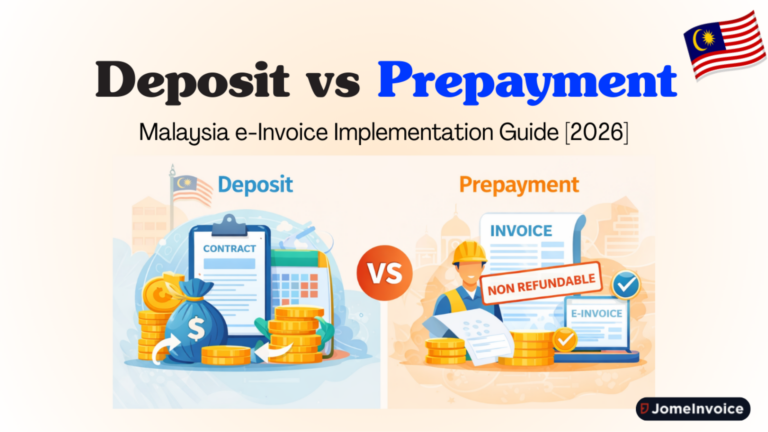
Key Points
- For Refundable Deposit: No e-Invoice required.
- For Non-refundable Deposit: e-Invoice required.
- Prepayment for Goods or Services : e-Invoice required.
- Businesses must adjust their invoicing workflow to include prepayment e-invoices. Departments must coordinate to ensure compliance with LHDN e-invoice requirements.
Many Malaysian businesses are confused about deposit and prepayment under the Malaysia e invoice system. A common question appears during the e-invoicing transition.
Do deposits require an LHDN e-invoice?
The answer depends on one key factor. Whether the payment is refundable or part of the sales income.
Understanding the difference between deposit, prepayment, and non-refundable deposit is important for proper e-invoice compliance. This article explains the rules, examples, and the changes businesses must prepare for during Malaysia e invoice implementation.
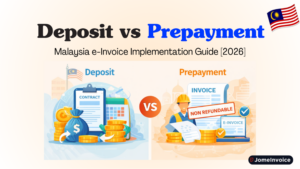
Deposit vs Prepayment in Malaysia e-Invoice
Under the Malaysia e invoice framework introduced by LHDN, not every payment requires an e-invoice immediately. The treatment depends on the nature of the payment.
Refundable Deposit
A refundable deposit acts as security. The business holds the money temporarily and returns it when the contract ends.
Examples include
- Rental security deposit
- Equipment deposit
- Booking deposit that will be returned
Since the deposit is not revenue, businesses normally do not issue an LHDN e-invoice for it.
The payment only acts as a safeguard. It does not represent a sale of goods or services.
Prepayment or Non-Refundable Deposit
A prepayment or non-refundable deposit represents advance income. The amount forms part of the total sales value.
Examples include
- Advance payment for renovation work
- Prepayment for services
- Non-refundable booking fees
- Advance payments for product orders
Other common prepayment types include
- Rental
Businesses may collect several years of rental in advance. For example, a company pays three to five years of office rental upfront. - Insurance
Companies often pay one year of insurance premium in advance. - Road tax
Vehicle owners normally pay one year of road tax upfront. - Subscription services
Software platforms often charge customers a one year subscription fee in advance.
Because the amount is part of revenue, an e-invoice must be issued.
This rule is part of the official Malaysia e invoice implementation guide issued by LHDN.
When Deposit Does Not Require an e-Invoice
The key condition is refundability.
Example
A landlord rents an office unit and collects the following payments
- Rental deposit RM3,000
- Advance rental RM1,500
The rental deposit RM3,000 will be returned at the end of the tenancy period if there is no damage or unpaid rent.
Because the deposit is refundable, it is not treated as income.
Result
No e-invoice is required for the refundable deposit.
However, the advance rental RM1,500 represents payment for the rental service. This amount forms part of the revenue.
Result
An LHDN e-invoice must be issued.
When Prepayment Requires an e-Invoice
If the deposit is non-refundable or forms part of the service or product price, the business must issue an e-invoice.
Example
A renovation contractor receives the following payments
- Deposit RM80,000
- Final payment RM100,000
The deposit is part of the project payment. The total project value is RM180,000.
Because the deposit represents advance income, the contractor must issue an e-invoice for the RM80,000 deposit separately from the final invoice.
Later, another e-invoice will be issued for the remaining RM100,000.
Some businesses prefer to issue the final e-invoice for the full amount RM180,000. In this situation, the earlier deposit can be recorded inside the prepayment information fields of the e-invoice.
Service Industry Example of Prepayment
Prepayment also appears in service bookings.
Example
A sports center sells a package for 10 hours of court rental.
The customer pays RM350 in advance for the first 5 hours. The remaining hours will be paid later.
RM350 is a prepayment for the service.
Result
The business must issue an e-invoice for the RM350 prepayment.
When the customer later pays for the remaining hours, the business will issue another e-invoice for the remaining amount.
How Malaysia e-Invoice Changes Your Invoicing Workflow
Many business owners ask whether e-invoicing will affect daily operations.
The answer is yes. Especially when dealing with prepayments.
Before Malaysia e invoice implementation, the workflow usually looks like this.
Old workflow
- Issue quotation or proforma invoice
- Customer pays deposit
- Business issues official receipt
- Goods delivered with delivery order
- Business issues full invoice
- Customer pays balance and receives receipt
Under the Malaysia e invoice system, the workflow changes.
New workflow with e-invoicing
- Issue quotation or proforma invoice
- Issue e-invoice for the prepayment
- Receive payment and issue receipt
- Deliver goods or services
- Issue e-invoice for remaining balance
- Receive final payment and issue receipt
The key difference is clear.
Prepayments now require an e-invoice during the transaction process instead of waiting for the final invoice.
Operational Impact on Businesses in Malaysia
The introduction of LHDN e-invoice affects more than just accounting.
Previously, the sales team could collect deposits and issue receipts without involving other departments.
Under the Malaysia e invoice system, businesses must ensure proper coordination between departments.
Example workflow
- Sales receives the deposit from the customer
- Finance team generates the e-invoice
- Operations prepares the delivery order
- Finance later issues the remaining e-invoice
This creates additional steps in the internal workflow.
Businesses preparing for e-invoice implementation should review their internal processes to ensure smooth coordination between sales, finance, and operations.
Important e-Invoice Fields for Prepayment
The Malaysia e invoice format includes specific fields to record prepayments.
These fields allow businesses to record earlier advance payments inside the final invoice.
Common prepayment fields include
- Prepayment amount
- Prepayment date
- Prepayment reference number
For example, if a contractor already issued an e-invoice for a deposit of RM80,000, the final invoice can record this deposit using the prepayment fields.
This improves transparency and ensures compliance with the LHDN e-invoice structure.
What Businesses Should Remember About Deposit and Prepayment E-Invoicing
Refundable deposits do not represent revenue and normally do not require an e-invoice.
Prepayments and non-refundable deposits form part of the sales value and require an LHDN e-invoice.
As Malaysia moves forward with e-invoicing implementation, businesses should review their invoicing workflow and ensure their systems support prepayment invoicing.
Our Advice: Avoid Last Minute e-Invoice Setup Before the 2026 Deadline
While Phase 4 businesses have a 12-month grace period in 2026, early adoption prevents vendor bottlenecks but many businesses worry that they must replace their existing systems to support e-invoicing.
This is usually not necessary.
If you are using Loyverse POS or SalesPlay, or running your online store on Shopify, WooCommerce, or Boutir, you do not need to upgrade or replace your current system for Malaysia e invoice compliance as they already have the e-Invoice integration feature with JomeInvoice support!
If your POS system, eCommerce platform, or accounting software does not support Malaysia e invoice features, you can connect it using an e-invoice middleware solution.
JomeInvoice works as an affordable middleware that connects your existing POS systems, eCommerce platforms, and accounting software directly to the LHDN MyInvois portal automatically.
This allows businesses to continue using their existing systems while staying compliant with LHDN e-invoice requirements.
Learn More about JomeInvoice – the Best e-Invoice Software for SMEs Malaysia and Large Enterprises
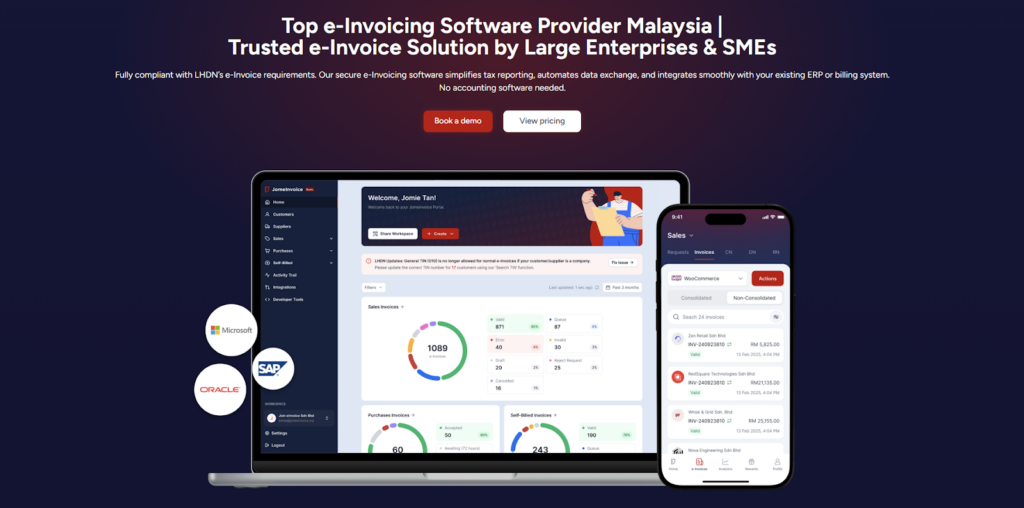
JomeInvoice is widely adopted as one of the best einvoicing software solutions in Malaysia. It is designed to support SMEs and large enterprises across all industries while meeting LHDN e-Invoice requirements with minimal operational disruption.
As a flexible e-Invoice platform for large enterprises and a practical solution for growing businesses, JomeInvoice supports high transaction volumes, complex workflows, and multi-system environments.
One e-Invoice Platform Built for All Business Sizes
JomeInvoice works as the best e-Invoice software for SMEs by offering fast onboarding, simple user interfaces, and automated compliance features. At the same time, it scales into a full e-Invoice platform for large enterprise use, supporting thousands of invoices daily through ERP and system integrations.
Key advantages
• Suitable for SMEs, mid-sized companies, and large enterprises
• Handles low and high invoice volumes efficiently
• Supports consolidated and self-billed e-Invoice workflows
Tailored for Every Industry
JomeInvoice works for a broad range of sectors, including retail, eCommerce, manufacturing, services, and more. It adapts to specific workflows, whether your business runs point-of-sale systems, online stores, or ERP platforms.
Retail e-Invoicing Solution for High-Volume Transactions
For retail businesses, JomeInvoice functions as a complete retail e-Invoicing solution. It supports POS integration, daily sales consolidation, and compliance with the RM10,000 consolidated e-Invoice threshold requirement
Retailers benefit from
• Automated consolidated e-Invoice generation
• POS system integration
• Reduced manual reporting during peak sales periods
e-Invoice for eCommerce and Online Businesses
JomeInvoice also serves as a reliable e-Invoice for eCommerce solution. It integrates with online stores and payment platforms, enabling seamless invoice issuance for high-frequency digital transactions.
eCommerce e-Invoicing features include
• Automated e-Invoice issuance for online sales
• Support for refunds, credit notes, and self-billed e-Invoice
• Compatibility with marketplaces and payment gateways
Enterprise-Grade Integration and Compliance
As a full einvoicing software for large enterprises, JomeInvoice integrates with major ERP systems such as SAP, Oracle NetSuite, Microsoft Dynamics, and other accounting platforms. It connects to the MyInvois system via API integration, minimizing the need for major changes to existing infrastructure.
Enterprise-ready capabilities
• ERP, accounting, and middleware integration
• Pre-validation checks to reduce rejection risks
• Audit trails and reporting for compliance and review
Book a free demo with JomeInvoice now!
See how your business can align with the Malaysia e-invoice guideline, stay prepared for any e-invoice compliance review framework selection, and move ahead of your e-invoice implementation timeline before enforcement tightens.
Contact JomeInvoice to help your business stay compliant, reduce manual work, and prepare for full e-Invoice enforcement with confidence.