

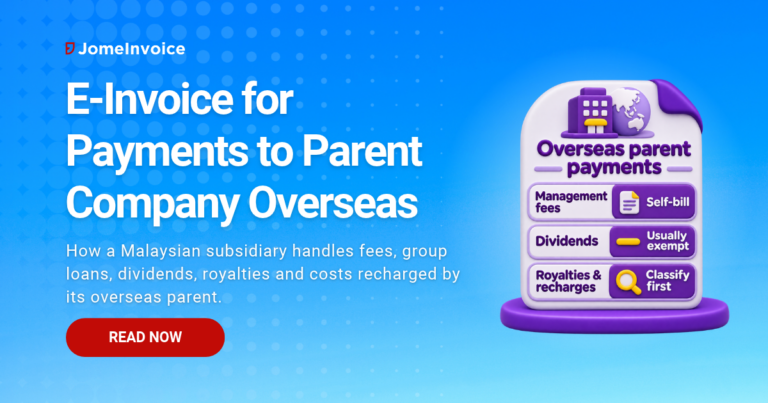
- For management fees and other services from a parent abroad, an individual self-billed e-Invoice is due by the end of the month after payment or receipt of the parent’s invoice, whichever happens first. Eligible monthly consolidation has a separate deadline (Specific Guideline v4.9, sections 8.3(b) and 10.4.9, General FAQs Q120).
- Ordinary interest paid to a China, Taiwan or Hong Kong parent that lends within its group is self-billed. The treasury exception covers related companies incorporated in Malaysia. Lenders that charge interest to the public fall under a separate exception (Specific Guideline v4.9, sections 8.3(g)(i) and (iv)).
- A dividend paid by a Malaysian company to its foreign parent ordinarily falls within the section 11.1.2 exemption, since section 108 of the Income Tax Act 1967 provides that a company is not entitled to deduct tax from dividends; the Inland Revenue Board of Malaysia (LHDN) reviews the exemption from time to time (Specific Guideline v4.9, section 11.1.2; General Guideline v4.8, section 1.6.7(d)).
- Self-billing is a closed list: a payment outside section 8.3 may not be self-billed (LHDN (Inland Revenue Board of Malaysia) e-Invoice General FAQs, 4 September 2026, Q27 and Q28), so royalties and recharges must be classified before the e-Invoice is chosen.
- Failing to issue a self-billed e-Invoice without reasonable excuse is an offence which, on conviction, carries a fine of RM200 to RM20,000 (Malaysian ringgit), up to 6 months’ imprisonment, or both (Income Tax Act 1967, subsection 82C(6) read with paragraph 120(1)(d)).
Once a Malaysian entity must e-invoice, it usually issues its own self-billed e-Invoice for payments to a parent company overseas. This covers management fees, other service charges and interest on an ordinary loan from a parent that lends within the group. If the parent only paid a supplier who invoiced the Malaysian entity directly, the repayment can need no e-Invoice. A dividend paid by a Malaysian company usually falls under an exemption. The Inland Revenue Board of Malaysia (LHDN) limits self-billing to specific transactions.
This guide is for head-office (HQ) finance teams and the Malaysian entity’s finance person in charge. It takes each payment to the group in turn: whether a self-billed e-Invoice is required, which rule applies, when it is due, what the parent must supply, and the exceptions. It is the detailed companion to our guide to e-invoicing for China, Taiwan and Hong Kong companies in Malaysia , which covers who is in scope and how the head-office enterprise resource planning (ERP) system connects.
Which Payments to an Overseas Parent Need a Self-Billed e-Invoice?
Most do, but not all, and the exceptions sit in the sub-clauses. A self-billed e-Invoice is an e-Invoice that the buyer issues in place of the supplier and submits to LHDN through MyInvois, LHDN’s e-Invoice system. It is allowed only for the circumstances listed in section 8.3 of the Specific Guideline.
The table applies once the Malaysian entity is required to e-invoice. For imported services, check the date of payment and the date the parent’s invoice arrived. If either came before the entity’s mandatory start date, it need not self-bill that service (General FAQs Q119).
| Payment to the group | e-Invoice needed? | Rule | Deadline | Exception to check |
|---|---|---|---|---|
| Management, IT or shared-service fee | Self-billed by the Malaysian entity | Sections 8.3(b), 10.4.9 and FAQs Q60, Q120 | Individual invoice due at the end of the month after payment or invoice receipt, whichever comes first. Eligible monthly consolidation is due seven calendar days later. | Check whether either event came before the entity’s mandate (FAQs Q119) |
| Recharge of costs the parent bought and allocates | Self-billed, with the cost and any fee on separate lines | Sections 5.6, 10.4; FAQs Q60 | As for services | LHDN’s recharge examples are domestic; cross-border reading, confirm with your tax adviser |
| Repayment of a cost the parent paid for you, where the supplier invoiced you directly | No e-Invoice for the repayment | Section 5.5, Example 9 | Not applicable | Any fee the parent charges for paying is self-billed (cross-border reading; confirm) |
| Royalty or licence fee | Depends on classification | Not named in section 8.3 | As for services, if within section 8.3(b) | Self-billing outside section 8.3 is not allowed (FAQs Q27, Q28) |
| Interest on an ordinary loan from a parent that lends within the group | Self-billed | Section 8.3(g) | No fixed day for an individual invoice (FAQs Q38). Use an accrual or paid basis (Q70). | Check the separate rules for lenders that lend to the public and for Malaysian-incorporated treasury companies. |
| Dividend | Not required in the ordinary case (section 11.1.2 exemption) | Sections 8.3(c), 11.1.2; General Guideline section 1.6.7(d) | Not applicable | Exemption “will be reviewed and updated from time to time” (section 11.1.2) |
| Capital reduction, share buyback or return of capital | Self-billed by the Malaysian entity | Section 8.3(i) | Agreement date, approval date or completion date | None stated |
Source: e-Invoice Specific Guideline v4.9 (7 September 2026), sections 5, 8.3, 10.4 and 11; LHDN e-Invoice General FAQs (4 September 2026), Q27, Q28, Q38, Q60, Q70, Q119 and Q120.
The closed list cuts both ways. LHDN states that self-billing is “only permitted for circumstances that are provided under Section 8.3”, and that a buyer may not self-bill because a supplier failed to issue an e-Invoice (FAQs Q27, Q28). Self-billing every payment to the parent “to be safe” therefore produces self-billed e-Invoices that LHDN does not allow; our overview of all nine self-billed circumstances lists the full set.
For two Malaysian group companies, the supplying company issues a normal e-Invoice for most charges. In Example 16 the subsidiary self-bills interest on an ordinary intra-group loan from its holding company. Our guide to related-company rules for e-Invoice covers that domestic side.
Withholding tax is a separate regime. Sections 109 and 109B of the Income Tax Act 1967 require tax to be deducted from certain interest, royalties and service fees paid to non-residents, and issuing a self-billed e-Invoice does not discharge that duty. Our guide to withholding tax in Malaysia covers which payments are caught.
How Do Management Fees and Shared-Service Charges Work?
A management fee charged by a parent in China, Taiwan or Hong Kong is a service rendered by a foreign supplier, so the Malaysian entity issues a self-billed e-Invoice for it (Specific Guideline v4.9, sections 8.3(b) and 10.4.3). LHDN also confirms that intercompany charges need an e-Invoice (FAQs Q60). The validated self-billed e-Invoice is the Malaysian entity’s proof of expense for tax purposes (section 10.4.6).
The deadline runs from the earlier of two events (section 10.4.9):
- Payment by the Malaysian entity.
- Receipt of the parent’s invoice.
For an individual invoice, the deadline is the end of the following month. Use the rules for imported taxable services to determine the trigger. Suppose a Shenzhen parent’s invoice reaches the Malaysian subsidiary on 27 November 2026 and the subsidiary pays on 15 December. The November receipt sets the deadline. The individual invoice is due by 31 December 2026. If the subsidiary qualifies for monthly consolidation and uses it, the consolidated invoice is due by 7 January 2027, seven calendar days after December ends (General FAQs Q116 and Q120).
Four operating rules shape the monthly routine:
- Check eligibility before consolidating. The usual rule is one self-billed e-Invoice per purchase from a foreign supplier (FAQs Q76 and Specific Guideline section 3.6.5). The interim relaxation period in Table 16.1 runs through 31 December 2027 for taxpayers with turnover up to RM5 million and a mandatory start date of 1 January or 1 July 2026. They may consolidate section 8.3 transactions monthly under section 16.2(b). A subsidiary with a later commencement date should confirm its eligibility with LHDN first. Our complete LHDN e-Invoice guide for 2026 covers the rollout dates.
- Service tax. Where service tax on imported taxable services applies under the sales and service tax (SST) legislation, the self-billed e-Invoice must include the service tax amount (section 10.4.7).
- Currency. The e-Invoice can stay in renminbi (RMB), New Taiwan dollars (TWD) or Hong Kong dollars (HKD); the ringgit (RM) equivalent is needed only where a legal or tax requirement says so (FAQs Q25; section 13).
- Corrections. A year-end true-up is recorded through a credit, debit or refund note, because a validated e-Invoice can be cancelled only within 72 hours (FAQs Q47, Q52); our guide to amending and cancelling e-Invoices covers each note type.
The field-by-field mechanics of a self-billed e-Invoice for services are in our guide to self-billed e-Invoices for imported services .
How Should Cost Recharges and Reimbursements to the Parent Be Treated?
The answer depends on who the third-party supplier invoiced, not on the word “recharge”. Section 5 of the Specific Guideline separates a cost the parent merely paid on the Malaysian entity’s behalf from a cost the parent bought and passes on.
| Situation | e-Invoice treatment | Source |
|---|---|---|
| A supplier invoices the Malaysian entity directly; the parent pays the supplier; the entity repays the parent | No e-Invoice for the repayment, because no sale is concluded between parent and entity | Section 5.5; Example 9 |
| The parent charges a fee for paying on the entity’s behalf | An e-Invoice is required; with the parent abroad, the entity self-bills it as a service from a foreign supplier | Example 9; section 10.4 |
| The parent buys a service itself and recharges or allocates it to the entity | Self-billed by the entity, with the cost incurred and the parent’s service fee as separate lines (cross-border reading; confirm) | Section 5.6.2; section 10.4 |
Two cautions apply. First, Example 9 and section 5.6 are written for Malaysian companies; as of Specific Guideline v4.9 (7 September 2026), LHDN has not published a cross-border version, so the self-billed treatment in rows two and three applies section 10.4 to them and should be confirmed with your tax adviser. Second, where the supplier who invoiced the entity directly is itself abroad, the entity self-bills that supplier, not the parent.
For goods bought from the parent, the individual self-billed e-Invoice is due by the end of the second month after customs clearance (section 10.4.8), as our guide to self-billed e-Invoices for imported goods explains.
Do Royalties and Licence Fees Paid to the Group Need a Self-Billed e-Invoice?
LHDN has not said. Neither the Specific Guideline v4.9 nor the FAQs of 4 September 2026 name royalties or licence fees, so the answer turns on whether the licence is a service rendered by the foreign licensor under section 8.3(b).
That classification matters in both directions:
- Within section 8.3(b): the Malaysian entity must self-bill, on the imported-services timing in section 10.4.9.
- Outside section 8.3: the Malaysian entity may not self-bill at all (FAQs Q27, Q28).
LHDN’s general position is that an e-Invoice is required for all types of income and expenses except those the guidelines exclude (FAQs Q56), and royalties are not among the exclusions. Record the classification for each trademark, software or technology licence, agree it with your tax adviser, and apply it the same way every month.
Is Interest on a Loan from a China, Taiwan or Hong Kong Group Company Self-Billed?
Yes for an ordinary loan from a parent that lends within its group. The Malaysian borrower self-bills the interest under section 8.3(g). Section 8.3(g)(iv) limits the centralised-treasury exception to a related company incorporated in Malaysia that provides treasury services to related companies. If the group lender also charges interest to the public, check the separate exception in section 8.3(g)(i) before deciding who should issue the invoice.
LHDN’s own examples draw the line: a subsidiary self-bills interest paid to a holding company that is not a treasury company (Example 16), while a Malaysian related company providing centralised treasury services issues a normal e-Invoice instead (Example 17). A treasury centre incorporated in Hong Kong or Taiwan that lends only within its group falls outside the Malaysian treasury exception.
Three practical rules follow:
- Timing basis. The self-billed e-Invoice on interest can be issued on an accrual basis or a paid basis (FAQs Q70); pick one and keep it.
- No routine consolidation. Outside the relaxation period, consolidated self-billed e-Invoices are allowed for interest only where it is paid to the public at large (section 3.6.5(b)), which a group loan is not.
- Sharing. Send the lender the validated individual self-billed e-Invoice for interest, or a visual copy (section 8.5). The lender can use the e-Invoice QR code to check the copy. If you use an eligible consolidated self-bill, you do not need to send it to the lender (General FAQs Q121).
The reverse flow is different. When the parent pays interest to the Malaysian entity, the Malaysian entity issues a normal e-Invoice, because interest paid by a foreign payor to a Malaysian taxpayer is an exception to self-billing (section 8.3(g)(iii)).
Does a Dividend to the Foreign Parent Need a Self-Billed e-Invoice?
Not for a Malaysian company in the ordinary case. Profit distributions are a self-billed circumstance (section 8.3(c)), but section 11.1.2 exempts “taxpayers that are not entitled to deduct tax under Section 108 of the Income Tax Act 1967” and taxpayers listed on Bursa Malaysia from issuing self-billed e-Invoices on dividend distribution. The General Guideline v4.8 lists “distribution of dividend in specific circumstances” among the items needing no e-Invoice (section 1.6.7(d)).
Section 108(1) of the Income Tax Act 1967 (updated text as at 1 January 2026) provides that a company paying a dividend “shall not be entitled to deduct tax from such dividend paid or credited”. Read together, a Malaysian private limited company (Sendirian Berhad, Sdn Bhd) paying a dividend to its parent in China, Taiwan or Hong Kong falls within the exemption and can continue with its existing dividend vouchers (section 11.1.3). Section 11.1.2 says the exemption “will be reviewed and updated from time to time”, so confirm the position with your tax adviser before each declaration.
Capital returned to the parent is treated differently. Capital reduction, share or capital redemption, share buyback, return of capital and liquidation proceeds are self-billed by the investee (section 8.3(i)). The date is the agreement date, the date of any required government approval or last condition, or the completion date where there is no written agreement.
What Must the Parent Company Supply?
The parent supplies its own invoice and a short set of registration details; the Malaysian entity fills in everything else. LHDN lets the Malaysian purchaser take the foreign seller’s details from its invoice or request them, and sets a fallback value for most fields the parent cannot provide (Specific Guideline v4.9, section 10.4.5 and Table 10.1).
| Field on the self-billed e-Invoice | What the parent provides | Fallback in Table 10.1 |
|---|---|---|
| Supplier’s name | Legal name of the parent or group company | None listed |
| Supplier’s TIN | LHDN-assigned tax identification number (TIN), if it has one | EI00000000030 |
| Registration number | Business registration number | “NA” |
| Address | Business address | None listed |
| Contact number | Telephone number | None listed |
| SST registration number | Malaysian SST number, if registered | “NA” |
| MSIC code | Malaysia Standard Industrial Classification (MSIC) code, if any | “00000” |
| Business activity description | Description of the parent’s business | “NA” |
Source: Specific Guideline v4.9, Table 10.1 (foreign sellers of goods and services); Table 8.3 applies equivalent options to other self-billed circumstances such as interest. Section 10.4.5 also allows “NA” where a required detail is not applicable or not provided, but name, address and phone are the fields with no listed fallback, so ask the parent for them first.
Two points save HQ teams time. The Malaysian entity must first check whether the group company already has an LHDN-assigned TIN, because the general TIN is only for those without one (FAQs Q35); our guide to general TIN codes for foreign suppliers lists every code. And for goods and services, LHDN notifies only the Malaysian purchaser, which is not obliged to share the self-billed e-Invoice with the foreign seller (sections 10.4.5 and 10.4.6), so head office sees nothing unless the entity sends it.
The Malaysian entity also chooses a classification code for each line. The MyInvois classification code list includes:
- 035 Self-billed: Importation of services
- 036 Self-billed: Others
- 016 Interest and financing expenses
- 006 Disbursement
- 027 Reimbursement
The list does not assign codes to group flows, so document the code chosen for each flow and use it consistently.
Action Plan for HQ and the Malaysian Finance Team
The sequence below turns the rules into a monthly routine for payments to the group.
- List every payment to the group. Assign each one a section 8.3 letter, or “no e-Invoice”.
- Classify royalties and recharges. Record the reasoning and your tax adviser’s confirmation.
- Collect the parent’s details once. Name, TIN, registration number, address and phone.
- Set the clock per flow. Mark the individual or eligible consolidated deadline for services. For group interest, choose an accrual or paid basis.
- Fix an exchange-rate policy. Apply any authority’s rate rule first, then one documented internal source.
- Map classification codes. One documented code per flow.
- Regularise past gaps. Use the e-Invoice Special Voluntary Disclosure Programme (SVDP) by 31 December 2027.
Missed self-billed e-Invoices can be regularised through the SVDP, which runs from 7 July 2026 to 31 December 2027 (Specific Guideline v4.9, section 17); our e-Invoice SVDP guide covers the steps. Responsibility stays with the Malaysian taxpayer and, for a company, its directors, even when head office or a provider runs the process (FAQs Q30).
How JomeInvoice Handles Group Payments
JomeInvoice is a Malaysian e-invoicing middleware company headquartered in Kuala Lumpur and backed by AGMO Holdings Berhad, a Bursa Malaysia-listed company. For a Malaysian entity paying a China, Taiwan or Hong Kong group, it keeps self-billed e-Invoices in the same system as sales:
- Self-billed and sales e-Invoices side by side. A dedicated Self-Billed module sits beside the Sales module, and both accept manual entry, file upload, an SFTP (secure file transfer protocol) feed or an application programming interface (API); foreign-currency invoices carry the exchange rate you enter (JomeInvoice docs, create an invoice, accessed 25 November 2026).
- Any ERP system connects through API, or through SFTP where an API is not possible. Kingdee and Yonyou are examples of head-office systems that can be connected this way, and each integration is scoped to the client.
- Mandarin support alongside Bahasa Malaysia and English, from a Malaysian team with a dedicated enterprise account manager.
- Onshore data on Amazon Web Services (AWS) in Malaysia, archived for 12 years for the duration of the subscription.
- Enterprise go-live in 4 to 8 weeks, subject to change where more complicated or customised solutions are needed.
See our enterprise e-invoicing solution.
Classify first, then self-bill
Payments to a parent in China, Taiwan or Hong Kong are mostly self-billed by the Malaysian entity, but dividends usually are not, Malaysian treasury companies are a narrow exception, and royalties need a recorded classification. Map each flow to its section 8.3 letter before the next month-end.
Are your payments to the group self-billed on time?
See how JomeInvoice issues self-billed e-Invoices for group payments from the ERP you already run, with Mandarin support.
Book a Demo Sign Up Free
Disclaimer: This article is for general informational purposes only and does not constitute legal or tax advice. LHDN guidelines are subject to updates. Always refer to the latest official LHDN e-Invoice Guidelines at myinvois.hasil.gov.my and consult a qualified tax professional for advice specific to your business.
Frequently Asked Questions
Do we need a self-billed e-Invoice for a management fee paid to our parent in China, Taiwan or Hong Kong?
Yes, once the Malaysian subsidiary must e-invoice. An individual self-bill is due by the end of the month after payment or invoice receipt, whichever comes first. An eligible monthly consolidation is due seven calendar days later [Specific Guideline section 10.4.9, General FAQs Q120].
Is interest on a loan from our overseas parent or group treasury centre self-billed?
Usually, for a loan within the group. Section 8.3(g)(iv) limits the treasury exception to Malaysian-incorporated related companies. If the lender also charges interest to the public, check the separate exception in section 8.3(g)(i).
Does a dividend paid to a foreign parent need a self-billed e-Invoice?
No, for a Malaysian company in the ordinary case. Section 11.1.2 exempts taxpayers not entitled to deduct tax under section 108 of the Income Tax Act 1967, and section 108 says a company is not entitled to deduct tax from dividends. LHDN reviews the exemption from time to time.
Do royalties paid to a group company abroad need a self-billed e-Invoice?
Specific Guideline v4.9 does not name royalties. If the licence qualifies as a service from the foreign licensor under section 8.3(b), self-bill it. Check the classification with your tax adviser, since self-billing is permitted only in the listed circumstances [General FAQs Q27 and Q28].
Can we self-bill every payment to the parent to be safe?
No. Self-billing is permitted only for the circumstances in section 8.3 of the Specific Guideline [FAQs Q27, Q28]. A pure repayment of a cost the parent paid on your behalf, where the supplier invoiced you directly, needs no e-Invoice at all [section 5.5; Example 9].
Can our self-billed e-Invoices to the parent be in RMB, TWD or HKD?
Yes. e-Invoices can be issued in any currency, and the RM equivalent is needed only where a legal or tax requirement says so [FAQs Q25]. Where a rate is needed, follow any authority’s rate rule first, such as the Royal Malaysian Customs Department’s, then your internal policy [section 13.2].
Which details must our parent company give us?
Ask for the parent’s legal name, address, phone number, business registration number and Malaysian TIN if it has one. Otherwise use EI00000000030 for the TIN. Table 10.1 gives fallback values for SST, MSIC and business activity details.
Who is liable if head office forgets to send the invoice?
The Malaysian entity is responsible, along with its directors [General FAQs Q30]. Failure to issue without reasonable excuse carries, on conviction, a fine of RM200 to RM20,000, up to six months in prison, or both [Income Tax Act 1967, sections 82C(6) and 120(1)(d)].
Last updated: 25 November 2026 | Written by Yinn Sheng Ng, Head of Marketing
References
Based on: e-Invoice Specific Guideline v4.9 (7 September 2026); e-Invoice General Guideline v4.8 (30 August 2026); LHDN e-Invoice General FAQs (4 September 2026). Verified against e-Invoice Specific Guideline v4.9 (7 September 2026) and e-Invoice General Guideline v4.8 (30 August 2026) on 25 November 2026.
- LHDN, e-Invoice Specific Guideline v4.9 (7 September 2026), sections 3.6.5–3.6.6, 5.5, 5.6, 8.3, 8.5, 10.4, 11.1, 13.2, 16.2 and 17, Examples 9, 16 and 17, Tables 8.3, 10.1 and 16.1: https://www.hasil.gov.my/wp-content/uploads/IRBM-e-Invoice-Specific-Guideline.pdf
- LHDN, e-Invoice General Guideline v4.8 (30 August 2026), section 1.6.7(d): https://www.hasil.gov.my/wp-content/uploads/IRBM-e-Invoice-Guideline.pdf
- LHDN, e-Invoice General FAQs (4 September 2026), Q14, Q25, Q27, Q28, Q30, Q35, Q38, Q47, Q52, Q56, Q60, Q70, Q76, Q113, Q116 and Q119–121: https://www.hasil.gov.my/wp-content/uploads/lhdnm-e-invoice-general-faqs.pdf
- Income Tax Act 1967 (Act 53), sections 82C, 108, 109, 109B and 120: https://www.hasil.gov.my/wp-content/uploads/Income-Tax-Act-1967-online-version-as-at-1-January-2026.pdf
- LHDN, MyInvois SDK, classification codes: https://sdk.myinvois.hasil.gov.my/codes/classification-codes/
- LHDN, MyInvois portal: https://myinvois.hasil.gov.my