

- LHDN (Lembaga Hasil Dalam Negeri Malaysia, the Inland Revenue Board of Malaysia) has no registration or certification requirement for e-invoice technology providers “at this juncture”, and says the certification position may change (LHDN e-Invoice General FAQs, 4 September 2026, Q138 and Q139). A claimed “LHDN certification” is a question to ask, not a reason to buy.
- Appointing a provider does not move liability: compliance stays with the Malaysian company and, for a company, with its directors (Q30). Provider-caused errors are still the taxpayer’s to fix (Q133).
- China, Taiwan and Hong Kong run on UTC+8 (Coordinated Universal Time plus 8 hours), the same clock as Malaysia. For these groups the support gap is language and Malaysian regulatory context, not time zone.
- The head-office (HQ) ERP (enterprise resource planning) system can stay the source of Malaysian e-Invoices: MyInvois, LHDN’s e-Invoice validation system, accepts submissions by API (application programming interface), directly or through a provider (e-Invoice General Guideline v4.8, section 2.2 and Table 2.1). The question is how the provider connects it and who maps the Malaysian fields.
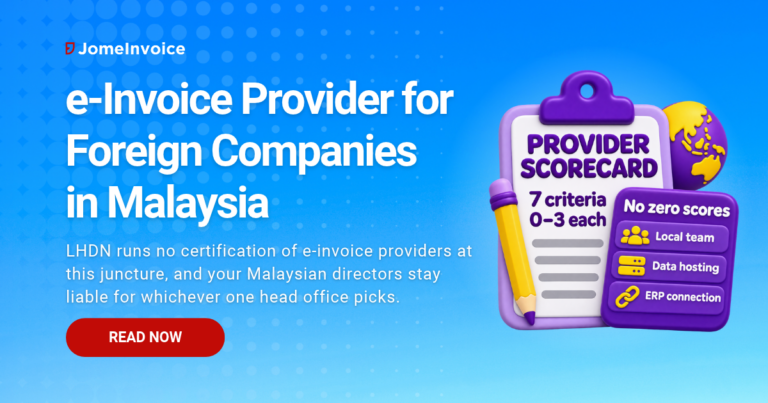
- Score each provider 0 to 3 on seven criteria. Below 14 out of 21, or a 0 on local team, data hosting or ERP connection (criteria 1, 3 or 4), keep looking.
The right e-invoice provider for a foreign company in Malaysia is the one that answers seven checklist questions in writing, from local support and data hosting to ERP connection and security certifications. LHDN has no certification requirement for providers at this juncture, and your Malaysian directors stay liable for whichever one head office picks.
This guide turns those seven points into a checklist you can score in a week. The checklist is the vendor-selection part of our e-invoicing guide for China, Taiwan and Hong Kong companies in Malaysia , which covers who must e-invoice and how group payments work. JomeInvoice answers last, on the same rows.
What Does a China, Taiwan or Hong Kong-Owned Company Need From an e-Invoice Provider?
A foreign-owned Malaysian entity needs a provider that two different readers can trust: the HQ approver who signs the contract, often reading in Mandarin, and the local finance team that runs e-invoicing every day in English or Bahasa Malaysia (BM). A provider pitch written for only one of them fails the other. Your shortlist has to satisfy both.
An e-invoice provider (often called middleware) is a service that takes invoice data from your ERP, formats it to LHDN’s rules, submits it to MyInvois and returns the validation result. For a foreign-owned entity it is also the local support line when an e-Invoice is rejected.
LHDN’s own rules shape what “trust” means here. The LHDN e-Invoice General FAQs of 4 September 2026 set four points that every foreign group should read before a vendor demo:
- No certification requirement at this juncture. There is no registration requirement for technology providers at this juncture, though providers must ensure the functionality and reliability of their API integration with LHDN (Q138). Providers also do not need to apply for certification at this juncture, but “this may change in the future” (Q139).
- Liability stays in Malaysia. “The responsibility to comply with the e-Invoice requirements remains with the company” when a provider is appointed; for a company, it rests with its director as defined in section 2 of the Income Tax Act 1967 (Q30).
- Provider fault is no defence. Where a provider or system vendor causes non-compliance, the taxpayer may regularise it under the e-Invoice SVDP (Special Voluntary Disclosure Programme) , open until 31 December 2027, but responsibility remains with the taxpayer (Q133).
- Any compliant transmission route is allowed. Taxpayers may combine API and the MyInvois portal (Q134) and may use Peppol (an international e-invoice exchange network) service providers; any provider that complies with LHDN’s API requirements is welcome (Q137).
The stakes are concrete. Failing to issue an e-Invoice carries a fine of RM200 to RM20,000, imprisonment of up to 6 months, or both (Income Tax Act 1967, section 82C(1) read with paragraph 120(1)(d)); our guide to LHDN e-invoice penalty rules explains how they apply.
So what: selection is a contract decision made in Malaysia’s legal frame. A badge proves nothing; written answers do.
The 7-Point Provider Checklist for Foreign-Owned Companies
Use this rubric to score every shortlisted provider, including the one HQ already uses elsewhere in Asia. Send the questions by email, score what comes back in writing, and score your current vendor the same way.
Key: SFTP is secure file transfer protocol. SDK is software development kit, LHDN’s published technical rules for MyInvois. ISO/IEC 27001 is the international information security management standard.
| # | Criterion | The question to ask | 0 points | 1 point | 2 points | 3 points |
|---|---|---|---|---|---|---|
| 1 | Local team and LHDN escalation | “Who in Malaysia owns our urgent ticket, and how do you escalate to LHDN?” | Cannot or will not answer | General queue, nothing in writing | Named Malaysian contact, escalation path not written | Named Malaysian team, written escalation path and response time |
| 2 | Support languages | “In which languages can your desk handle an urgent ticket?” | Cannot or will not answer | Languages stated verbally only | Languages in writing; not all three for urgent tickets | Mandarin, English and BM for urgent tickets, in writing |
| 3 | Data hosting and retention | “Where is our data hosted and backed up, and for how long?” | Cannot or will not answer | “In the cloud”, no country named | Country named; backups unclear or retention under 7 years | Country and region in contract; retention of 7+ years |
| 4 | HQ ERP connection | “How will you connect our ERP, by name and version?” | Cannot or will not answer | “We integrate with anything”, no plan | Method named (API or SFTP), mapping owner unclear | Written scope: method, field-mapping owner, test run |
| 5 | Rule-change absorption | “When did you support the 24 October 2026 SDK validation change?” | Cannot or will not answer | Claims support, no dates | Dated release notes; customer work needed | Dated release notes; no customer development needed |
| 6 | Go-live plan | “What is our timeline, and what would lengthen it?” | Cannot or will not answer | A single number, no plan | Written plan; assumptions, test run or parallel run missing | Written plan with assumptions, test run and parallel run |
| 7 | Security certifications | “Which certificates cover the service we would use?” | Cannot or will not answer | None held, or certification “in progress” | ISO/IEC 27001 held, scope unclear | Current certificates whose scope covers the e-invoice service |
Decision threshold: a total below 14 out of 21, or a 0 on criterion 1, 3 or 4, means the provider is not ready for a foreign-owned entity. For a wider field of options, compare against our list of e-invoice middleware providers in Malaysia .
Who Will Support Us, and in Which Languages?
Support for a China, Taiwan or Hong Kong-owned entity should come from a Malaysian team with a direct LHDN escalation path, in Mandarin as well as English and BM. Language matters because the person approving a fix at HQ and the person keying it in Kuala Lumpur often read different languages, and a translated ticket thread loses time.
Time zone is not the issue for these groups. Malaysia, China, Taiwan and Hong Kong all run on UTC+8, so an HQ team in Shenzhen, Taipei or Hong Kong works the same hours as the Malaysian entity. What HQ usually lacks is Malaysian regulatory context: reading an LHDN rejection, knowing which guideline section applies, and knowing when to escalate.
LHDN’s clocks are short, so support speed is measurable:
| Clock | Duration | Source |
|---|---|---|
| Validation of a submitted e-Invoice | Near real time, generally under 2 seconds | LHDN FAQs, Q42 |
| Cancelling a validated e-Invoice | Within 72 hours of validation; after that, a credit, debit or refund note, with no time limit | LHDN FAQs, Q47 and Q52 |
| Issuing e-Invoices after a MyInvois outage | Within 72 hours after the system is back | LHDN FAQs, Q143 |
All three rows: LHDN e-Invoice General FAQs, 4 September 2026.
A 72-hour cancellation window and a ticket that waits for translation and a second-line team abroad are a poor pairing. Ask every provider in which languages its desk handles an urgent ticket, and get the answer in writing; do not assume any provider’s coverage either way. For how local and overseas middleware differ on support, see our guide to local versus overseas e-invoice middleware .
Where Will Our e-Invoice Data Be Hosted, and for How Long?
Hosting country and retention period belong in the contract, because LHDN’s look-back periods can outlast your subscription term. HQ legal teams in China, Taiwan and Hong Kong will also ask where Malaysian invoice data sits and who can reach it from abroad; the provider should answer both in writing.
Three periods set the minimum:
| Period | Length | Source |
|---|---|---|
| LHDN compliance review | Up to 2 assessment years | Compliance Review Framework, section 4.1 |
| Record keeping | 7 years | Malaysian record-keeping requirement |
| Prosecution time limit | Up to 12 years from the year of the offence | Income Tax Act 1967, section 121(1) |
How the periods interact for one e-Invoice:
| e-Invoice validated in | Keep records until at least | Prosecution possible until |
|---|---|---|
| 2026 | 2033 | 2038 |
| 2027 | 2034 | 2039 |
Indicative years, counted from the year of the e-Invoice or offence; confirm the exact start point with your tax adviser.
Ask three questions:
- In which country and cloud region is the data stored, processed and backed up?
- How long is it kept, and does retention survive the end of the subscription?
- In what format can the full archive be exported if you leave?
A provider that keeps data only for the current year leaves the Malaysian directors without records for the 12-year prosecution period. Security due diligence is covered further below.
Can the Provider Connect Our Head-Office ERP?
Yes, if the provider can show a written integration scope for your exact system. MyInvois accepts submissions through the portal or through API integration, directly or via intermediary technology providers (General Guideline v4.8, section 2.2 and Table 2.1), so a Kingdee, Yonyou or other HQ system can remain the source of Malaysian e-Invoices. Our guide to e-invoice integration models in Malaysia compares the routes.
For e-invoice integration in Malaysia, providers typically take data in one of two ways:
- API: the ERP sends each invoice to the provider as it is created.
- SFTP file feed: the ERP drops CSV (comma-separated values), JSON or XML files into a folder on a schedule, for systems that cannot call an API.
The harder part is the data, not the pipe. A head-office system built for China, Taiwan or Hong Kong rarely holds the Malaysian fields an e-Invoice needs: the TIN (tax identification number), MSIC (Malaysia Standard Industrial Classification) code, classification codes and SST (sales and service tax) registration number.
A self-billed e-Invoice, for example, asks for the supplier’s TIN, registration number, SST registration, MSIC code and classification codes (e-Invoice Specific Guideline v4.9, Table 8.3). Ask who maps each field and who maintains the mapping.
Volume and format rules add a second test. MyInvois accepts at most 5MB and 100 e-Invoices per submission, and 300KB per e-Invoice (LHDN FAQs, Q135).
From 24 October 2026, MyInvois Production caps every monetary amount field at 26 digits and the PASSPORT ID type at 12 characters (MyInvois SDK release notes). A provider that absorbed that change before its production date, with no development on your side, has passed criterion 5.
So what: “we support every ERP” is not an answer. A field-mapping owner, a test run and a named method are. To see how the large global ERPs approach the same problem, read our comparison of how SAP, NetSuite and Dynamics 365 connect to MyInvois .
How Long Should Go-Live Take, and What Can Slow It?
A credible provider quotes a range with its assumptions, not a single number. For a foreign-owned entity, four variables decide the timeline:
- Source system: an HQ ERP that already holds Malaysian master data moves fastest.
- Connection method: API or SFTP, and whether HQ IT must change anything.
- Group flows: each payment type to and from the group needs its e-Invoice type mapped, including self-billed e-Invoices.
- Sign-off chain: approvals that pass between Kuala Lumpur and HQ add calendar time.
Ask for a written plan that names the test run and a parallel run of at least one billing cycle before cut-over. Representative sample files shorten setup, so ask each provider which sample files it needs before it scopes the work.
Which Security Certifications Should We Ask For?
Ask for current certificates and their scope, not a list of logos. ISO/IEC 27001 covers information security management, ISO 20000-1 covers IT service management and ISO 9001 covers quality management. The test is whether the certificate’s scope includes the e-invoice service you would use, not another business unit.
Also ask how the provider handles personal data under Malaysia’s Personal Data Protection Act 2010 (PDPA), and how it tests and rolls back emergency fixes. Our 8 security questions for e-invoice vendors cover incident timelines, test environments and access control in detail.
Questions to Ask Every Provider Before You Sign
Copy these into your request for proposal (RFP). Each needs an answer in writing.
- Who in Malaysia owns our urgent ticket, and what is the response time?
- How do you escalate an issue to LHDN, and who does it?
- In which languages can your desk handle an urgent ticket?
- In which country and cloud region is our data stored and backed up?
- How long do you keep our e-Invoices, and in what format can we export them?
- How will you connect our ERP, by name and version: API, SFTP or both?
- Who maps the Malaysian fields, and who maintains the mapping?
- On what date did you support the 24 October 2026 SDK validation change (26-digit amount fields, 12-character passport IDs)?
- What is our go-live plan, and what would lengthen it?
- Who fixes errors your system causes, and how fast, given that liability stays with us (Q30, Q133)?
How JomeInvoice Answers the Checklist
JomeInvoice is a Malaysian e-invoicing middleware company headquartered in Kuala Lumpur and backed by AGMO Holdings Berhad, a Bursa Malaysia-listed company. Against the seven criteria:
- Local team and escalation: a Malaysian team with local LHDN expertise, a direct LHDN escalation path and a dedicated enterprise account manager.
- Languages: support in Mandarin, English and Bahasa Malaysia.
- Data: hosted onshore on Amazon Web Services (AWS) in Malaysia, and archived for 12 years for the duration of the subscription.
- HQ ERP connection: any ERP or system connects through API, or through an SFTP file feed where an API is not possible; Kingdee and Yonyou are examples of HQ systems that can be connected this way. Each integration is scoped to the client; the SFTP feed can return optional outcome files, and “the more representative your sample files are, the faster the setup” (JomeInvoice docs, automated SFTP feed, accessed 25 November 2026).
- Rule changes: LHDN guideline and SDK changes are absorbed by JomeInvoice, not by your ERP.
- Go-live: enterprise go-live in 4 to 8 weeks, subject to change where more complicated or customised solutions are needed.
- Certifications: ISO 9001, ISO 20000-1 and ISO 27001 certified, and PDPA compliant.
See how this fits a group setup on our enterprise e-invoicing solution page , then score us next to your shortlist.
Score the answers, not the badges
LHDN has no certification requirement for providers at this juncture, and liability stays with your Malaysian directors. Send the seven questions, score the written answers, and choose the provider that serves both HQ and the local finance team.
Score JomeInvoice against your shortlist
Mandarin, English and Bahasa Malaysia support, data on AWS Malaysia, and your head-office ERP connected by API or SFTP.
Book a Demo Sign Up Free
Disclaimer: This article is for general informational purposes only and does not constitute legal or tax advice. LHDN guidelines are subject to updates. Always refer to the latest official LHDN e-Invoice Guidelines at myinvois.hasil.gov.my and consult a qualified tax professional for advice specific to your business.
Frequently Asked Questions
Does LHDN certify e-invoice providers?
No. LHDN has no registration or certification requirement for technology providers at this juncture, and says the certification position may change [LHDN FAQs, 4 September 2026, Q138 and Q139]. Compare providers on written answers about support, data, integration and error handling instead.
If our e-invoice provider makes a mistake, who is liable?
The Malaysian company is, and for a company that means its directors [LHDN FAQs, Q30]. Provider fault is not a defence; the taxpayer can regularise provider-caused errors through the e-Invoice SVDP, open until 31 December 2027 [Q133].
Can a foreign company use its head-office ERP for Malaysian e-invoicing?
Yes. MyInvois accepts API submissions directly or through intermediary technology providers [General Guideline v4.8, section 2.2], so an HQ system such as Kingdee or Yonyou can stay the source. The ERP must supply Malaysian fields such as TIN, MSIC code and classification codes.
Should a foreign-owned company choose a local or an overseas e-invoice provider?
It depends on the written answers. For a China, Taiwan or Hong Kong group, weigh a Malaysian team with LHDN escalation, Mandarin support and onshore hosting most heavily, then score every provider, local or overseas, on the same seven criteria.
How long does it take to go live with an e-invoice provider in Malaysia?
4 to 8 weeks is JomeInvoice’s typical enterprise go-live, subject to change where more complicated or customised solutions are needed. Timelines depend on the source system, the connection method, the number of group flows and the HQ sign-off chain.
Where should our Malaysian e-invoice data be hosted?
In a country and cloud region named in your contract, with retention of at least 7 years. LHDN can prosecute up to 12 years from the year of an offence [Income Tax Act 1967, section 121(1)], so ask what happens to the archive after the subscription ends.
Can the e-invoice provider support our team in Mandarin?
It depends on the provider. Ask each one in writing; coverage varies and should never be assumed. JomeInvoice supports customers in Mandarin, English and Bahasa Malaysia.
Last updated: 25 November 2026 | Written by Yinn Sheng Ng, Head of Marketing
References
Based on: e-Invoice Specific Guideline v4.9 (7 September 2026); e-Invoice General Guideline v4.8 (30 August 2026); LHDN e-Invoice General FAQs (4 September 2026). Verified against e-Invoice Specific Guideline v4.9 (7 September 2026) and e-Invoice General Guideline v4.8 (30 August 2026) on 25 November 2026.
- LHDN, e-Invoice General FAQs (4 September 2026), Q30, Q42, Q47, Q52, Q133, Q134, Q135, Q137, Q138, Q139, Q143: https://www.hasil.gov.my/wp-content/uploads/lhdnm-e-invoice-general-faqs.pdf
- LHDN, e-Invoice General Guideline v4.8 (30 August 2026), section 2.2 and Table 2.1: https://www.hasil.gov.my/wp-content/uploads/IRBM-e-Invoice-Guideline.pdf
- LHDN, e-Invoice Specific Guideline v4.9 (7 September 2026), Table 8.3: https://www.hasil.gov.my/wp-content/uploads/IRBM-e-Invoice-Specific-Guideline.pdf
- HASiL media statement on the Rangka Kerja Semakan Pematuhan e-Invois (framework effective 15 December 2025), section 4.1: https://www.hasil.gov.my/wp-content/uploads/20251216-kenyataan-media-hasil-rke-semakan-pematuhan-einvois-di-portal-rasmi-hasil.pdf
- Income Tax Act 1967 (Act 53), sections 2, 82C, 120 and 121(1): https://www.hasil.gov.my/wp-content/uploads/20240521-akta-cukai-pendapatan-1967-akta-53.pdf
- LHDN, MyInvois SDK release notes (SDK Updates 6 August 2026, Production 24 October 2026): https://sdk.myinvois.hasil.gov.my/sdk-1-0-release/
- LHDN, MyInvois portal: https://myinvois.hasil.gov.my