

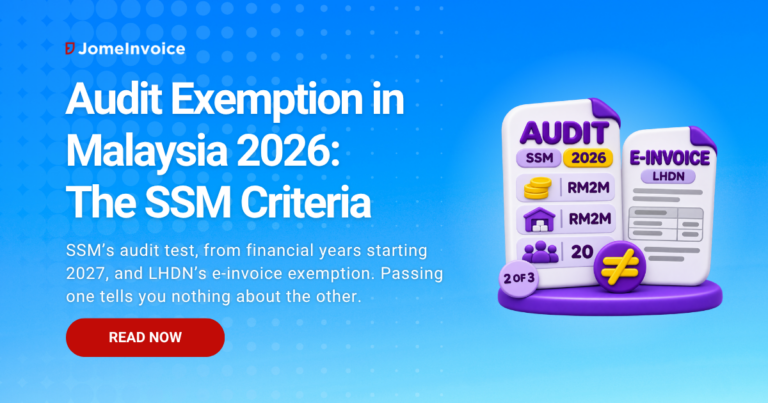
- A private company may skip the statutory audit if it meets at least two of three tests (annual revenue, total assets, full-time employees) in the current and the two preceding financial years (Companies Commission of Malaysia (SSM), Practice Directive 10/2024, para 5).
- RM3 million is the end state, not the 2026 test. Financial years starting in 2026 use RM2 million revenue, RM2 million total assets and 20 employees; RM3 million, RM3 million and 30 employees apply to financial years starting on or after 1 January 2027 (SSM Practice Directive 10/2024, para 9).
- The two prior years are measured against the current phase’s limits, so a 2026 financial year needs 2024 and 2025 within the RM2 million revenue or assets and 20-employee limits too, for at least two criteria (SSM Frequently Asked Questions (FAQ) Part Q, updated 19 May 2026, Q23).
- The SSM audit test and the Lembaga Hasil Dalam Negeri Malaysia (LHDN, Inland Revenue Board of Malaysia) e-invoice exemption are separate rules. From 2027 financial years, the audit test reads “do not exceed RM3,000,000”, company by company (SSM Practice Directive 10/2024, para 5; SSM FAQ Part Q, Q28). The e-invoice exemption needs turnover “less than RM3,000,000” and fails where a non-individual shareholder, holding company, related company or joint venture reaches RM3 million (LHDN e-Invoice General Guideline v4.8, 30 August 2026, §1.6.1(e) and §1.6.10).
- Audit exemption needs no application to SSM, but the company still lodges unaudited financial statements with a director’s certificate within 30 days of circulating them (SSM FAQ Part Q, Q15 and Q17; Practice Directive 10/2024, para 18), and still files its income tax return (Form C) with LHDN (Income Tax Act 1967, s.77A(1); LHDN RF Filing Programme 2026).
Audit exemption in Malaysia lets a private company skip the statutory audit when it meets at least two of three tests (revenue, total assets and full-time employees) in the current financial year and the two years before it. For financial years starting in 2026, the limits are RM2 million revenue, RM2 million total assets and 20 employees. The RM3 million revenue test applies to financial years starting on or after 1 January 2027 (Companies Commission of Malaysia (SSM), Practice Directive 10/2024, paragraphs 5 and 9).
That RM3 million figure is not the RM3 million e-invoice exemption that Lembaga Hasil Dalam Negeri Malaysia (LHDN, the Inland Revenue Board of Malaysia) set on 30 August 2026. The two rules come from different regulators and work differently, so a company can pass one and fail the other.
This guide covers the SSM criteria by financial year, who is excluded, what an audit-exempt company still files, and a side-by-side comparison of the two thresholds. For the wider calendar of company obligations, see our Malaysia business tax guide .
What audit exemption means for a private company (Sdn Bhd)
Audit exemption is the Registrar of Companies’ permission for a qualifying private company not to appoint an auditor for a financial year. Section 267(1) of the Companies Act 2016 requires every private company to appoint an auditor each year, and section 267(2) lets the Registrar exempt companies that meet the criteria set in a practice directive (SSM Practice Directive 10/2024, paras 3 and 4).
Practice Directive 10/2024 is that directive. SSM issued it on 16 December 2024, and it governs financial statements for annual periods starting on or after 1 January 2025. Its predecessor, Practice Directive 3/2017, still governs financial periods that started on or before 31 December 2024 (paras 20 and 22).
Three features matter for a Sdn Bhd (sendirian berhad):
- Elective. A qualifying company may still appoint an auditor (SSM FAQ Part Q, Q17).
- No application. The company assesses its own eligibility; directors should weigh risk profile, complex transactions, governance and internal controls (Q17, Q31).
- No offence. An eligible company that appoints no auditor commits no offence under the Companies Act 2016 (Q32).
The SSM audit exemption criteria under Practice Directive 10/2024
A private company qualifies when it fulfils at least two of these three criteria (SSM Practice Directive 10/2024, para 5):
- Annual revenue in the current financial year and each of the two preceding years does not exceed the phase limit.
- Total assets in the current statement of financial position and each of the two preceding years do not exceed the phase limit.
- Number of employees at the end of the current financial year and each of the two preceding years does not exceed the phase limit.
Each criterion is itself a three-year test. A criterion counts only if the company stayed within its limit in all three years.
The directive defines each measure (para 6):
- Annual revenue includes revenue received and receivable during the year. It excludes credit entries reversing earlier entries, taxation entries, reversals of provisions, and gains on derecognising property, plant, equipment and investment property.
- Total assets are current and non-current assets under the approved accounting standards. Choosing the Malaysian Private Entities Reporting Standard (MPERS) or Malaysian Financial Reporting Standards (MFRS) does not change the assessment (SSM FAQ Part Q, Q30).
- Employees are full-time employees at the end of each financial year, including local, foreign, contract and probationary workers. Directors or shareholders working full time are excluded, as are family members or friends who are unpaid or paid irregular wages.
SSM’s FAQ sets the full-time line: paid workers working at least 6 hours a day for at least 20 days a month, or at least 120 hours a month (SSM FAQ Part Q, Q19).
Which audit exemption threshold applies to your financial year
The threshold depends on when your financial year starts, not on the calendar year in which you file. SSM Practice Directive 10/2024 phases the limits in over three years (para 9; SSM FAQ Part Q, Q12):
| SSM phase | Financial period | Submission year | Revenue | Total assets | Employees |
|---|---|---|---|---|---|
| SSM Phase 1 | Starting 1 Jan 2025 to 31 Dec 2025 | From 1 Jan 2026 | RM1,000,000 | RM1,000,000 | 10 |
| SSM Phase 2 | Starting 1 Jan 2026 to 31 Dec 2026 | From 1 Jan 2027 | RM2,000,000 | RM2,000,000 | 20 |
| SSM Phase 3 | Starting on or after 1 Jan 2027 | From 1 Jan 2028 | RM3,000,000 | RM3,000,000 | 30 |
Source: SSM, Practice Directive 10/2024, para 9. These SSM phases are unrelated to LHDN’s e-invoice phases. SSM’s FAQ notes the Phase 3 limits remain unchanged unless the Registrar reviews them (SSM FAQ Part Q, Q12).
The lookback uses the current phase’s limits for all three years. To assess a 2026 financial year, the figures for 2024 and 2025 must not exceed the Phase 2 limits (SSM FAQ Part Q, Q23). A company that crossed RM2 million in revenue in 2024 therefore fails the revenue criterion for its 2026 financial year, even if 2026 revenue falls back under the limit.
Non-calendar year ends follow the start date. SSM’s Scenario 4 company, with years running 1 July to 30 June, does not qualify for the year ending 30 June 2026 because it “only meets the exemption criteria for the current year but not for the immediate past 2 financial years”. It qualifies for the year ending 30 June 2027 under Phase 2 (SSM FAQ Part Q, Q20, Scenario 4).
Eligibility can also end. A company that stops meeting the criteria loses the exemption for later years but stays exempt for the years in which it qualified (SSM Practice Directive 10/2024, para 13).
How to check whether your company qualifies
Run these steps for each financial year, before the accounts are prepared. SSM’s FAQ encourages companies to take professional advice from their accountants or auditors on the decision (SSM FAQ Part Q, Q31).
Step 1: Fix the SSM phase from your financial year start date
Find the start date of the financial year being assessed and read its limits from the table above. A year starting 1 April 2026 sits in SSM Phase 2.
Step 2: Collect three years of figures
Pull revenue, total assets and full-time headcount at year end for the current year and the two preceding years. Where a financial period changed length, take the earlier period’s revenue in full without apportioning it (SSM FAQ Part Q, Q29).
Step 3: Confirm at least two criteria hold in all three years
Mark a criterion as met only if all three years are within the current phase limit. Any two criteria will do.
Step 4: Check the exclusions and audit triggers
Rule out the excluded company types and any member, lender, licensing or legal requirement for audited accounts, covered in the sections below.
Step 5: Record the decision
Minute the directors’ assessment and keep the workings with the accounts, since a director signs a certificate stating the company is entitled to the exemption (SSM Practice Directive 10/2024, para 19).
Dormant and newly incorporated companies
Dormant companies keep their exemption without meeting the numerical tests. A company dormant since incorporation, or dormant in both the current and the immediate past financial year, continues to be exempt from audit (SSM Practice Directive 10/2024, para 10).
Dormant has a strict meaning: the company carries on no business and records no accounting transaction. Payments the company must make under any law, and the costs of complying, do not break dormancy (para 11).
A newly incorporated company that is trading does not qualify in its early years. Eligibility needs figures for the current year and the two preceding financial years, which a new company does not have (SSM FAQ Part Q, Q27).
Who cannot use the audit exemption
Four types of company are excluded outright (SSM Practice Directive 10/2024, para 12):
- An exempt private company that lodges a certificate of its exempt private company status with the Registrar under section 260 of the Companies Act 2016, instead of lodging financial statements.
- A public company, including a listed company.
- A private company that is a subsidiary of a public company.
- A foreign company.
SSM’s FAQ adds two clarifications. A private company that is part of a public company through joint control is excluded too, while an associate of a public company can qualify if it meets the criteria (SSM FAQ Part Q, Q25). A private company with corporate shareholders can still qualify (Q14), and the figures are tested on each company’s own accounts, not the group’s consolidated results (Q28).
An eligible company must still be audited in three situations (SSM Practice Directive 10/2024, para 14):
- Members eligible to vote and holding at least 5% of the issued shares, or of a class of shares, give written notice requiring an audit.
- At least 5% of the members eligible to vote give written notice.
- The Registrar directs the company to have its accounts audited.
The members’ notice must arrive during the financial year and no later than one month before it ends.
Other requirements can override the directive. Where another law, requirement or guideline mandates audited accounts, that rule prevails (SSM FAQ Part Q, Q26).
SSM also notes that banks, government agencies and other authorities may still ask for audited financial statements for licences, grants and loans (Q21). Check your loan covenants and licence conditions before dropping the audit.
What an audit-exempt company still files
Audit exemption removes the audit, not the reporting. A company that elects the exemption lodges with SSM (SSM Practice Directive 10/2024, paras 15 to 19):
- Unaudited financial statements prepared under the approved accounting standards.
- The directors’ report, statement by directors and statutory declaration.
- A certificate, signed by a director, stating that members have not requested an audit, that the directors accept their accounting responsibilities, and that the statements follow the applicable standards (Appendix 1).
The company must still prepare and circulate its financial statements within the time the Companies Act 2016 allows. It then lodges them with SSM within 30 days after circulation (SSM FAQ Part Q, Q15).
The income tax return is a separate duty under a separate law. Every company must furnish a return to LHDN for each year of assessment within seven months from the date following the close of its accounting period (Income Tax Act 1967, s.77A(1)); LHDN’s Return Form Filing Programme for 2026 lists this as Form C, filed through e-Filing, with a one-month grace period.
On whether LHDN needs audited accounts, SSM’s FAQ points to subsection 77A(4) of the Income Tax Act 1967 and to an LHDN announcement that the provision does not apply where a company is not required to submit audited accounts to SSM. SSM tells companies to confirm this with LHDN directly (SSM FAQ Part Q, Q18).
Our 2026 tax filing deadlines guide sets out the full filing calendar, and our list of accounting documents to keep for tax filing covers the records behind unaudited accounts.
Two RM3 million thresholds: audit exemption vs e-invoice exemption
The SSM audit threshold and the LHDN e-invoice exemption share a number, not a test. Our news report on the RM3 million e-invoice exemption explains the 30 August 2026 change, and the complete LHDN e-invoice guide covers the wider mandate.
| SSM audit exemption | LHDN e-invoice exemption | |
|---|---|---|
| Regulator | Companies Commission of Malaysia (SSM) | Lembaga Hasil Dalam Negeri Malaysia (LHDN) |
| Legal basis | Companies Act 2016 s.267(2); SSM Practice Directive 10/2024 | Mandate: Income Tax Act 1967 s.82C. Exemption: General Guideline v4.8 §1.6.1(e), §1.6.10 |
| Who it covers | Private companies only | All taxpayer categories: individuals, partnerships, companies, co-operatives |
| Test | Two of three: revenue, total assets, employees | Annual turnover or revenue only |
| Wording | “do not exceed RM3,000,000” (RM3 million exactly passes) | “less than RM3,000,000”; mandated at “at least RM3 million” (LHDN FAQ Q101) |
| Limit for a financial year starting in 2026 | RM2 million revenue and assets, 20 employees | Below RM3 million |
| Years tested | Current year plus two preceding years | Any year reaching RM3 million triggers the mandate (LHDN FAQ Q12, Q13, Q100); no later exemption once mandated (Q104) |
| Group view | Figures tested at company level (SSM FAQ Q28), but excluded if a subsidiary of, or jointly controlled by, a public company | Denied if a non-individual shareholder, holding company, related company or joint venture has at least RM3 million |
| What it removes | The statutory audit | The duty to issue e-invoices, including self-billed |
| Who decides eligibility | The company’s directors; no SSM application | The taxpayer; no LHDN application |
| Risk if ignored | Unaudited accounts lodged for a year that did not qualify | e-invoices not issued for a period when they were required |
Sources: SSM Practice Directive 10/2024 and SSM FAQ Part Q (19 May 2026); LHDN e-Invoice General Guideline v4.8 (30 August 2026) and LHDN e-Invoice General FAQs (4 September 2026).
The two rules also connect through your accounts. LHDN reads annual turnover for the e-invoice threshold from the audited financial statements where a company has them, and from the annual revenue in the tax return where it does not (LHDN e-Invoice General FAQs, 4 September 2026, Q101). An audit-exempt company’s tax return revenue therefore becomes the figure LHDN tests.
Three hypothetical companies show how the results diverge. Each has a 1 January to 31 December financial year and no e-invoicing mandate before 2026.
| Hypothetical company | Figures | SSM audit exemption | LHDN e-invoice exemption |
|---|---|---|---|
| A: trading company, financial year 2026 | Revenue RM2.5M, assets RM1.2M, 15 full-time staff in 2024, 2025 and 2026 | Fails revenue (above RM2M) but meets assets and employees: may elect exemption | Below RM3M with no group link: exempt under §1.6.1(e) |
| B: subsidiary, financial year 2026 | Revenue RM800K, assets RM500K, 6 staff in each year; private holding company turnover RM10M; no public company in the group | Tested on its own figures; not a subsidiary of, or jointly controlled by, a public company: may elect exemption | Not exempt: subsidiary of a holding company with at least RM3M (§1.6.10(b)); mandated from 1 July 2026 (LHDN FAQ Q12(b)) |
| C: services company, financial year 2027 | Revenue below RM3M every year from 2022 to 2026 (RM2.9M in 2025 and 2026), then exactly RM3,000,000 in 2027; assets RM1M; 12 staff | 2025 to 2027 all within SSM Phase 3 limits: may elect exemption | Exempt through 31 December 2028: reaching RM3,000,000 in 2027 makes e-invoicing mandatory from 1 January 2029 (LHDN FAQ Q12(a), Q100) |
Company B is the easiest case to miss. Related-company and joint venture links work the same way, and our related company e-invoice guide explains when two companies count as related. For a company that misses its start date, our e-invoice penalty guide sets out the exposure.
Audit status does not decide e-invoicing. Companies B and C can both skip the audit and still be required to issue e-invoices.
Our guide to the e-invoice exemption for smaller businesses covers those cases in full, and the Phase 4 extension guide covers the relaxation period for newly mandated businesses.
How JomeInvoice fits
JomeInvoice is Malaysia’s e-invoicing middleware. It connects your existing accounting, sales or point-of-sale system to MyInvois, LHDN’s e-invoice portal, without custom development on your side, so your team keeps working in the system it already uses. The team is Malaysian, with support in Bahasa Malaysia, English and Mandarin.
If your company sits at or above the RM3 million e-invoice line, or a group link takes it out of the exemption, see how JomeInvoice handles e-invoicing for your setup .
Test each RM3 million rule on its own terms
Read the SSM audit limits from your financial year’s start date, then check the LHDN e-invoice exemption separately against turnover and group links. Confirm both with your accountant or tax agent.
At or above the RM3 million e-invoice line? See how JomeInvoice handles it
JomeInvoice connects your existing accounting or sales system to MyInvois, with a Malaysian team supporting you in Bahasa Malaysia, English and Mandarin.

Disclaimer: This article is for general informational purposes only and does not constitute legal or tax advice. LHDN guidelines are subject to updates. Always refer to the latest official LHDN e-Invoice Guidelines at myinvois.hasil.gov.my and consult a qualified tax professional for advice specific to your business.
Frequently Asked Questions
Does my Sdn Bhd need an audit in 2026?
It depends. For financial years starting in 2026, a company may skip the audit if two of three tests stay within RM2 million revenue, RM2 million assets and 20 employees for three years; years starting in 2025 use RM1 million and 10 [SSM Practice Directive 10/2024, paras 5 and 9].
What are the audit exemption criteria in Malaysia?
The audit exemption criteria are three tests: revenue, total assets and full-time employees. A private company must meet any two in the current and two preceding years. Limits are RM2 million, RM2 million and 20 for financial years starting in 2026 [SSM Practice Directive 10/2024, paras 5 and 9].
Is the audit exemption threshold the same as the e-invoice exemption?
No. SSM’s audit test is two of three tests per company: RM2 million for financial years starting in 2026, RM3 million for those starting from 2027 [SSM Practice Directive 10/2024, para 9]. LHDN exempts turnover below RM3,000,000 unless a group carve-out applies [General Guideline v4.8 §1.6.10].
Do I still file tax returns if exempt from audit?
Yes. Audit exemption under the Companies Act 2016 does not change the income tax return duty. Every company furnishes a return (Form C) to LHDN within seven months from the date following the close of its accounting period [Income Tax Act 1967, s.77A(1); LHDN RF Filing Programme 2026].
Do I need to apply to SSM for audit exemption?
No. A company that meets the criteria simply elects not to appoint an auditor. It then lodges unaudited financial statements with a director’s certificate within 30 days of circulating them [SSM FAQ Part Q, Q15 and Q17; Practice Directive 10/2024, para 18].
Can a newly incorporated company be exempt from audit?
No, unless it is dormant. Eligibility needs figures for the current year and the two preceding financial years, which a new trading company does not have. A company dormant since incorporation stays exempt [SSM FAQ Part Q, Q27; SSM Practice Directive 10/2024, para 10].
Can a subsidiary be exempt from audit?
Yes, if it is not a subsidiary of a public company or jointly controlled by one, and it meets the criteria on its own figures. An associate of a public company can qualify [SSM Practice Directive 10/2024, para 12; SSM FAQ Part Q, Q25 and Q28].
Last updated: 6 November 2026 | Written by Yinn Sheng Ng, Head of Marketing
References
- Companies Commission of Malaysia (SSM), Practice Directive No. 10/2024, Qualifying Criteria for Audit Exemption for Certain Private Companies in Malaysia (16 December 2024): https://www.ssm.com.my/Pages/Legal_Framework/Document/PRACTICE-DIRECTIVE-10-2024.pdf
- SSM, Frequently Asked Questions Part Q: Audit Exemption (updated 19 May 2026): https://www.ssm.com.my/Pages/Legal_Framework/Document/PART%20Q%20(19.5.2026).pdf
- SSM, Audit Exemption page: https://www.ssm.com.my/Pages/Legal_Framework/Audit-Exemption.aspx
- Income Tax Act 1967 (Act 53), updated text as at 21 May 2024, s.77A and s.82C (wording unchanged in the reprint as at 1 January 2026): https://www.hasil.gov.my/wp-content/uploads/20240521-akta-cukai-pendapatan-1967-akta-53.pdf
- LHDN, Return Form (RF) Filing Programme for the Year 2026 (published 30 December 2025): https://www.hasil.gov.my/wp-content/uploads/rf-filing-programme-for-2026.pdf
- LHDN, e-Invoice General Guideline (Version 4.8, 30 August 2026): https://www.hasil.gov.my/wp-content/uploads/IRBM-e-Invoice-Guideline.pdf
- LHDN, e-Invoice General FAQs (updated 4 September 2026), Q12, Q13, Q15 to Q20, Q100, Q101, Q104: https://www.hasil.gov.my/wp-content/uploads/lhdnm-e-invoice-general-faqs.pdf
Verified against SSM Practice Directive 10/2024 (16 December 2024), SSM FAQ Part Q (19 May 2026), Income Tax Act 1967 (texts as at 21 May 2024 and 1 January 2026), LHDN RF Filing Programme 2026 (30 December 2025), LHDN e-Invoice General Guideline v4.8 (30 August 2026), e-Invoice Specific Guideline v4.9 (7 September 2026) and e-Invoice General FAQs (4 September 2026) on 5 November 2026.